

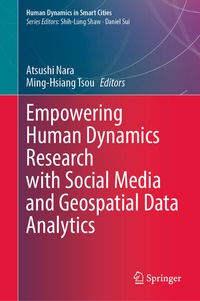
Empowering Human Dynamics Research with Social Media and Geospatial Data Analytics
Description

This book discusses theoretical backgrounds, techniques and methodologies, and applications of the current state-of-the-art human dynamics research utilizing social media and geospatial big data. It describes various forms of social media and big data with location information, theory development, data collection and management techniques, and analytical methodologies to conduct human dynamics research including geographic information systems (GIS), spatiotemporal data analytics, text mining and semantic analysis, machine learning, trajectory data analysis, and geovisualization. The book also covers applied interdisciplinary research examples ranging from disaster management, public health, urban geography, and spatiotemporal information diffusion. By providing theoretical foundations, solid empirical research backgrounds, techniques, and methodologies as well as application examples from diverse interdisciplinary fields, this book will be a valuable resource to students, researchers and practitioners who utilize or plan to employ social media and big data in their work.
More details
Other editions
Additional editions
Persons
Atsushi Nara [Ph.D., Arizona State University], Assistant Professor, Department of Geography, San Diego State University; Associate Director, Center for Human Dynamics in the Mobile Age (HDMA). His research interests are in spatiotemporal data analytics, modeling behavioral geography and complex urban and social systems, and geospatial computation. He served on the editorial boards of Computational Urban Science. His recent research projects study human mobility, disaster responses, evacuation decision support systems, air pollution, food environment, and geocomputational education.
Ming-Hsiang Tsou [Ph.D., University of Colorado, Boulder], Professor, Department of Geography, San Diego State University; Founding Director, Center for Human Dynamics in the Mobile Age (HDMA). His research interests are in big data, human dynamics, social media, visualization, and internet Geographic Information Systems (GIS). He is co-author of Internet GIS, a scholarly book published in 2003 by Wiley and served on the editorial boards of the Annals of GIS (2008-), Cartography and GIScience (2013-), the Professional Geographers (2011-2019), and International Journal of Geographic Information Science (2019-). His recent NSF research projects focus on health disparities, disaster responses, and spatial social networks.
