

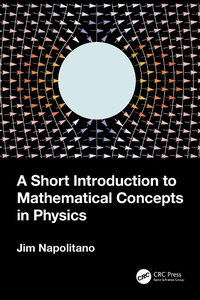
A Short Introduction to Mathematical Concepts in Physics
1st Edition
Published on 22. January 2024
242 pages
978-1-003-80303-4 (ISBN)
Description

Mathematics is the language of physics and yet, mathematics is an enormous subject. This textbook provides an accessible and concise introduction to mathematical physics for undergraduate students taking a one semester course.
It assumes the reader has studied a year of introductory physics and three semesters of basic calculus, including some vector calculus, but no formal training in differential equations or matrix algebra. It equips readers with the skills and foundational knowledge they need for courses that follow in classical mechanics, electromagnetism, quantum mechanics, and thermal physics.
This book exposes students early on to the kinds of mathematical manipulations they will need in upper-level courses in physics. It can also serve as a useful reference for their further studies.
Key features:
Accompanied by homework problems and a solutions manual for instructors, available upon qualifying course adoption
Bridges the gap between calculus and physics, explaining fundamental mathematics (differentiation, integration, infinite series) in physical terms
Explores quick extensions into mathematics useful in physics, not typically taught in math courses, including the Gamma Function, hyperbolic functions, Gaussian integrals, Legendre polynomials, functions of a complex variable, and probability distribution functions
It assumes the reader has studied a year of introductory physics and three semesters of basic calculus, including some vector calculus, but no formal training in differential equations or matrix algebra. It equips readers with the skills and foundational knowledge they need for courses that follow in classical mechanics, electromagnetism, quantum mechanics, and thermal physics.
This book exposes students early on to the kinds of mathematical manipulations they will need in upper-level courses in physics. It can also serve as a useful reference for their further studies.
Key features:
Accompanied by homework problems and a solutions manual for instructors, available upon qualifying course adoption
Bridges the gap between calculus and physics, explaining fundamental mathematics (differentiation, integration, infinite series) in physical terms
Explores quick extensions into mathematics useful in physics, not typically taught in math courses, including the Gamma Function, hyperbolic functions, Gaussian integrals, Legendre polynomials, functions of a complex variable, and probability distribution functions
More details
Edition
1. Auflage
Language
English
Place of publication
London
United Kingdom
Publishing group
Taylor & Francis Ebooks
Target group
College/higher education
Illustrations
76 Line drawings, black and white; 1 Halftones, black and white; 77 Illustrations, black and white
ISBN-13
978-1-003-80303-4 (9781003803034)
Copyright in bibliographic data and cover images is held by Nielsen Book Services Limited or by the publishers or by their respective licensors: all rights reserved.
Schweitzer Classification
Other editions
Additional editions
Jim Napolitano
A Short Introduction to Mathematical Concepts in Physics
Book
01/2024
1st Edition
CRC Press
€80.50
Shipment within 10-20 days
Jim Napolitano
A Short Introduction to Mathematical Concepts in Physics
Book
01/2024
1st Edition
CRC Press
€207.70
Shipment within 10-20 days
Person
Jim Napolitano is Professor of Physics at Temple University. His undergraduate degree is in Physics from Rensselaer Polytechnic Institute, and he earned his PhD in Physics at Stanford University. For the first ten years of his career, he was on the staffs at Argonne National Laboratory and Jefferson Laboratory, but has been a Physics faculty member at Rensselaer and Temple for more than 25 years.
Professor Napolitano has taught courses at all level, from introductory physics, to intermediate and upper level theoretical and experimental physics, and graduate quantum mechanics. His research field is Experimental Nuclear Physics, and has published many papers in the Physical Review, Physical Review Letters, and other journals. In 2016 he shared the Fundamental Physics Breakthrough Prize with his collaborators on the Daya Bay Reactor Neutrino Experiment. He was elected a Fellow of the American Physical Society in the Division of Nuclear Physics in 2011, has contributed as a member of the Physical Review C Editorial Board, and serves on or chairs several review panels in the field of Nuclear and High Energy Physics.
Professor Napolitano has taught courses at all level, from introductory physics, to intermediate and upper level theoretical and experimental physics, and graduate quantum mechanics. His research field is Experimental Nuclear Physics, and has published many papers in the Physical Review, Physical Review Letters, and other journals. In 2016 he shared the Fundamental Physics Breakthrough Prize with his collaborators on the Daya Bay Reactor Neutrino Experiment. He was elected a Fellow of the American Physical Society in the Division of Nuclear Physics in 2011, has contributed as a member of the Physical Review C Editorial Board, and serves on or chairs several review panels in the field of Nuclear and High Energy Physics.
Content
1. Basic Concepts 2. Infinite Series 3. Ordinary Differential Equations 4. Vector Calculus and Partial Differential Equations 5. Fourier Analysis 6. Vectors and Matrices 7. Calculus of Variations 8. Functions of a Complex Variable 9. Probability and Statistics
