

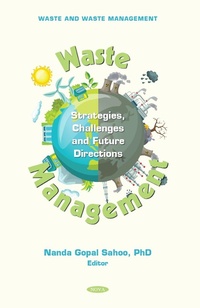
Waste Management: Strategies, Challenges and Future Directions
Published on 2. December 2021
538 pages
978-1-68507-394-7 (ISBN)
Description

The management of waste is a sensitive issue which affects everyone all over the globe. With the advent of globalization and urbanization, the amount of waste generated has increased to an extent never seen before. Such an increase has come with threatening consequences. To make human life easier, several innovations have been introduced in recent years, such as the development of plastic goods and electronic items, which have led to an exponential growth in waste. Most waste is untreated and unutilized, and as such it is burned, mismanaged and dumped in landfills. This has endangered our ecosystem, polluted water bodies and caused ecological imbalance in the biosphere. Overall, this waste is spoiling the beauty of our planet and polluting the environment. To overcome this situation, many efforts have been made by the scientific community and municipal bodies to no avail. Thus, there is a great need for efficient scientific waste management approaches as well as advanced technology that can convert waste into value-added products. There are many ways to tackle this, but more research and development in this area is required to achieve desired results. This book explores a new aspect of managing waste and developing efficient technology to convert this waste into value-added products. It reviews challenges and advancements in waste management technologies and gives direction for future planning. It also provides cutting-edge knowledge on classification and management of waste, recycling and upcycling of waste into value-added products or carbon nanomaterials, utilization of waste towards enhancing the global economy, the role of microorganisms for the treatment of waste, the role of nanotechnology in waste treatment and water purification, and management of e-waste and biomedical waste. This book will emerge as a reference guide that overviews up-to-date literature in the field of waste and its management, challenges, converting technology and future possibilities.
More details
Other editions
Additional editions
Book
12/2021
Nova Science Publishers Inc
€409.20
Shipment within 15-20 days
Content
- Intro
- Contents
- Preface
- Chapter 1
- Sustainable Management of Waste: Present Challenges and Future Planning
- Abstract
- 1. Introduction
- 2. Global Scenario of Waste Management
- 2.1. Waste Generation Volume
- 2.2. Waste Management Methods
- 2.3. Present Regulation for Waste Management
- 2.4. Environmental Impacts of Waste Management
- 3. Sustainability Planning Approaches
- 3.1. Quantitative Planning Approach
- 3.2. Qualitative, Participatory Approaches
- 4. Integrated Waste Management Methodologies: An Approach for Attaining SDG
- 4.1. Understanding Current Challenges and Future Needs
- 4.1.1. Waste Generation
- 4.1.2. Waste Collection and Its Transport
- 4.1.3. Waste Treatment
- 4.2. Strategy Development
- 4.3. Simulate, Evaluate, and Policy Implication
- 5. Cost-Effective Waste Utilization Technologies: Waste-to-Energy/Resource Recovery
- 5.1. Thermochemical Conversion Technologies
- 5.2. Physicochemical Conversion Technologies
- 5.3. Biochemical Conversion Technologies
- 5.4. Resource Recovery from Wastewater
- 6. Waste Management in a Circular Economy
- 7. The Way Forward
- Conclusion
- References
- Chapter 2
- Classification and Management of Waste: Upcycling of Waste into Nanomaterials for Water Remediation
- Abstract
- 1. Introduction
- 2. Classification of Waste
- 2.1. Municipal Waste
- 2.1.1. Household Waste
- 2.1.2. Commercial Waste
- 2.1.3. Demolition Waste
- 2.2. Agricultural Waste
- 2.3. Biomedical Waste
- 2.4. Special Hazardous Waste
- 2.4.1. Radioactive Waste
- 2.4.2. Electronic Waste
- 2.4.3. Explosive Waste
- 2.5. Waste Water/Industrial Waste
- 3. Importance of Waste Management
- 4. Methods of Waste Management
- 4.1. Landfill
- 4.2. Incineration
- 4.3. Recovery Techniques
- 4.4. Recycle Techniques
- 4.5. Plasma Arc Gasification
- 4.6. Composting
- 4.7. Wastes to Energy
- 4.8. Avoidance/Waste Minimization
- 5. New Insights for Upcycling Waste to Value-Added Products
- 5.1. Waste to Nanomaterials
- 5.2. Waste to Fuel
- 5.3. Waste to Construction Block
- 5.4. Waste to Adsorbents Material
- 6. Significance of Waste Upcycled Nanomaterials for Water Remediation
- 7. Present and Future Challenges
- Conclusion
- Acknowledgments
- References
- Chapter 3
- Waste: Problem, Sustainable Management, and Conversion to Value Added Products
- Abstract
- 1. Introduction
- 2. Classification of Waste
- 2.1. Agricultural Waste
- 2.2. Medical Waste
- 2.3. Industry Waste
- 2.4. Household Waste
- 3. Problem Generated with Waste
- 4. Nanotechnology as Solution to Waste
- 4.1. Nanotechnology as a Solution for Water Disinfection
- 4.2. Nanotechnology as a Solution for Air Purification
- 5. Nanoparticles from Waste: 3R's of Sustainable Goals
- 6. Nanotechnology as a Solution not Further Harm
- 6.1. Activated Carbon from Waste
- 6.2. Carbon Nanotubes (CNTs) from Waste
- 6.3. Graphene from Waste
- 6.4. Reduced Graphene Oxide (RGO) from Waste
- Conclusion
- References
- Chapter 4
- Advancement towards Sustainable Management and Utilisation of Agriculture Wastes in the Global Economy
- Abstract
- 1. Introduction
- 2. Types of Agriculture Wastes
- 3. Environmental Hazards of Agricultural Waste
- 4. Agricultural Waste Management System (AWMS)
- 4.1. AWM Including the '3R' Approach
- 4.2. The AWM Involving 3R Hierarchy
- 5. Utilization of Agricultural Wastes
- 6. Waste Utilization Routes
- 6.1. Briquetting
- 6.2. Animal Fodder
- 6.3. Biogas Generation
- 6.4. Fertilizers
- 6.5. Composting
- 6.6. Anaerobic Digestion
- 6.7. Adsorbents in the Elimination of Heavy Metals
- 6.8. Pyrolysis
- 7. Waste To Energy Conversion
- 7.1. Electricity Generation through Direct Combustionof Wood Residues
- 7.2. Electricity Generation Using Gasification
- 7.3. Production of Ethanol
- 7.4. Thermal Conversion Process (TCP)
- 7.5. Bio-Reduction
- 7.6. Syntec Process
- 8. Conversion of Agriculture Waste Streams for Production of Value-Added Products
- 8.1. Cultivation of Filamentous Fungi using the by-Products of Agricultural and Food-Processing Streams
- 8.2. Oncom Production
- 8.3. Single Cell Protein Production
- 8.4. Activated Carbon
- 8.5. Graphene Oxide
- Conclusion
- References
- Chapter 5
- Analysis of the Evolution of Urban Solid Waste Management in 10 Middle Income Geographic Regions: A Mini-Review
- Abstract
- 1. Introduction
- 2. Methodology
- 3. Theoretical Framework
- 3.1. Concepts and the Importance of Waste Management Sector
- 3.2. Generation of Urban Solid Waste: Evolution and Implications in USWM
- 3.3. The Unsustainability of the Linear Waste Management Model
- 3.4. USWM Context in Developed and Developing Countries
- 4. Results and Discussion
- 4.1. Synthesized Analysis of USWM Context in Different Geographic Regions
- 4.1.1. Step 1: Identification of GR/Location/Scientific Reference Used
- 4.1.2. Step 2: Synthesizing the Key Aspects Highlighted by the Authors (Fragilities and Opportunities)
- 4.1.3. Step 3: Most Recurring Aspects in USWM of GRs (Weaknesses and Opportunities)
- 4.1.4. Step 4: Reflections on the USWM Context of the GR and the Priorities Established in Demajorovic's Phases
- Conclusion
- Acknowledgements
- References
- Chapter 6
- Waste Plastic Recycling: Current State, Challenges, and Forthcoming Opportunities in Recycling Technology
- Abstract
- 1. Introduction
- 2. Plastic Waste Management: Overview
- 2.1. Current State and Challenges
- 3. Recycling Techniques
- 3.1. Traditional Techniques
- 3.1.1. Mechanical Recycling
- 3.2. Advanced Recycling Technology
- 3.2.1. Biological Recycling
- 3.2.2. Chemical and Thermal Recycling
- 3.2.3. Energy Recovery
- 4. Waste Plastic into Value-Added Products
- Conclusion
- Acknowledgments
- References
- Chapter 7
- Environmentally Sustainable Waste Management at a Major Global Hub Airport
- Abstract
- 1. Introduction
- 2. Background
- 2.1. Sustainable Airport Waste Management
- 2.2. The Circular Economy and Waste Minimization
- 2.3. Waste Management Hierarchy
- 2.4. Waste Management Regulatory Frameworks
- 3. Research Methodology
- 3.1. Research Approach
- 3.2. Data Collection
- 3.3. Data Analysis
- 4. Results
- 4.1. A Brief Overview of Frankfurt Airport
- 4.2. Fraport AG Environmental Management
- 4.3. Frankfurt Airport Waste Management Regulatory Framework
- 4.4. Frankfurt Airport Waste Handling Methods
- 4.5. Annual Volumes of Waste Generated at Frankfurt Airport
- 4.6. Hazardous Wastes at Frankfurt Airport
- 4.7. Non-Hazardous Wastes at Frankfurt Airport
- 4.8. Disposed Wastes at Frankfurt Airport
- 4.9. Reclaimed Wastes at Frankfurt Airport
- 4.10. Wastes from International Flights at Frankfurt Airport
- 4.11. Total Waste Measures for Frankfurt Airport
- Conclusion
- References
- Chapter 8
- The Role of Microorganisms in Bioremediation
- Abstract
- 1. Introduction
- 2. Types of Bioremediations
- 2.1. Techniques for Ex-Situ Bioremediation
- 2.2. Techniques for In-Situ Bioremediation
- 2.2.1. Biosparging
- 2.2.2. Bioventing
- 2.2.3. Bioaugmentation
- 2.2.4. Biopiling
- 3. Different Methodologies Involve in Bioremediation
- 3.1. Microbial-Bioremediation
- 3.2. Phytoremediation
- 3.3. Enzymatic Bioremediation
- 3.3.1. Oxidoreductases
- 3.3.2. Hydrolases
- 4. Factor Affecting Bioremediation
- 4.1. Biotic Conditions
- 4.2. Environmental or Climatic Conditions
- 4.2.1. Temperature
- 4.2.2. Moisture, pH, Concentration of Oxygen and Soil Structure
- 5. Microorganisms and Pollutants
- 6. Genetic Engineering of Microorganism for Enhanced Bioremediation
- Conclusion
- References
- Chapter 9
- Agriculture Waste to Value Added Products Conversion Technology: Present, Past and Future
- Abstract
- 1. Introduction
- 2. Circular Economy Model
- 3. Value-Added Products from Agriculture Waste
- 3.1. Biofuels
- 3.1.1. Production of Bioethanol, Biobutanol, Biohydrogen and Biogas through Biochemical Conversion Routes
- 3.1.1.1. Bioethanol
- 3.1.1.2. Biobutanol
- 3.1.1.3. Biogas
- 3.1.1.4. Biohydrogen
- 3.1.2. Production of Biodiesel Through Chemical Conversion Route
- 3.1.3. Production of Biofuels Through Thermochemical Conversion Routes
- 3.1.3.1. Pyrolysis
- 3.1.3.2. Gasification
- 3.1.3.3. Torrefaction
- 3.2. Soil Management
- 3.3. Bioplastics
- 3.4. Construction Material - Reinforcement Additives
- 3.5. Bioactive Compounds
- 3.6. Adsorbents
- 3.7. Other Uses
- Conclusion
- Acknowledgements
- References
- Chapter 10
- The Role of Nanotechnology in Water Quality Management and Waste Water Treatment
- Abstract
- 1. Introduction
- 1.1. Water Scarcity and Quality
- 1.2. Water Pollution and Its Causes
- 1.3. Effects of Water Pollution on Human Health
- 2. Analytical Methods for Water Quality Measurement
- 2.1. Colorimetric Sensors
- 2.2. Fluorescence-Based Sensors
- 2.3. Atomic Absorption Spectroscopy
- 2.3.1. Flame Atomic Absorption Spectrometry (FAAS)
- 2.3.2. Graphite Furnace Atomic Absorption Spectrometry (GFAAS)
- 2.4. Electrochemical Sensors
- 2.4.1. Potentiometric Sensing Method
- 2.4.2. Amperometric Sensing Method
- 2.4.3. Conductometric Sensing Method
- 2.5. Chromatography
- 2.5.1. GC-MS
- 2.5.2. HPLC
- 2.5.3. Ion Chromatography
- 3. Nanotechnological Approach for Water Quality Management
- 3.1. Noble NPs Based Colorimetric Sensing
- 3.2. Quantum Dot Based Sensing
- 3.3. Immunochromatographic Strip Based Sensing
- 3.4. Electrochemical Sensing
- 3.5. Raman-Based Sensing
- 4. Nanotechnological Approach for Waste Water Treatment
- 4.1. Nanoadsorption
- 4.2. Nanomembrane Based Filtration/Nanofiltration
- 4.3. Water Disinfection
- 4.4. Nanophotocatalysts
- 5. Role of Metal and Metal Oxide Nanomaterials in the Waste Water Remediation
- 5.1. Iron Oxide Nanomaterials
- 5.2. Zinc Oxide (ZnO) Nanoparticles
- 5.3. Silver Nanoparticles
- 5.4. TiO2 Nanoparticles
- 5.5. Carbon Based Nanomaterials
- 5.5.1. Fullerenes
- 5.5.2. Carbon Nanotubes (CNTs)
- 5.5.3. Graphene Nanoparticles
- 6. Patented Products of Nanomaterials for Wastewater Treatment
- Conclusion and Future Perspectives
- References
- Chapter 11
- Mobile Phone Design with Extended Producer Responsibility Approach
- Abstract
- Background
- Methods
- Results
- Conclusion
- 1. Introduction
- 2. Method
- 3. Result
- 3.1. Extended Producer Responsibility
- 3.2. Mobile Phone Component
- 3.3. Interview and Observation
- 3.4. Proposed Solution
- 3.5. Product Structure
- 3.5.1. Mobile Phone Basic Structure
- 3.5.2. Mobile Phone Quantified Structure
- 3.6. Dummy
- 3.7. Prototype - Design Alternative
- 3.8. Prototype - Final Design
- 3.8.1. Product Specification
- 3.9. User Review
- 4. Discussion
- Conclusion
- References
- Chapter 12
- Purification of Wastewater Using Graphene Derivatives
- Abstract
- Abbreviations
- Introduction
- Graphene and Its Derivatives
- The Functionality of Graphene/Derivatives as Filtering Materials
- Electrostatic Interaction
- Pi-Pi Stacking
- Hydrophobic Interaction
- Coordination Bond
- Further Interactions
- application of graphene derivatives in waste water treatment
- Removal of Different Pollutants Using Graphene and Its Derivatives
- Purification of Organic Contaminants
- Adsorption of Inorganic Contaminants
- Adsorption of Biological Contaminants
- Graphene Derivatives
- Graphene Oxide
- Reduced Graphene Oxide
- Graphene/GO Sponge
- Functional Graphene
- Inorganic Graphene Composite
- Challenges and Prospects
- Acknowledgments
- References
- Chapter 13
- Circular Cities: Challenges in Adaptation of New Waste Management Strategies
- Abstract
- 1. Introduction
- 2. Technical Challenges
- 2.1. Infrastructure
- 2.1.1. Wastewater Segregation and Collection
- 2.1.2. Waste Segregation and Collection
- 2.2. Waste to Energy Plants
- 2.3. Water/Wastewater Treatment
- 2.4. Waste Management
- 3. Environmental Challenges
- 3.1. Environmental Impact of Recovered Products
- 3.2. Environmental Impacts of Recovery Technologies
- 4. Economic and Financial Challenges
- 5. Human Resources
- 6. Social-Cultural
- 7. Regulatory Challenges
- Conclusion
- References
- Chapter 14
- Sustainable Management of Agricultural Waste: Present, Past and Future
- Abstract
- 1. Introduction
- 2. Agricultural Waste Generation
- 3. Utilization of Agricultural Waste
- 3.1. Fertilizer Application
- 3.2. Removal of Metal from Waste Water and Soil
- 3.3. Anaerobic Digestion
- 3.4. Direct Combustion
- 3.5. Pyrolysis
- 4. Value Added Applications of Agricultural Waste
- 4.1. Biofuel Production
- 4.2. Enzyme Production
- 4.3. Pigment Production
- 4.4. Citric Acid Production
- 4.5. Extraction of Bioactive Compounds
- 4.6. Extraction of Food Flavouring and Preservative Compounds
- 4.7. Recycled agricultural composting
- Conclusion and Future Perspective
- References
- Chapter 15
- Waste Management Using TPM Pillars Implementation - A Case Study
- Abstract
- Introduction
- Literature Review
- Literature Justifying OEE as Measure of Operational Performance
- Literature Justifying Six Major Losses as a Part of OEE through TPM
- Literature Justifying the Role of TPM towards Performance Improvement
- Literature Justifying Role TPM Pillars towards Performance Improvement
- Research Framework and Methodology
- Implementation Procedure of TPM Pillars
- 5S Implementation
- Autonomous Maintenance or Jishu Hozen
- Planned Maintenance
- Quality Maintenance
- Kobetsu Kaizen/Focussed Improvement
- Impact of Implementing TPM Pillars
- Conclusion, Practical Implications and Limitations
- References
- Chapter 16
- Biomedical Waste (BMW): Hazards, Safe Disposal, Legal Aspects, and Their Management Perspectives
- Abstract
- 1. Introduction
- 2. International Conventions and Agreements on Waste Management, Role and Participation of India
- 3. Risks from Biomedical Waste
- 3.1. Health Risks (Acc. to WHO Documents)
- 3.2. Sharps-Related Injuries
- 3.3. Environmental Impact of Biomedical Waste
- 3.4. Bio-Medical Waste Management Rules, 2016. (Capoor et al., 2017)
- 4. Biomedical Waste (BMW) Classification and Categories
- 5. Treatment/Disposal of Bio-Medical Wastes (BMW) (Capoor et al., 2017
- Datta et al., 2018
- Mathur et al., 2012)
- 5.1. BMW Treatment Using Incineration (Glasser et al., 1991)
- 5.1.1. Operating Standards
- 5.1.2. Emission Standards
- 5.1.3. Stack Height
- 5.2. BMW Treatment Using Plasma Pyrolysis
- 5.2.1. Operating and Emission Standards
- 5.2.2. Standards/Measures for Air Emission/Air Pollution Control/Ash disposal
- 5.3. BMW Treatment Using Autoclaving (Myneedu et al., 2020)
- 5.3.1. Standards/Measures for Autoclaving
- 5.4. BMW Management Using Microwaving (Myneedu Et Al., 2020)
- 5.4.1. Standards/Measures of Microwaving
- 5.5. BMW Management/Disposal Using Deep Burial
- 5.5.1. Standards/Measures of Deep Burial
- 6. Advances in Waste Management (Gahlot et al., 2019)
- 7. Nanotechnology for BMW Management
- Conclusion
- References
- Chapter 17
- Water Pollution and Its Treatment: From Conventional to Novel Methods
- Abstract
- 1. Introduction
- 2. Water Pollution
- 2.1. Sources of Water Pollution
- 2.1.1. Natural Sources for Pollution
- 2.1.2. Sewage Pollutants (Domestic and Municipal Waste)
- 2.1.3. Suspended Solids
- 2.1.4. Agriculture Waste
- 2.1.5. Industrial Waste
- 2.1.6. Nutrients Enhancement
- 2.1.7. Oil Spillage
- 2.1.8. The Disruption of Sediments
- 2.2. Types of Water Pollutants
- 2.2.1. Organic Pollutants
- 2.2.2. Inorganic Pollutants
- 2.2.3. Radioactive Pollutants
- 2.2.4.Pathogens
- 2.2.5.Nutrients and Agricultural pollutants
- 2.2.6. Thermal Pollutants
- 3. Methods of Removal Water Pollutants
- 3.1. Distillation Method
- 3.2. Coagulation and Flocculation
- 3.3. Filtration Technique
- 3.4. Adsorption Technique
- 3.5. Ion-Exchange Method
- 3.6. Membrane Filtration
- 3.6.1. Microfiltration
- 3.6.2. Ultrafiltration
- 3.6.3. Nanofiltration
- 3.6.4. Reverse Osmosis
- 4. Advantagesand Disadvantages of Various Methods Used in Water Purification
- 5. Nanotechnology Based Removal of Pollutants from Water
- 5.1. Nanocellulose Based Water Purification
- 5.2. Graphene Coated Nanofilters
- 5.3. Electrochemical Carbon Nanotube Filtration
- 6. Merits of Nanotechnology
- 7. Future Perspective
- References
- Chapter 18
- Road Map towards Future Planning for Waste Management in Circular Cities: Decision Making Strategies and Complementary Tools
- Abstract
- 1. Introduction
- 2. Waste Management
- 3. Circular City
- 4. Decision Making Strategies for Roadmap of Waste Management in Circular Cities
- 5. Complementary Tools for Roadmap Studies
- 5.1. Material Flow Analysis
- 5.2. System Dynamics-Based Approach
- 5.3. Life Cycle Assessment
- 5.4. Life Cycle Costing
- 5.5. Social Life Cycle Assessment
- Conclusion
- References
- Chapter 19
- Role of Microorganisms in Degradation of Hazardous Solid Waste
- Abstract
- Introduction
- Waste: A Brief Outline
- Categorization of Waste
- Waste Management What does It Mean?
- Waste Management and Microbes
- Composting
- Compostability Factors
- Microorganisms
- Temperature
- pH
- Amount of Humidity
- Carbon and Nitrogen Ratio
- Particle Nature and Size
- Biodegradation
- Efficiency for Bacterial Degradation
- Plant-Associated Bacteria Guided Bioremediation
- Mycorrhizal Degradation Caused by Microfungi
- Algal Bio-Decomposition
- Xenobiotic Compound Biodegradation (XC)
- What Does XC Stand for?
- The Effects of XC on the Biosphere
- Biodegradation of Xenobiotics: Mechanisms at Work
- Biodegradation-Involved Microbial Enzymes
- Oxidoreductases in Microbes
- Microbial Oxygenase
- Microbial Dehalogenases
- Phosphotriesterases
- Biodegradation of Plastic Wastes
- Types of Plastics
- Plastics Have Risks
- Plastic Biodegradation and Role of Microorganism
- Microorganism Associated Plastic Degradation
- Microbial Degradation Impacting Factors
- Microbial Biofilm Mediated Waste Water Treatment
- System Biology Approach in Microbial Remediation of Wastes
- Bioremediation
- In Situ Bioremediation
- Biosparging
- Bioventing
- Bio Enhancement
- Ex Situ Bioremediation
- Conclusion
- References
- About the Editor
- Index
- Blank Page
- Blank Page
