

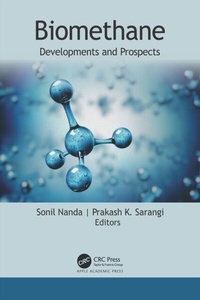
Biomethane
Developments and Prospects
1st Edition
Published on 7. June 2022
196 pages
978-1-000-56516-4 (ISBN)
Description

This book presents a comprehensive synopsis of the production and utilization of biomethane along with important recent advances. Biomethane production offers valuable alternative energy solutions for the replacement of fossil fuels to lessen environmental impacts and strategize for mitigating global warming and climate change.
Chapters first focus on the production of biogas (or biomethane) with emphasis on the different biomass utilization for industrial and domestic applications and describe the characteristics, parameters, and process design of anaerobic digesters for biomethane production from waste biomass. The book then goes on to discuss advanced genetic engineering tools and techniques to enhance biomethanation and biomethane production. The volume also offers a state-of-the-art review of anaerobic digestion of biogenic solid wastes, the impact of different chemical pretreatment processes and products, and the influence of operating parameters on biomethane yields.
Differentiating between the thermochemical technologies (e.g., gasification and pyrolysis) and biological technologies (e.g., anaerobic digestion) for biomethane production, the book assesses some recent advancements in biomethane production along with its socioeconomic impacts and applications. Other topics include gasification technology and syngas cleaning for biosynthetic natural gas production, the use of catalysts for enhanced synthetic natural gas production, biohythane fuel produced from microbial fermentative pathways, and more.
Biomethane: Developments and Prospects offers valuable insight and information on the current status of production and utilization of biomethane that has cross-disciplinary value in biotechnology, fermentation technology, bioprocess engineering, chemical engineering, and environmental technology with a common interest in biofuels and bioenergy.
Chapters first focus on the production of biogas (or biomethane) with emphasis on the different biomass utilization for industrial and domestic applications and describe the characteristics, parameters, and process design of anaerobic digesters for biomethane production from waste biomass. The book then goes on to discuss advanced genetic engineering tools and techniques to enhance biomethanation and biomethane production. The volume also offers a state-of-the-art review of anaerobic digestion of biogenic solid wastes, the impact of different chemical pretreatment processes and products, and the influence of operating parameters on biomethane yields.
Differentiating between the thermochemical technologies (e.g., gasification and pyrolysis) and biological technologies (e.g., anaerobic digestion) for biomethane production, the book assesses some recent advancements in biomethane production along with its socioeconomic impacts and applications. Other topics include gasification technology and syngas cleaning for biosynthetic natural gas production, the use of catalysts for enhanced synthetic natural gas production, biohythane fuel produced from microbial fermentative pathways, and more.
Biomethane: Developments and Prospects offers valuable insight and information on the current status of production and utilization of biomethane that has cross-disciplinary value in biotechnology, fermentation technology, bioprocess engineering, chemical engineering, and environmental technology with a common interest in biofuels and bioenergy.
More details
Edition
1. Auflage
Language
English
Place of publication
London
United Kingdom
Publishing group
Taylor & Francis Ltd
Target group
College/higher education
Professional and scholarly
Illustrations
9 Tables, black and white; 16 Line drawings, color; 22 Line drawings, black and white; 2 Halftones, color; 18 Illustrations, color; 22 Illustrations, black and white
ISBN-13
978-1-000-56516-4 (9781000565164)
Copyright in bibliographic data and cover images is held by Nielsen Book Services Limited or by the publishers or by their respective licensors: all rights reserved.
Schweitzer Classification
Other editions
Additional editions
Book
08/2024
1st Edition
Apple Academic Press Inc.
€120.20
Shipment within 3-4 weeks
Book
06/2022
1st Edition
Apple Academic Press Inc.
€182.10
Shipment within 3-4 weeks
Persons
Sonil Nanda, PhD, is Director of Research & Development at Titan Clean Energy Projects Corporation in Craik, Saskatchewan, Canada. He has published over 120 peer-reviewed journal articles and 70 book chapters and has presented at many international conferences. He is the editor of many books and serves as a fellow and/or member of many professional associations. Dr. Nanda is Assistant Subject Editor of the International Journal of Hydrogen Energy as well as Associate Editor of Environmental Chemistry Letters and Applied Nanoscience. He has also edited several special issues of renowned journals. His research areas are related to the production of advanced biofuels and biochemicals through thermochemical and biochemical conversion technologies such as gasification, pyrolysis, carbonization, torrefaction, and fermentation.
Prakash K. Sarangi, PhD, is a scientist with a specialization in food microbiology at the Central Agricultural University in Imphal, Manipur, India. Dr. Sarangi's current research is focused on bioprocess engineering, renewable energy, biofuels, biochemicals, biomaterials, fermentation technology, and postharvest engineering and technology. He has more than 10 years of teaching and research experience in biochemical engineering, microbial biotechnology, downstream processing, food microbiology, and molecular biology. He has served as a reviewer for many international journals and has authored more than 70 peer-reviewed research articles and 50 book chapters. Dr. Sarangi has also edited many books and serves as an academic editor for PLOS One journal.
Prakash K. Sarangi, PhD, is a scientist with a specialization in food microbiology at the Central Agricultural University in Imphal, Manipur, India. Dr. Sarangi's current research is focused on bioprocess engineering, renewable energy, biofuels, biochemicals, biomaterials, fermentation technology, and postharvest engineering and technology. He has more than 10 years of teaching and research experience in biochemical engineering, microbial biotechnology, downstream processing, food microbiology, and molecular biology. He has served as a reviewer for many international journals and has authored more than 70 peer-reviewed research articles and 50 book chapters. Dr. Sarangi has also edited many books and serves as an academic editor for PLOS One journal.
Content
1. Utilization of Waste Biomass Resources for Biogas Production 2. Characteristics, Parameters, and Process Design of Anaerobic Digesters 3. Metabolic Engineering of Methanogenic Archaea for Biomethane Production from Renewable Biomass 4. Biomethane Production through Anaerobic Digestion of Lignocellulosic Biomass and Organic Wastes 5. Recent Advancements in Thermochemical Biomethane Production 6. Thermochemical Methanation Technologies for Biosynthetic Natural Gas Production 7. A Brief Overview of Fermentative Biohythane Production 8. Socio-Economic and Techno-Economic Aspects of Biomethane and Biohydrogen
