

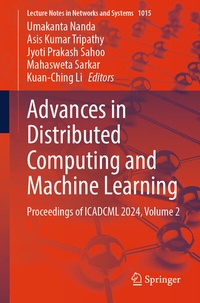
Advances in Distributed Computing and Machine Learning
Description

This book is a collection of peer-reviewed best selected research papers presented at the Fifth International Conference on Advances in Distributed Computing and Machine Learning (ICADCML 2024), organized by School of Electronics and Engineering, VIT - AP University, Amaravati, Andhra Pradesh, India, during 5-6 January 2024. This book presents recent innovations in the field of scalable distributed systems in addition to cutting edge research in the field of Internet of Things (IoT) and blockchain in distributed environments.
More details
Other editions
Additional editions
Persons
Umakanta Nanda has received the MTech and PhD degrees in Electronics and Communication Engineering from National Institute of Technology, Rourkela, India in 2010 and 2017 respectively. He is currently working as an Associate Professor and Dean of School of Electronics Engineering at VIT-AP University, India. He has a total 14 years of teaching and research experience in different educational institutions. He has guided more than 20 UG and PG student projects. He has guided 1 PhD scholar and four others are working under him in areas like Analog and Mixed signal integrated circuits, beyond CMOS devices and circuits, application specific processor design and embedded systems design. He has published more than 75 research papers including reputed SCI and SCOPUS indexed journals, conference proceedings and book chapters. He is also co-inventor of 6 patents which have been published. He has successfully conducted many workshops, FDPs, STTPs, seminars, value added courses, training programs, and conferences. He has also worked as reviewer and editor of numerous journals and conferences.
Asis Kumar Tripathy is a Professor in the School of Information Technology and Engineering, Vellore Institute of Technology, Vellore, India. He has more than ten years of teaching experience. He completed his Ph.D. from the National Institute of Technology, Rourkela, India, in 2016. His areas of research interests include wireless sensor networks, cloud computing, Internet of things and advanced network technologies. He has several publications in refereed journals, reputed conferences and book chapters to his credit. He has served as a program committee member in several conferences of repute. He has also been involved in many professional and editorial activities. He is a senior member of IEEE and a member of ACM.
Jyoti Prakash Sahoo is a Senior Member, IEEE, and an experienced Assistant Professor with a demonstrated history of working in engineeringeducation. Currently, he is working in the Dept of Computer Science and Information Technology, Institute of Technical Education and Research, Siksha 'O' Anusandhan (Deemed to be University) for the last 10 years. Prior to joining Siksha 'O' Anusandhan, he also worked as an Assistant Professor with CV Raman College of Engineering, Bhubaneswar (now C. V. Raman Global University). He is having more than 12 years of academic and research experience in Computer science and engineering education. He has published several research papers in various international journals and conferences. He is also serving many journals and conferences as an editorial or reviewer board member. He is having expertise in the field of Cloud computing and Machine learning. He served as Publicity chair, Web Chair, Organizing secretary, and Organizing member of technical program committees for many national and international conferences. Being a WIPRO Certified Faculty, he has also contributed to industry-academiacollaboration, student enablement, and pedagogical learning. Furthermore, he is associated with various educational and research societies like IET, IACSIT, IAENG, etc.
Mahasweta Sarkar is currently working as a Professor of the department of Electrical and Computer Engineering and Senior Associate Dean, Global Campus in San Diego State University. Her M.S and Ph.D. degrees were completed at the University of California, San Diego (UCSD) in 2003 and 2005 respectively. She received her B.S. degree in Computer Science & Engineering (Summa Cum Laude) in May 2000 from San Diego State University. Dr.Sarkar is a recipient of the "President's Leadership Award for Faculty Excellence" for the year 2010. She delivered invited lectures and keynotes in different universities spread all over the globe. The talks were on Wireless Body Area Networks, and Brain-Computer Interface. Her research interest lies in the area of MAC layer power management algorithms and Quality-of-Service issues and protocols in WLANs, WMANs, WBANs, sensor networks, and wireless ad-hoc networks. She has published over eighty research papers in these fields in various International Journals and Conferences of high repute.
Kuan-Ching Li is currently appointed as Distinguished Professor at Providence University, Taiwan. He is a recipient of awards and funding support from several agencies and high-tech companies, as also received distinguished chair professorships from universities in several countries. He has been actively involved in many major conferences and workshops in program/general/steering conference chairman positions and as a program committee member, and has organized numerous conferences related to high-performance computing and computational science and engineering. Professor Li is the Editor-in-Chief of technical publications Connection Science (Taylor & Francis), International Journal of Computational Science and Engineering (Inderscience) and International Journal of Embedded Systems (Inderscience), and serves as associate editor, editorial board member and guest editor for several leading journals. Besides publication of journal and conference papers, he is the co-author/co-editor of several technical professional books published by CRC Press, Springer, McGraw-Hill, and IGI Global. His topics of interest include parallel and distributed computing, Big Data, and emerging technologies. He is a Member of the AAAS, a Senior Member of the IEEE, and a Fellow of the IET.
Content
- Intro
- Preface
- Contents
- Editors and Contributors
- OSNR Monitoring for QPSK and QAM in Fiber-Optic Networks Using Machine Learning
- 1 Introduction
- 2 Proposed Method
- 3 Support Vector Machine Algorithms
- 4 Simulation Results and Discussion
- 5 Conclusion and Future Research
- References
- Classification of Star and Galaxy Objects Utilizing Machine Learning Techniques and Deep Neural Networks
- 1 Introduction
- 2 Dataset
- 2.1 Processing Data
- 3 Machine Learning Approach for Star Versus Galaxy Classification
- 4 Convolutional Neural Networks-(CNN)
- 4.1 Convolutional Layers
- 4.2 Implementation Details
- 5 Result and Analysis
- 6 Conclusion
- References
- Probabilistic Forecasting Analysis on Electric Load Systems
- 1 Introduction
- 2 Review of Literature
- 3 Description of the Model
- 4 Sources of Data Generation
- 5 Computational Analysis and Results
- 5.1 Representation of ELG Units
- 5.2 Correlation Analysis
- 5.3 Bivariate Normal Distribution
- 5.4 Linear Regression and ARIMA Models
- 5.5 Electricity Consumption Charges
- 6 Conclusion
- References
- Smart City Survey on AIoT Using Machine Learning, Deep Learning, and Its Computing Tools
- 1 Introduction
- 2 IoT-Oriented Perspective
- 2.1 Smart Infrastructure
- 2.2 Air Management
- 2.3 Traffic Management
- 2.4 Waste Management
- 3 ML-Orient Perspective
- 3.1 Infrastructure
- 3.2 Air Management
- 3.3 Traffic Analysis
- 3.4 Waste Management
- 4 Deep Learning-Oriented Perspective
- 4.1 Supervised Learning
- 4.2 Unsupervised Learning
- 4.3 Reinforcement Learning
- 5 Computing Tools for Smart City
- 5.1 Cloud Computing
- 5.2 Fog Computing
- 5.3 Edge Computing
- 6 Conclusion
- References
- Energy Harvesting Integrated Sensor Node Architecture for Sustainable IoT Networks
- 1 Introduction
- 1.1 Contributions Made in This Research
- 2 Literature Study on Energy Harvesting
- 3 System Architecture
- 3.1 Hardware Requirements
- 3.2 Circuit Implementation
- 3.3 Energy Source: The PV Cell
- 3.4 Energy Storage Structures
- 3.5 Power Management Protocols
- 4 Lifetime Evaluation with Solar Energy Harvester
- 4.1 System Implementation and Analysis
- 5 Conclusion
- References
- Enhancing Real Estate Price Prediction in Smart Cities: A Comparative Analysis of Machine Learning Techniques
- 1 Introduction
- 2 Related Work
- 3 Limitation
- 4 Methodology
- 4.1 Feature Engineering
- 4.2 Model Description and Predicting the Value
- 5 Results
- 6 Conclusion
- 7 Future Work
- References
- Real-Time AI-Based Face-Mask Detection
- 1 Introduction
- 2 Proposed Design Approach
- 2.1 Custom Dataset Gathering
- 2.2 Data Augmentation for Best Results
- 2.3 Training Model
- 3 Methodology
- 3.1 YOLO Algorithm
- 3.2 MobileNetV2
- 4 Results and Discussion
- 5 Conclusion
- References
- A Logical Model for Multiple People Activity Recognition Using Non-intrusive Sensors for Geriatric Care
- 1 Introduction
- 2 Related Work
- 3 Problem Scenario
- 4 Logical FHMM for Multiple People Activity Recognition
- 4.1 Solution Overview
- 5 Experiments
- 5.1 Experimental Setup
- 6 Conclusion
- References
- From Sea to Table: A Blockchain-Enabled Framework for Transparent and Sustainable Seafood Supply Chains
- 1 Introduction
- 2 Related Work
- 3 Seafood Supply Chain and Blockchain
- 4 Conceptual Blueprint
- 4.1 The Flow of Code Implementation
- 5 Result
- 6 Discussion
- 7 Conclusion and Future Scope
- References
- Distributed State Estimation for GPS Navigation: The Correntropy Extended Kalman Filter Approach
- 1 Introduction
- 2 Literature Study
- 3 Correntropy Extended Kalman Filter
- 4 Results and Discussion
- 5 Conclusion
- References
- Nayantara: Crime Analysis from CCTV Footage Using MobileNet-V2 and Transfer Learning
- 1 Introduction
- 2 Related Works
- 3 Proposed Methodology
- 3.1 System Architecture
- 3.2 Detection Model
- 3.3 Web Application
- 4 Experiments and Results
- 4.1 Dataset
- 4.2 Data Preprocessing
- 4.3 Working of the Detection Algorithm
- 4.4 CNN Model
- 4.5 Results
- 5 Conclusion
- References
- Bird Detection in Microlight Aircraft Strip Using YOLOv8for Adventure Tourism
- 1 Introduction
- 2 Bigdata Analytics Unlocks for Tourism Industry
- 2.1 Why is Microlight Aircraft Safety Important?
- 3 Literature Review
- 4 Implementation and Discussion
- 4.1 Methodology Used
- 4.2 Dataset Used
- 5 Performance Analysis and Results
- 6 Conclusion
- References
- A Graphical Tuning Method-Based Robust PID Controller for Twin-Rotor MIMO System with Loop Shaping Technique
- 1 Introduction
- 2 Preliminaries
- 2.1 Description of Twin-Rotor MIMO System
- 2.2 Design of Decouplers
- 2.3 FOPDT Model
- 3 upper H Subscript normal infinityHinfty Controller
- 4 Results an Discussions
- 5 Conclusion
- References
- Signature Verification Using Deep Learning: An Empirical Study
- 1 Introduction
- 2 Proposed Method
- 2.1 Data Acquisition
- 2.2 Pre-processing
- 2.3 Feature Extraction
- 2.4 Model and Algorithm Hyperparameters
- 2.5 Optimizing Algorithm
- 2.6 Batch Normalization and Dropout
- 3 Results
- 3.1 Performance Stats
- 3.2 Evaluation Metrics
- 4 Discussion
- 5 Conclusion
- References
- An Intelligent and Automated Machine Learning-Based Approach for Heart Disease Prediction and Personalized Care
- 1 Introduction
- 2 Related Work
- 3 Methodology
- 3.1 Dataset Description
- 3.2 Data Pre-processing
- 3.3 Handling Imbalanced Classes
- 3.4 Data Normalization
- 3.5 Feature Relevance Analysis
- 4 Results and Discussion
- 4.1 Comparative Analysis
- 5 Conclusion
- References
- Parkinson's Disease Diagnosis Through Deep Learning: A Novel LSTM-Based Approach for Freezing of Gait Detection
- 1 Introduction
- 2 Related Work
- 3 Methodology
- 3.1 Dataset
- 3.2 Data Pre-processing
- 3.3 LSTM Architecture
- 4 Results and Discussion
- 4.1 Comparative Analysis
- 5 Conclusion
- References
- Polarity Detection of Online News Articles Using Deep Learning Techniques
- 1 Introduction
- 1.1 Deep Learning and Polarity Detection
- 2 Literature Survey
- 2.1 RNN with GRU
- 2.2 RNN with LSTM
- 2.3 Bidirectional RNN
- 2.4 CNN
- 2.5 Dynamic Dictionaries
- 3 Proposed Method
- 4 Experiment and Result Discussion
- 5 Conclusion and Future Work
- References
- Harnessing ResNet50 and EfficientNetB5 for Detection of Diabetic Retinopathy Using Explainable AI
- 1 Introduction
- 2 Literature Survey
- 3 Methodology
- 4 Results
- 4.1 Model Performance
- 4.2 Interpretation of Result
- 4.3 Model Explainability
- 5 Conclusion
- References
- A Grey Wolf and Rough Set Hybrid Approach for the Detection of Chronic Kidney Disease
- 1 Introduction
- 2 Schematic Representation of Proposed Research
- 3 Experimental Research on Chronic Kidney Disease
- 4 Result Analysis
- 4.1 Proposed GWRSO Data Analysis
- 5 Conclusion
- References
- Efficient Rice Disease Classification Using Intelligent Techniques
- 1 Introduction
- 2 Methodology
- 3 Data Description
- 3.1 Bacterial Leaf Blight
- 3.2 Brown Spot
- 3.3 Blast
- 3.4 Tungro
- 4 Experimental Setup and Performance Analysis
- 5 Conclusion
- References
- Maize Crop Yield Prediction Using Machine Learning Regression Approach
- 1 Introduction
- 2 Methodology
- 2.1 Dataset
- 2.2 Data Preprocessing
- 2.3 Feature Selection
- 2.4 Data Transformation
- 2.5 Model Building Algorithms
- 2.6 Evaluation Metrics
- 3 Experiment and Results
- 3.1 Model Building, Training, and Testing
- 3.2 Dimension Reduction Using Principal Component Analysis (PCA)
- 3.3 Comparison of the Results
- 3.4 Identification of Main Features
- 3.5 Discussion of the Findings
- 4 Conclusion
- References
- Mode Division Multiplexing-Based Passive Optical Networks for High-Capacity Data Rate via Radio Over Fiber Technology
- 1 Introduction
- 2 Proposed Mode Division Multiplexing Passive Optical Network
- 3 Mode Division Multiplexing Layout Simulation by Using OptiSystemV20
- 4 Simulation Design of MDM with QAM and DSPK
- 5 Simulation Design of MDM for Noise Removal Systems
- 6 Result and Discussion
- 7 Conclusion
- References
- Enhancing Urban Connectivity: Free Space Optics as a Resilient Backup Link for Fiber Networks in Urban Environments
- 1 Introduction
- 2 Proposed Block Diagram of FSO-NRZ System Model
- 3 Result and Discussion
- 4 Conclusion
- References
- Integrating ANSYS Simulation and Machine Learning Techniques for Thermo-Mechanical Analysis of PCBs
- 1 Introduction
- 2 Problem Statement and Methodology
- 3 Results and Discussions
- 4 Conclusions
- References
- Automation of Quality Assessment Procedures in School Education
- 1 Introduction
- 2 Software Tool for Quality Evaluation: Design and Software Prototype Development
- 3 Experiments
- 4 Conclusions
- References
- The FGSM Attack on Image Classification Models and Distillation as Its Defense
- 1 Introduction
- 2 Related Work
- 3 Theoretical Background
- 4 Results of the FGSM Attack
- 4.1 The Classification Results in the Absence of the FGSM Attack
- 4.2 The Classification Results in the Presence of the FGSM Attack
- 5 Distillation for Defense Against the FGSM Attack
- 6 Conclusion
- References
- An Experimentation of Firefly Algorithm Using a Different Set of Objective Functions
- 1 Introduction
- 2 Related Studies
- 3 Classical Firefly Algorithm
- 4 Tuned Firefly Algorithm
- 4.1 Objective Functions
- 5 Results and Discussion
- 6 Conclusion and Future Scope
- References
- Enhanced Traffic Management in IoT-Integrated Internet of Vehicles (IoV) with Optimized Routing and Deep Learning Algorithm
- 1 Introduction
- 2 Literature Survey
- 3 Proposed Method
- 4 Preprocessing
- 5 Result and Discussion
- 5.1 Packet Delivery Ratio
- 5.2 Energy Consumption
- 5.3 Accuracy
- 6 Conclusion
- References
- Forest in the Clouds: Navigating Big Data with GRP and RFC
- 1 Introduction
- 2 Related Work
- 2.1 Dimensionality Reduction: Gaussian Random Projection (GRP)
- 2.2 Machine Learning: Embracing Random Forest (RF)
- 2.3 GRP and RF
- 2.4 Distributed RF and Spark Implementations
- 2.5 Delving Deeper into GRP and Randomized Techniques "Gaussian Random Projection for Big Data" by Li et al. and Zhang et al.
- 3 Methodology
- 3.1 K-Means Clustering
- 3.2 Using Random Forest Classifier with Gaussian Random Projection
- 4 Results and Discussion
- 4.1 Figures and Tables
- 5 Conclusion
- References
- Forest Aerial Image Segmentation Through Satellite Images Using Refine U-Net Model
- 1 Introduction
- 2 Methodology
- 2.1 Refine-Net Architecture
- 3 Implementation
- 3.1 Data Collection and Preprocessing
- 3.2 Results
- 4 Conclusion and Future Recommendations
- References
- Speech Enhancement Using U-Net-Based Progressive Learning with Squeeze-TCN
- 1 Introduction
- 2 Signal Model
- 3 The Proposed Framework Architecture
- 3.1 Feature Extraction Layer (FEL)
- 3.2 Reconstructor
- 4 Experiments
- 4.1 Datasets
- 4.2 Model Setup
- 4.3 Results and Analysis
- 4.4 Discussion
- 5 Conclusion
- References
- IoT Integrated Transmission Line Fault Detection Using Cloud Server from Remote Location
- 1 Introduction
- 2 Proposed Cloud Enabled Iot Based Fault Detection
- 2.1 System Design
- 2.2 Data Storage and Management
- 2.3 Real-Time Monitoring and Analysis
- 3 Results and Discussions
- 3.1 Observation on Serial Monitor
- 3.2 Observation on ThingSpeak Server
- 4 Conclusions
- References
- Web-Based Framework for the Prediction of Type 1 Diabetes in Youth Using EHR's Data
- 1 Introduction
- 2 Literature Review
- 3 Methodology
- 3.1 Data Collection
- 3.2 Web Portal Development
- 3.3 Regression Model Implementation
- 3.4 Deployment and Accessibility
- 3.5 Random Forest Regressor
- 4 Results
- 5 Conclusion
- References
- Antenna Design and Optimization Using Machine Learning: A Comprehensive Review
- 1 Introduction
- 2 Challenges in Traditional Antenna Design
- 3 Fundamentals of Machine Learning in Antenna Design
- 3.1 Supervised Learning
- 3.2 Unsupervised Learning
- 3.3 Reinforcement Learning
- 3.4 Neural Networks
- 4 Antenna Parameter Optimization Through ML
- 4.1 Parameter Optimization
- 4.2 Multi-objective Optimization
- 5 ML Applications in Antenna Pattern Synthesis
- 5.1 Beamforming
- 5.2 Array Configuration Optimization
- 6 Performance Enhancement Through Machine Learning
- 6.1 Intelligent Tuning
- 6.2 Interference Mitigation
- 7 Current Trends in ML Applications for Antenna Design
- 8 Challenges in ML Applications for Antenna Design
- 9 Conclusion and Future Directions
- References
- IoT Enabled Battery Management System (BMS) with Active Balancing
- 1 Introduction
- 1.1 Proposed Solution
- 2 System Design
- 2.1 Architecture
- 3 System Setup
- 4 Implementation
- 5 Experimentation and Result
- 6 Conclusion
- References
