

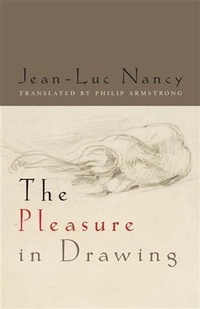
The Pleasure in Drawing
Published on 16. July 2013
128 pages
978-0-8232-5231-2 (ISBN)
Description

Originally written for an exhibition Jean-Luc Nancy curated at the Museum of Fine Arts in Lyon in 2007, this book addresses the medium of drawing in light of the question of form-of form in its formation, as a formative force, as a birth to form. In this sense, drawing opens less toward its achievement, intention, and accomplishment than toward a finality without end and the infinite renewal of ends, toward lines of sense marked by tracings, suspensions, and permanent interruptions.
Recalling that drawing and design were once used interchangeably, Nancy notes that drawing designates a design that remains without project, plan, or intention. His argument offers a way of rethinking a number of historical terms (sketch, draft, outline, plan, mark, notation), which includes rethinking drawing in its graphic,filmic, choreographic, poetic, melodic, and rhythmic senses.
If drawing is not reducible to any form of closure, it never resolves a tension specific to itself. Rather, drawing allows the pleasure in and of drawing, the gesture of a desire that remains in excess of all knowledge, to come to appearance. Situating drawing in these terms, Nancy engages a number of texts in which Freud addresses the force of desire in the rapport between aesthetic and sexual pleasure, texts that also turn around questions concerning form in its formation, form as a formative force. Between the sections of the text, Nancy has placed a series of "sketchbooks" on drawing, composed of a broad range of quotations on art from different writers, artists, or philosophers.
Recalling that drawing and design were once used interchangeably, Nancy notes that drawing designates a design that remains without project, plan, or intention. His argument offers a way of rethinking a number of historical terms (sketch, draft, outline, plan, mark, notation), which includes rethinking drawing in its graphic,filmic, choreographic, poetic, melodic, and rhythmic senses.
If drawing is not reducible to any form of closure, it never resolves a tension specific to itself. Rather, drawing allows the pleasure in and of drawing, the gesture of a desire that remains in excess of all knowledge, to come to appearance. Situating drawing in these terms, Nancy engages a number of texts in which Freud addresses the force of desire in the rapport between aesthetic and sexual pleasure, texts that also turn around questions concerning form in its formation, form as a formative force. Between the sections of the text, Nancy has placed a series of "sketchbooks" on drawing, composed of a broad range of quotations on art from different writers, artists, or philosophers.
Reviews / Votes
What is it about drawing that might attract a philosopher's eye? Many things no doubt but not least, there is the (literally) unthinkable movement by which something begins to take shape. Jean-Luc Nancy's approach in The Pleasure in Drawing moves beyond art-historical categories and conceptual schemas to touch on precisely that: he considers the 'formative force' of drawing, not in terms of its formal achievement but in terms of the pleasures afforded by its constant beginning-pleasures of attraction, sense, permanent interruption, tension and intensity. A book full of dazzling insights, imaginative curves and provocative renewals. -- -Sarah Clift * University of King's College *More details
Language
English
Place of publication
NY
United States
Target group
Professional and scholarly
File size
2,25 MB
ISBN-13
978-0-8232-5231-2 (9780823252312)
Copyright in bibliographic data and cover images is held by Nielsen Book Services Limited or by the publishers or by their respective licensors: all rights reserved.
Schweitzer Classification
Other editions
Additional editions
Jean-Luc Nancy
The Pleasure in Drawing
Book
07/2013
Fordham University Press
€29.00
Shipment within 10-20 days
Jean-Luc Nancy
The Pleasure in Drawing
Book
07/2013
Fordham University Press
€89.00
Shipment within 10-20 days
Persons
Jean-Luc Nancy is Distinguished Professor of Philosophy at the Universite Marc Bloch, Strasbourg. His wide-ranging thought is developed in many books, including Expectation: Philosophy, Literature; The Possibility of a World; The Banality of Heidegger; The Disavowed Community; and, with Adele Van Reeth, Coming (all Fordham). Philip Armstrong is Associate Professor in the Department of Comparative Studies at The Ohio State University.
