

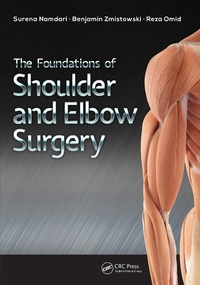
The Foundations of Shoulder and Elbow Surgery
1st Edition
Published on 1. June 2024
388 pages
978-1-040-13750-5 (ISBN)
Description

A comprehensive introductory text with more than 150 color images and figures, The Foundations of Shoulder and Elbow Surgery provides essential information on shoulder and elbow care for students, residents, fellows, and new doctors.
Surgery of the shoulder and elbow has grown more common in recent decades as understanding of anatomy, physiology, and pathology has improved. Additionally, innovations in surgical techniques and implant design have given surgeons the tools to address a higher number of shoulder and elbow pathologies. To adequately care for this increasing patient population, the basics of shoulder and elbow care must be disseminated to those in training.
Together with their expert contributors, Drs. Surena Namdari, Benjamin Zmistowski, and Reza Omid explore the foundational concepts of shoulder and elbow surgery, including:
Shoulder anatomy and physical examination, shoulder instability, and rotator cuff disease
Frozen shoulder (adhesive capsulitis) and injuries to the biceps-labral complex
Shoulder arthritis (glenohumeral arthritis), shoulder fractures, and the athlete's shoulder and elbow
Scapular disorders and acromioclavicular disorders
Elbow anatomy and physical exam, elbow instability, and tendon injuries
Neuropathies of the upper extremity
Elbow arthritis, fractures of the elbow, and humeral shaft fractures
In conjunction with clinical experience, The Foundations of Shoulder and Elbow Surgery will serve as an invaluable resource for orthopedic surgeons-in-training.
Surgery of the shoulder and elbow has grown more common in recent decades as understanding of anatomy, physiology, and pathology has improved. Additionally, innovations in surgical techniques and implant design have given surgeons the tools to address a higher number of shoulder and elbow pathologies. To adequately care for this increasing patient population, the basics of shoulder and elbow care must be disseminated to those in training.
Together with their expert contributors, Drs. Surena Namdari, Benjamin Zmistowski, and Reza Omid explore the foundational concepts of shoulder and elbow surgery, including:
Shoulder anatomy and physical examination, shoulder instability, and rotator cuff disease
Frozen shoulder (adhesive capsulitis) and injuries to the biceps-labral complex
Shoulder arthritis (glenohumeral arthritis), shoulder fractures, and the athlete's shoulder and elbow
Scapular disorders and acromioclavicular disorders
Elbow anatomy and physical exam, elbow instability, and tendon injuries
Neuropathies of the upper extremity
Elbow arthritis, fractures of the elbow, and humeral shaft fractures
In conjunction with clinical experience, The Foundations of Shoulder and Elbow Surgery will serve as an invaluable resource for orthopedic surgeons-in-training.
More details
Edition
1. Auflage
Language
English
Place of publication
London
United Kingdom
Publishing group
Taylor & Francis Ltd
Target group
Professional and scholarly
ISBN-13
978-1-040-13750-5 (9781040137505)
Copyright in bibliographic data and cover images is held by Nielsen Book Services Limited or by the publishers or by their respective licensors: all rights reserved.
Schweitzer Classification
Other editions
Additional editions
Surena Namdari | Benjamin Zmistowski | Reza Omid
The Foundations of Shoulder and Elbow Surgery
Book
05/2020
1st Edition
SLACK Incorporated
€214.00
Shipment within 3-4 weeks
Persons
Surena Namdari, MD, MSc completed his medical school at Brown Medical School in 2007. He went on to complete his orthopedic residency at the University of Pennsylvania and his shoulder and elbow fellowship at Washington University in St. Louis. He practices at the Rothman Orthopaedic Institute where he serves as co-director of Shoulder and Elbow Research. He is also an Associate Professor of Orthopaedic Surgery and the Shoulder and Elbow Surgery Fellowship Director at Thomas Jefferson University Hospital in Philadelphia, Pennsylvania.
Benjamin Zmistowski, MD graduated medical school from Thomas Jefferson University in 2014. He completed his orthopedic residency at Thomas Jefferson University in 2019 and his shoulder and elbow fellowship at Washington University in St. Louis in 2020. He now practices shoulder and elbow surgery at Washington University.
Reza Omid, MD graduated medical school from Chicago Medical School in 2005, his orthopedic residency at University of Southern California in 2010, and shoulder and elbow fellowship at Washington University in 2011. He is an Associate Professor and Associate Program Director at the Keck School of Medicine of the University of Southern California in Los Angeles, California.
Benjamin Zmistowski, MD graduated medical school from Thomas Jefferson University in 2014. He completed his orthopedic residency at Thomas Jefferson University in 2019 and his shoulder and elbow fellowship at Washington University in St. Louis in 2020. He now practices shoulder and elbow surgery at Washington University.
Reza Omid, MD graduated medical school from Chicago Medical School in 2005, his orthopedic residency at University of Southern California in 2010, and shoulder and elbow fellowship at Washington University in 2011. He is an Associate Professor and Associate Program Director at the Keck School of Medicine of the University of Southern California in Los Angeles, California.
Content
Dedication Acknowledgments About the Editors Contributing Authors Preface Section I: Elbow Chapter 1: Elbow Anatomy and Physical Examination Chapter 2: Tendon Injuries Chapter 3: Elbow Instability Chapter 4: Neuropathies of the Upper Extremity Chapter 5: Fractures of the Elbow Chapter 6: Elbow Arthritis Chapter 7: Humeral Shaft Fractures Section II: Shoulder Chapter 8: Anatomy and Physical Examination Chapter 9: Rotator Cuff Disease Chapter 10: Shoulder Instability Chapter 11: Frozen Shoulder: Adhesive Capsulitis Chapter 12: Injuries to the Biceps-Labral Complex Chapter 13: Shoulder Fractures Chapter 14: Shoulder Arthritis: Glenohumeral Arthritis Chapter 15: Scapular Disorders Chapter 16: Acromioclavicular Disorders Chapter 17: The Athlete's Shoulder and Elbow Section III: Literature Review
