

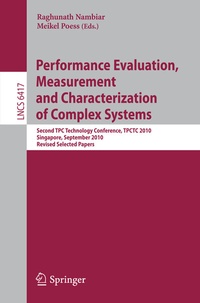
Performance Evaluation and Benchmarking
Second TPC Technology Conference, TPCTC 2010, Singapore, September 13-17, 2010. Revised Selected Papers
Published on 19. January 2011
XVI, 233 pages
978-3-642-18206-8 (ISBN)
Description

This book constitutes the proceedings of the Second Technology Conference on Performance Evaluation and Benchmarking, TPCTC 2010, held in conjunction with the 36th International Conference on Very Large Data Bases, VLDB 2010, in Singapore, September 13-17, 2010.
The 14 full papers and two keynote papers were carefully selected and reviewed from numerous submissions. This book considers issues such as appliance; business intelligence; cloud computing; complex event processing; database optimizations; data compression; energy and space efficiency, green computing; hardware innovations; high speed data generation; hybrid workloads; very large memory systems; and virtualization.
More details
Other editions
Additional editions
Raghunath Nambiar | Meikel Poess
Performance Evaluation and Benchmarking
Second TPC Technology Conference, TPCTC 2010, Singapore, September 13-17, 2010. Revised Selected Papers
Book
01/2011
1st Edition
Springer
€53.49
Shipment within 5-7 days
Content
- Title Page
- Preface
- TPCTC 2010 Organization
- About the TPC
- TPC 2010 Organization
- TPC 2010 Organization
- Table of Contents
- Transaction Processing Performance Council (TPC): State of the Council 2010
- Introduction
- Current Industry Standards
- TPC-E Benchmark
- TPC-C Benchmark
- TPC-H Benchmark
- Specifications Consistent across All Standards
- TPC-Pricing Specification
- TPC-Energy Specification
- Industry Standards under Development
- TPC-ETL Committee
- TPC-Virtualization Committee
- TPC Technology Conference and the Future of Benchmark Development
- References
- Liquid Benchmarks: Towards an Online Platform for Collaborative Assessment of Computer Science Research Results
- Introduction
- Motivating Scenarios
- Benchmarking Challenges in Computer Science
- Conceptual Model
- Liquid Benchmarks: Architecture and Implementation
- Conclusions and Outlook
- References
- A Discussion on the Design of Graph Database Benchmarks
- Introduction
- Graph Oriented Benchmarks
- Benchmark Considerations
- Analysis of Motivating Applications
- Graph Description
- Graph Operations
- Query Categorization
- Experimental Setting
- Conclusions
- References
- A Data Generator for Cloud-Scale Benchmarking
- Introduction
- Related Work
- Design Goals
- Platform Independence
- Extensibility
- Configurability
- Scalability
- High Performance
- Data Generation Approach
- Architecture
- Performance Evaluation
- Conclusion
- References
- How to Advance TPC Benchmarks with Dependability Aspects
- Introduction
- The Dependability Benchmarking Concept
- Metrics
- Faultload
- Levels of Dependability Testing in TPC Benchmarks
- Extending the Specification of TPC Benchmarks
- Including Dependability Metrics in TPC Benchmarks
- Defining the Faultload by Extending the ACID Tests
- The DBench-OLTP Dependability Benchmark, Example of Previous Work
- Unified Approach for Augmenting TPC Benchmarks
- Dependency Level Approach
- Dependability Metric Approach
- Conclusion and Future Steps
- References
- Price and the TPC
- Introduction
- Eroding Strengths of the Original Metrics
- Proposed Enhancements Included in This Paper
- Availability Date
- Availability Date - Proposed Enhancements for the TPC
- Hardware Pricing
- Hardware Pricing - Proposed Enhancements for the TPC
- Software Pricing
- Software Pricing - Proposed Enhancements for the TPC
- Maintenance Pricing
- Maintenance Pricing - Proposed Enhancements for the TPC
- The Relationship between the "TPC Price" and TCO
- Summary
- Another Alternative
- References
- Impact of Recent Hardware and Software Trends on High Performance Transaction Processing and Analytics
- Introduction
- Multicore
- Large Main Memories
- Storage Class Memories
- Database Appliances
- Transactional Memory
- Key Value Stores
- Cloud Computing
- Conclusions
- References
- EXRT: Towards a Simple Benchmark for XML Readiness Testing
- Introduction
- Related Benchmarking Work
- The EXRT Benchmark Design
- EXRT Database Design
- EXRT Queries and Updates
- EXRT Testing Procedure
- Preliminary Results
- Queries with XML Construction or Full Document Retrieval
- Queries that Extract Partial Documents
- Aggregation Queries
- Full Document Inserts and Deletes
- Sub-Document Insert, Delete, and Update Operations
- Conclusions and Future Work
- References
- Transaction Performance vs. Moore's Law: A Trend Analysis
- Introduction
- Background of TPC's OLTP Benchmarks and Why TPC-C Is Suitable for Long Term Trend Analysis
- History of TPC-C Revisions
- Why TPC-C Is a Good Candidate for Technology Trend Analysis
- Comparison of TPC-C Metrics with Moore's Law
- Comparison of TPC-C Performance with Moore's Law
- Comparison of TPC-C Price-Performance with Moore's Law
- Conclusion
- References
- TPC-V: A Benchmark for Evaluating the Performance of Database Applications in Virtual Environments
- Introduction
- State of Virtualization
- Benefits of Virtualized Servers
- Virtualization Benchmarks
- The Need for a Database-Centric Virtualization Benchmark
- Genesis of the TPC-V Benchmark
- TPC-V Properties
- Business and Application Environment
- The TPC-E Benchmark
- TPC-V Design Considerations
- Benchmark Development Status
- Challenges
- References
- First TPC-Energy Benchmark: Lessons Learned in Practice
- TPC-Energy Specification
- TPC-Energy Metrics Characteristics
- Intelligent Configuration
- The Benchmark Configuration
- TPC-E Benchmark Configuration
- TPC-C Benchmark Configuration
- Energy Measurement Configuration
- Reported Energy Configuration
- Power Measurable Unit
- PMU Substitution
- Power Analyzer Configuration
- Power Analyzer Range Settings
- Power Analyzer Accuracy Calculations
- Power Analyzer Connections to PMU
- Energy Measuring System
- Energy Measuring System Controller
- Power Temperature Daemon Manager
- Power Temperature Daemon
- Report Generator
- Tuning the SUT for Energy Efficiency
- System Configuration
- Experimental Data
- Conclusion
- References
- Using Solid State Drives as a Mid-Tier Cache in Enterprise Database OLTP Applications
- Introduction
- SSDs as a Mid-Tier General Purpose Cache in DBMSs
- Contribution
- Background and Related Work
- Implementation of an SSD Cache
- Software SSD Solution
- Hardware Solution
- Experiment Methodology and Infrastructure
- The Cost Model
- Benchmark Description
- System Configuration
- Experiment Methodology and Infrastructure
- All SSD vs. All HDD Solution
- Hardware SSD Caching Solution
- Software SSD Caching Solution
- Future Work
- Conclusion
- References
- Benchmarking Adaptive Indexing
- Introduction
- Related Work and Background
- Classic and Online Indexing
- Adaptive Indexing
- Traditional and Online Index Tuning Benchmarks
- Framework for Adaptive Indexing Benchmarks
- Stages of Adaptive Indexing
- Design Considerations
- Partial Reference Implementation
- General Experimental Setup
- Planting, Nursing, and Growing Stages
- Shorter Stages
- Multiple Workload Phases, Including Updates
- Outlook
- Summary
- References
- XWeB: The XML Warehouse Benchmark
- Introduction
- Related Work
- Relational Decision Support Benchmarks
- XML Benchmarks
- Reference XML Warehouse Model
- XWeB Specifications
- Principle
- Database Model
- Workload Model
- Sample Experiments
- Load Test
- Performance Test
- Conclusion and Perspectives
- References
- Benchmarking Using Basic DBMS Operations
- Introduction
- Benchmark Specifications
- Scan Queries
- Aggregation Queries
- Join Queries
- CPU Intensive Queries
- Index Queries
- Experimental Results
- Conclusions
- References
- Assessing and Optimizing Microarchitectural Performance of Event Processing Systems
- Introduction
- Background
- Assessing and Improving CPU Performance of EP Systems
- Workload
- Experiments: Setup and Methodology
- Preliminary Results
- Optimizing Internal Data Structures
- Improving Algorithms Efficiency at the CPU Level
- Optimizations in a Multi-query Scenario
- Optimizations on a Real EP System
- Conclusions and Future Work
- References
- Author Index
