

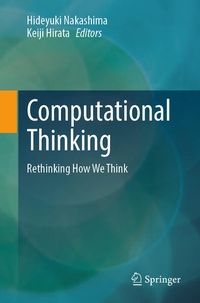
Computational Thinking
Description

This book introduces computational thinking, defining computational thinking as "thinking like a computer scientist." Chapter 1 explains the origins of computer science and its unique worldview by contrasting it with fields like physics and mathematics, while also addressing its relationship with programming, deep learning, and generative AI. Chapter 2 describes the practical benefits of applying computational thinking in the real world, introducing the essential concepts of abstraction, modeling, and virtualization. Chapter 3 introduces another essential concept, meta, and its related idea of self-reference. Chapter 4 introduces computational thinking perspectives in everyday activities such as cooking. Chapter 5 shares the findings regarding computational thinking from the perspective of a cognitive scientist with no background in computer science
This book is accessible to anyone interested in computational thinking, regardless of prior knowledge.
More details
Other editions
Additional editions
Persons
Hideyuki Nakashima is a researcher of artificial intelligence. He earned his PhD in engineering from the University of Tokyo in 1983. Having worked at Electrotechnical Laboratories (now AIST, 1983-2001), Future University Hakodate as president (2004-2016) and professor/president emeritus (2016 -), and the University of Tokyo as specially appointed professor (2016-2018), he is the president of Sapporo City University (2018-). He has held important roles in various academic communities, e.g., PRICAI steering committee (2003-) and chair (2016-), president of Japanese Cognitive Science Society. He is the editor of "Handbook of Ambient Intelligence and Smart Environments" (Springer, 2010).
Keiji Hirata is a director of Mirai Share Co., Ltd., and a researcher in music informatics and MaaS. He earned his PhD in engineering from the University of Tokyo in 1987. Having worked at NTT Basic Research Laboratories (1987-2011), the Institute for New Generation Computer Technology (ICOT, 1990-1993), and Future University Hakodate as professor (2011-) and vice president (2020-2023), he joined Mirai Share Co., Ltd. as a director in 2024. He has held important roles in various academic communities, e.g., the first chair of Special Interest Group on Music and Computer (1993), a member of the board of directors of Information Processing Society of Japan (2005-2007, 2011-2013), and the editor-in-chief of Digital Practice (2010-2015). He is a fellow of Information Processing Society of Japan.
Content
Chapter 1: What is Computational Thinking?.- Chapter 2: Practice of Computational Thinking.- Chapter 3: Meta.- Chapter 4: Life and Computational Thinking.- Chapter 5: Joy of Understanding Computational Thinking.
