

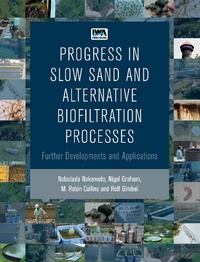
Progress in Slow Sand and Alternative Biofiltration Processes
Published on 14. May 2014
586 pages
978-1-78040-638-1 (ISBN)
Description

This book provides a state-of-the-art assessment on a variety of biofiltration water treatment systems from studies conducted around the world. The authors collectively represent a perspective from 23 countries and include academics/researchers, biofiltration system users, designers, and manufacturers.
Progress in Slow Sand and Alternative Biofiltration Processes - Further Developments and Applications offers technical information and discussion to provide perspective on the biological and physical factors affecting the performance of slow sand filtration and biological filtration processes. Chapters were submitted from the 5th International Slow Sand and Alternative Biological Filtration Conference, Nagoya, Japan in June 2014.
Authors: Nobutada Nakamoto, Shinshu University, Japan, Nigel Graham, Imperial College London, UK, M. Robin Collins, University of New Hampshire, Durham, NH, USA and Rolf Gimbel,Universitaet Duisburg, Essen, Germany.
Progress in Slow Sand and Alternative Biofiltration Processes - Further Developments and Applications offers technical information and discussion to provide perspective on the biological and physical factors affecting the performance of slow sand filtration and biological filtration processes. Chapters were submitted from the 5th International Slow Sand and Alternative Biological Filtration Conference, Nagoya, Japan in June 2014.
Authors: Nobutada Nakamoto, Shinshu University, Japan, Nigel Graham, Imperial College London, UK, M. Robin Collins, University of New Hampshire, Durham, NH, USA and Rolf Gimbel,Universitaet Duisburg, Essen, Germany.
More details
Language
English
Place of publication
London
United Kingdom
Target group
College/higher education
Professional and scholarly
File size
36,01 MB
ISBN-13
978-1-78040-638-1 (9781780406381)
Copyright in bibliographic data and cover images is held by Nielsen Book Services Limited or by the publishers or by their respective licensors: all rights reserved.
Schweitzer Classification
Other editions
Additional editions
Nobutada Nakamoto | Nigel Graham | Rolf Gimbel
Progress in Slow Sand and Alternative Biofiltration Processes
Book
05/2014
IWA Publishing
€206.50
Article exhausted; check different version
Content
- Cover
- Copyright
- Contents
- Preface
- Conference programme advisory panel
- Part I: General Overview
- Chapter 1: Slow Sand Filtration: Recent Research and Application Perspectives
- Chapter 2: A Review of Biologically-Based Drinking Water Treatment Processes for Organic Micropollutant Removal
- Chapter 3: Overview on the current condition of slow sand filtration and its challenges in Japan
- Chapter 4: The Centenary Slow Sand Filtration in Nagoya City - A 100 Year Trend of Water Quality
- Chapter 5: The centenary slow sand filtration in Nagoya City - the reconstruction of the slow sand filters
- Chapter 6: Value of Adenosine Tri-Phosphate and Total Cell Count for the assessment of general microbial water quality after sand filtration
- Chapter 7: Evaluation of dissolved organic matter fractions removal due to biodegradation
- Chapter 8: Comparison between different filter systems as a post treatment after tertiary ozonation
- Part II: Slow Sand Filtration - Process Behaviour
- Chapter 9: Food chain is the key in ecological purification system: new concept and new name of slow sand filter
- Chapter 10: A study of protistan movement speed and filtration rate in slow sand filter as an ecological purification system
- Chapter 11: Analysis of bacterial community structures in slow sand filtration bed on different region and soil depth by PCR-DGGE method
- Chapter 12: Gut bacterial floras of aquatic invertebrates inhabiting slow sand filter beds
- Chapter 13: The functioning of biological slow sand filtration in relation to the presence and the role of Annelids in the schmutzdecke
- Chapter 14: The inhibitory effect of Tubificid on head loss in slow sand filtration
- Chapter 15: Schmutzdecke development and treated water quality
- Chapter 16: The silicon circulation hypothesis based on slow sand filtration/ecological purification system
- Chapter 17: Effect of sudden changes of slow sand filtration rate on number of bacteria and particles in effluent
- Part III: Slow Sand Filtration - Treatment Performance
- Chapter 18: Slow sand filtration process model for removal of microorganisms
- Chapter 19: Removal of anti-inflammatory compounds by ecological filtration
- Chapter 20: Removal of bromophenols by slow sand filtration
- Chapter 21: The iron and manganese removal process: Its microbial habitats and functions
- Chapter 22: Biological iron removal from community water source - Corriverton, Republic of Guyana
- Chapter 23: Case studies of slow sand filtration/ecological purification system in small scale water supply
- Chapter 24: Water supply of a small community with a small slow sand filtration/ecological purification system unit
- Chapter 25: Refocus on slow sand filter in Kakuda city and Marumori town after Great East Japan Earthquake
- Chapter 26: Small slow sand filter system for rural area in Bolivia
- Part IV: Slow Sand Filtration - Process Developments
- Chapter 27: Switching on pesticide degraders in biological filters used in drinking water production
- Chapter 28: Bioaugmentation reduces negative effect of estrogens on coliform removal in slow sand filters
- Chapter 29: Reduction of water hardness with a compact slow sand filtration system
- Chapter 30: Installing a DIY-based home slow sand filter - Is it possible to make it without speciality?
- Chapter 31: Development of an unmanned operate system for a slow sand filter/ecological purification system
- Chapter 32: Process Optimization of Solar Energy Based Slow Sand Filtration
- Chapter 33: Performance of ecological purification system in Samoa
- Chapter 34: Household bio-purification device
- Chapter 35: A study to further reduce the turbidity level of slow sand filtered water in Tanigahara water purification plant, Japan
- Chapter 36: The countermeasure against the increase of disinfection by-products concentration by humic substances at a water purification plant using a slow sand filtration system
- Chapter 37: On the function of upflow roughing filter for slow sand filter - pilot experiment in Niigata, Japan
- Chapter 38: Enhancement of the efficiency of upflow slow sand filtration - effect of combined application with a fiber filter unit
- Chapter 39: Surface water treatment plant using ecological purification system in Bangladesh
- Chapter 40: Development of ecological purification unit for producing drinking water from organically polluted raw water (BOD~30 mg/L)
- Chapter 41: Slow sand and slow biochar filtration of raw wastewater
- Part V: Biosand Filters
- Chapter 42: Global Review of the Adoption, Use, and Performance of the Biosand Filter
- Chapter 43: Recent advances in household biosand filter design
- Chapter 44: Performance optimisation of household biosand filters
- Chapter 45: Optimizing intermittent slow sand filters (biosand) construction for more consistent microbial removals
- Chapter 46: Utilizing structural equation modeling as an evaluation tool for critical parameters of the biosand filter in a pilot study in Para, Brazil
- Chapter 47: Household filter to remove iron and nitrate for drinking water
- Chapter 48: Long-term performance evaluation of biosand filters modified with zero-valent iron
- Part VI: Alternative Biofiltration - Process Behaviour
- Chapter 49: Mechanisms of DOC removal from secondary effluents in a lab biofilter
- Chapter 50: Change of water treatment efficiency in the transition from granular activated carbon to biological activated carbon on an advanced water purification plant
- Chapter 51: Autotrophic growth competition between ammonia-oxidizing archaea and ammonia-oxidizing bacteria in biological activated carbon filter with nitrification potential
- Chapter 52: Influence of preozonation on the performance of subsequent bio-filter in water treatment under low temperature condition: Biomass and community analysis
- Chapter 53: Deterioration mechanisms of granular activated carbon in fluidized-bed contactor with biological and physical effects
- Chapter 54: Living-Filter: an in-reservoir biofiltration system for phytoplankton reduction at the abstraction point
- Part VII: Alternative Biofiltration - Treatment Performance
- Chapter 55: Removal of easily and more complex biodegradable NOM by full-scale BAC filters to produce biological stable drinking water
- Chapter 56: Renewal and selection of granular activated carbon in advanced drinking water purification in Tokyo
- Chapter 57: Biofilm accumulation characteristics of heterotrophic bacteria in tap water produced by biological activated carbon process
- Chapter 58: Manganese removal in BAC facilities without ozonation in water purification plants
- Chapter 59: Use of water sensitive urban design systems for biofiltration of urban stormwater: laboratory biodegradation batch studies
- Part VIII: Alternative Biofiltration - Process Developments
- Chapter 60: Applicability of spherical coconut shell activated carbon to biological activated carbon for advanced drinking water treatment
- Chapter 61: Development of biological roughing filter as an alternative to coagulation-sedimentation process
- Chapter 62: The environmentally-friendly effects of biotreatments in Osaka Water Supply Authority
- Chapter 63: Biofilm development in upflow gravel filters in layers with a fabric cover
- Chapter 64: Up-flow biological contact filter for advanced water treatment system
- Chapter 65: pH conditioning using limestone with upflow gravel filters
- Chapter 66: Upward biological contact filtration (U-BCF) in Vietnam
- Chapter 67: Biofiltration of pig manure: behavior of nitrogen compounds
- Chapter 68: Exploring sand and bentonite - enhanced sand as filter media for nitrate removal
- Part IX: River Bank Filtration and Groundwater Recharge
- Chapter 69: Reduction of the formation potentials of trihalomethanes (THMs) and haloacetic acids (HAAs) in reclaimed water by soil aquifer treatment
- Chapter 70: Removals of pharmaceuticals and personal care products in reclaimed water during soil aquifer treatment with different soil types, hydraulic retention time, and saturated condition
- Chapter 71: Behavior of trace organic contaminants in soil aquifer treatment (SAT) process for reuse of secondary sewage effluent
- Author Index
- Keyword Index
