

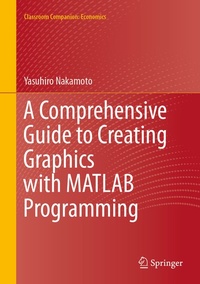
A Comprehensive Guide to Creating Graphics with MATLAB Programming
Description

This textbook teaches you how to use MATLAB to create high-quality graphs using student-friendly statistical data at a level of mathematics accessible to middle or high school students. With more than 500 illustrated examples, this book quickly guides you to the essential information you need to create and customize high-quality graphs without requiring advanced mathematical knowledge. MATLAB gives you complete control over the appearance of each component in your graph. For example, in addition to creating the main graph, such as a scatter plot, line graph, bar graph, or histogram, you can also customize lines, legends, captions, titles, axis labels, gridlines, and many other elements.
Whether you use this book for teaching and research or not, you will have the incredible power of MATLAB graphics at your fingertips.
More details
Other editions
Additional editions
Person
Yasuhiro Nakamoto
Yasuhiro Nakamoto is a professor in the Faculty of Informatics at Kansai University. He teaches MATLAB to undergraduate students at Kansai University. He holds a Ph.D. (Top Student) in Economics, awarded by Osaka University in 2009. He has worked at Kyushu Sangyo University and Freie Universität Berlin as an Alexander von Humboldt Fellow. He participated in the 5th Lindau Nobel Laureate Meetings in Economics.
His research focuses on two main topics. First, in the area of macroeconomic theory, he analyzes the effects of macroeconomic policies on welfare, income distribution, and natural resources, using MATLAB to effectively present the simulation results. Second, in the area of behavioral economics, he studies decision-making, focusing in particular on catastrophe insurance purchase decisions, the role of future simulations in individual decision-making, and goal-setting behavior. In this case, he uses MATLAB for both statistical graphics and statistical analysis. His manuscripts have been published in Journal of Economic Dynamics and Control, Environmental and Resource Economics, Economic Theory, Journal of Economics, Economic Letters, and International Tax and Public Economics, etc.
Content
Table of Contents.- Preface.- About the Author.- Chapter 1 Introduction.- Chapter 2 Importing Data.- Chapter 3 Scatter Function.- Chapter 4 Scatter3 Function.- Chapter 5 Plot Function.- Chapter 6 Plot3 Function.- Chapter 7 Bar Function.- Chapter 8 Bar3 Function.- Chapter 9 Barh Function.- Chapter 10 Bar3h Function.- Chapter 11 Histogram Function.- Chapter 12 Histogram2 Function.- Chapter 13 Boxchart Function.- Chapter 14 Piechart and Donutchart Functions.- Chapter 15 Plotmatrix Function.- Chapter 16 Bubblechart Function.- Chapter 17 Bubblechart3 Function.- Chapter 18 Useful Optional Functions.
