

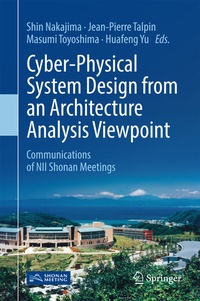
Cyber-Physical System Design from an Architecture Analysis Viewpoint
Description

CPS are based on a new design paradigm intended to enable emerging software-intensive systems. Embedded computers and networks monitor and control the physical processes, usually with the help of feedback loops where physical processes affect computations and vice versa. The principal challenges in system design lie in this constant interaction of software, hardware and physics. Developing reliable CPS has become a critical issue for the industry and society, because many applications such as transportation, power distribution, medical equipment and tele-medicine are dependent on CPS. Safety and security requirements must be ensured by means of powerful validation tools. Satisfying such requirements, including quality of service, implies having formally proven the required properties of the system before it is deployed.
The book is concerned with internationally standardized modeling languages such as AADL, SysML, and MARTE. As the effectiveness of the technologies is demonstrated with industrial sample cases from the automotive and aerospace sectors, links between the methods presented and industrial problems are clearly understandable. Each chapter is self-contained, addressing specific scientific or engineering problems, and identifying further issues. In closing, it includes perspectives on future directions in CPS design from an architecture analysis viewpoint.
More details
Other editions
Additional editions
Persons
Editors:
Shin Nakajima is a professor at the National Institute of Informatics (NII) and also a professor at the Graduate University for Advanced Studies (SOKENDAI). His research interests include formal methods, automated verification, and software testing.
Jean-Pierre Talpin is a senior research associate (directeur de recherche) with Inria and leads Inria project-team TEA (time, events and architectures). His research background ranges from type theory, programming languages, concurrency theory, code generation, scheduling, and verification to proof. His current research interests include the component-based design, analysis, verification, and integration of cyber-physical systems.Masumi Toyoshima is a research project manager at DENSO Corporation. His research background includes design of distributed computing systems and recent interest is Systems Engineering.
Huafeng Yu is a senior researcher with Boeing Research & Technology. He serves onIEEE Technical Committee on for Cyber-Physical Systems. His research interests include mobile autonomous systems, software architecture and safety, model-based engineering, and software certification.
