

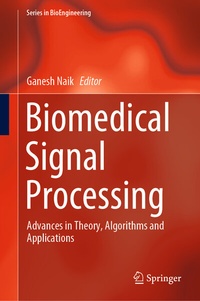
Biomedical Signal Processing
Description

This book reports on the latest advances in the study of biomedical signal processing, and discusses in detail a number of open problems concerning clinical, biomedical and neural signals. It methodically collects and presents in a unified form the research findings previously scattered throughout various scientific journals and conference proceedings. In addition, the chapters are self-contained and can be read independently. Accordingly, the book will be of interest to university researchers, R&D engineers and graduate students who wish to learn the core principles of biomedical signal analysis, algorithms, and applications, while also offering a valuable reference work for biomedical engineers and clinicians who wish to learn more about the theory and recent applications of neural engineering and biomedical signal processing.
More details
Other editions
Additional editions
Person
Ganesh Naik received his BE in Electronics and Communication Engineering from the University of Mysore, India, in 1997, his ME in Communication and Information Engineering from Griffith University, Brisbane, Australia, in 2002, and his PhD in Electronics Engineering, specializing in Biomedical Engineering and Signal Processing, from RMIT University, Melbourne, Australia, in 2009.
He is currently an academic and postdoctoral research fellow at MARCS Institute, Western Sydney University. Prior to that he held a Chancellor's Post-Doctoral Research Fellowship position at the Faculty of Engineering and Information Technology (FEIT), UTS. To date he has edited 11 books, and authored more than 100 book chapters and articles in peer-reviewed journals and conference proceedings. His research interests include EMG signal processing, pattern recognition, Blind Source Separation (BSS) techniques, biomedical signal processing, Human-Computer Interface (HCI) and audio signal processing.
At present, he is serving as an associate editor of IEEE ACCESS and two Springer journals. He is also a reviewer and member of the editorial board for several reputed journals. He was a recipient of the Baden-Württemberg Scholarship from the University of Berufsakademie, Stuttgart, Germany (2006-2007). In 2010, Dr Naik was awarded an ISSI overseas fellowship by the Skilled Institute in Victoria, Australia.
Content
Surface Electromyography (EMG) Signal Processing, Classification, and Practical Considerations.- Estimation of ankle joint torque and angle based on S-EMG signal for assistive rehabilitation robots.- Force Myography and its Application to Human Locomotion.- Comparison of Independence of Triceps Brachii and Biceps Brachii between Paretic and Non-Paretic side during different MVCs-A case study.- An EEG brain-computer interface to classify motor imagery signals.
