

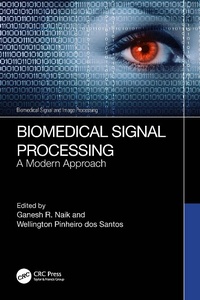
Biomedical Signal Processing
A Modern Approach
1st Edition
Published on 27. September 2023
294 pages
978-1-000-90648-6 (ISBN)
Description

This book presents the theoretical basis and applications of biomedical signal analysis and processing. Initially, the nature of the most common biomedical signals, such as electroencephalography, electromyography, electrocardiography and others, is described. The theoretical basis of linear signal processing is summarized, with continuous and discrete representation, linear filters and convolutions, Fourier and Wavelets transforms. Machine learning concepts are also presented, from classic methods to deep neural networks. Finally, several applications in neuroscience are presented and discussed, involving diagnosis and therapy, in addition to other applications.
Features:
Explains signal processing of neuroscience applications using modern data science techniques.
Provides comprehensible review on biomedical signals nature and acquisition aspects.
Focusses on selected applications of neurosciences, cardiovascular and muscle-related biomedical areas.
Includes computational intelligence, machine learning and biomedical signal processing and analysis.
Reviews theoretical basis of deep learning and state-of-the-art biomedical signal processing and analysis.
This book is aimed at researchers, graduate students in biomedical signal processing, signal processing, electrical engineering, neuroscience and computer science.
Features:
Explains signal processing of neuroscience applications using modern data science techniques.
Provides comprehensible review on biomedical signals nature and acquisition aspects.
Focusses on selected applications of neurosciences, cardiovascular and muscle-related biomedical areas.
Includes computational intelligence, machine learning and biomedical signal processing and analysis.
Reviews theoretical basis of deep learning and state-of-the-art biomedical signal processing and analysis.
This book is aimed at researchers, graduate students in biomedical signal processing, signal processing, electrical engineering, neuroscience and computer science.
More details
Series
Edition
1. Auflage
Language
English
Place of publication
London
United Kingdom
Publishing group
Taylor & Francis Ltd
Target group
College/higher education
Professional and scholarly
Product notice
Reflowable
Illustrations
53 Tables, black and white; 71 Line drawings, black and white; 5 Halftones, black and white; 76 Illustrations, black and white
ISBN-13
978-1-000-90648-6 (9781000906486)
Copyright in bibliographic data and cover images is held by Nielsen Book Services Limited or by the publishers or by their respective licensors: all rights reserved.
Schweitzer Classification
Other editions
Additional editions
Book
08/2025
1st Edition
CRC Press
€95.70
Shipment within 10-20 days
Book
09/2023
1st Edition
CRC Press
€222.84
Shipment within 10-20 days
Persons
Ganesh Naik ranked as Top 2% of researchers in Biomedical Engineering (Stanford University Research), is a leading expert in biomedical engineering and signal processing. He received his Ph.D. degree in Electronics Engineering, specializing in biomedical engineering and signal processing, from RMIT University, Melbourne, Australia, in December 2009.
He held a Postdoctoral Research Fellow position at MARCS Institute, Western Sydney University (WSU) between July 2017 to July 2020 and worked on a CRC project for sleep. During his tenure at WSU, he has developed several novel algorithms for wearables related to sleep projects. Before that, he held a Chancellor's Post-Doctoral Research Fellowship position in the Centre for Health Technologies, University of Technology Sydney (UTS), between February 2013 and June 2017. As an early mid-career researcher, he has edited 12 books, authored around 150 papers in peer-reviewed journals and conferences. Ganesh serves as an associate editor for IEEE ACCESS, Frontiers in Neurorobotics, and two Springer journals (Circuits, Systems, and Signal Processing and Australasian Physical & Engineering Sciences in Medicine). He is a Baden-Wuerttemberg Scholarship recipient from Berufsakademie, Stuttgart, Germany (2006-2007). In 2010, he was awarded an ISSI overseas fellowship from Skilled Institute Victoria, Australia.
Wellington Pinheiro dos Santos holds a degree in Electrical and Electronic Engineering (2001) and a Master's degree in Electrical Engineering (2003) from the Federal University of Pernambuco, and a PhD in Electrical Engineering from the Federal University of Campina Grande (2009). He is currently an Associate Professor (exclusive dedication) at the Department of Biomedical Engineering at the Center for Technology and Geosciences / School of Engineering of Pernambuco, Federal University of Pernambuco, working in the Undergraduate Program in Biomedical Engineering and the Graduate Program in Biomedical Engineering. He is also a member of the Graduate Program in Computer Engineering at Escola Politecnica de Pernambuco, Universidade de Pernambuco, since 2009. He has experience in the field of Computer Science, with an emphasis on Graphics Processing, working mainly in the following areas: topics: digital image processing, pattern recognition, computer vision, evolutionary computing, numerical optimization methods, computational intelligence, image formation techniques, virtual reality, game design and applications of Computing and Engineering in Medicine and Biology. He is a member of the Brazilian Society of Biomedical Engineering (SBEB), of the Brazilian Society of Computational Intelligence (SBIC, ex-SBRN), and of the International Federation of Medical and Biological Engineering (IFMBE).
He held a Postdoctoral Research Fellow position at MARCS Institute, Western Sydney University (WSU) between July 2017 to July 2020 and worked on a CRC project for sleep. During his tenure at WSU, he has developed several novel algorithms for wearables related to sleep projects. Before that, he held a Chancellor's Post-Doctoral Research Fellowship position in the Centre for Health Technologies, University of Technology Sydney (UTS), between February 2013 and June 2017. As an early mid-career researcher, he has edited 12 books, authored around 150 papers in peer-reviewed journals and conferences. Ganesh serves as an associate editor for IEEE ACCESS, Frontiers in Neurorobotics, and two Springer journals (Circuits, Systems, and Signal Processing and Australasian Physical & Engineering Sciences in Medicine). He is a Baden-Wuerttemberg Scholarship recipient from Berufsakademie, Stuttgart, Germany (2006-2007). In 2010, he was awarded an ISSI overseas fellowship from Skilled Institute Victoria, Australia.
Wellington Pinheiro dos Santos holds a degree in Electrical and Electronic Engineering (2001) and a Master's degree in Electrical Engineering (2003) from the Federal University of Pernambuco, and a PhD in Electrical Engineering from the Federal University of Campina Grande (2009). He is currently an Associate Professor (exclusive dedication) at the Department of Biomedical Engineering at the Center for Technology and Geosciences / School of Engineering of Pernambuco, Federal University of Pernambuco, working in the Undergraduate Program in Biomedical Engineering and the Graduate Program in Biomedical Engineering. He is also a member of the Graduate Program in Computer Engineering at Escola Politecnica de Pernambuco, Universidade de Pernambuco, since 2009. He has experience in the field of Computer Science, with an emphasis on Graphics Processing, working mainly in the following areas: topics: digital image processing, pattern recognition, computer vision, evolutionary computing, numerical optimization methods, computational intelligence, image formation techniques, virtual reality, game design and applications of Computing and Engineering in Medicine and Biology. He is a member of the Brazilian Society of Biomedical Engineering (SBEB), of the Brazilian Society of Computational Intelligence (SBIC, ex-SBRN), and of the International Federation of Medical and Biological Engineering (IFMBE).
Content
1. Signal Processing for Understanding Physiological Mechanisms for Information Decoding 2. Automated Recognition of Alzheimer's Dementia: A Review of Recent Developments in the Context of Interspeech ADReSS Challenges 3. Electrogastrogram Signal Processing: Techniques and Challenges with Application for Simulator Sickness Assessment 4. Impact of Cognitive Demand on the Voice Responses of Parkinson's Disease and Healthy Cohorts 5. Electroencephalography and Epileptic Discharge Identification 6. A Novel End-to-End Secure System for Automatic Classification of Cardiac Arrhythmia 7. Machine Learning for Detection and Classification of Motor Imagery in Electroencephalographic Signals 8. Emotion Recognition from Electroencephalographic and Peripheral Physiological Signals Using Artificial Intelligence with Explicit Features 9. Identification of Emotion Parameters in Music to Modulate Human Affective States: Towards Emotional Biofeedback as a Therapy Support 10. Updated ICA Weight Matrix for Lower Limb Myoelectric Classification 11. Cortical Correlates of Unilateral Transfemoral Amputees during a Balance Control Task with Vibrotactile Feedback 12. Assessing the Impact of Body Mass Index on Gait Symmetry of Able-Bodied Adults Using Pressure-Sensitive Insole 13. Analysis of Lower Limb Muscle Activities during Walking and Jogging at Different Speeds 14. Biosensors in Optical Devices for Sensing and Signal Processing Applications
