

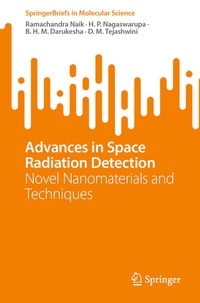
Advances in Space Radiation Detection
Description

This brief explores the development and enhancement of space radiation detection systems through the integration of advanced nanomaterials, specifically focusing on metal oxide nanomaterials such as ZrO2. It covers the synthesis, characterization, and thermoluminescence properties of these nanomaterials, as well as their incorporation into plastic scintillators to improve detection efficiency. The book also discusses the challenges and advancements in creating reliable radiation detection technology for space exploration, highlighting potential applications and future directions in the field. It is a useful resource for scientists and graduate students involved in the fields of space exploration, radiation detection technologies, and nanotechnology.
More details
Other editions
Additional editions
Persons
Dr. Ramachandra Naik is a distinguished Senior Assistant Professor of Physics at New Horizon College of Engineering, Bangalore, India, with an impressive academic background and a wealth of research experience spanning over 12 years. Dr. Naik has established himself as a prominent figure in the field, having published 59 research and review articles in reputable international journals. His research contributions focus on the synthesis of multifunctional inorganic metal oxides-based nanomaterials tailored for energy applications. As an accomplished author, Dr. Naik has authored six books and contributed chapters to five others.
Dr. H. P. Nagaswarupa is a distinguished Professor in the Department of Studies in Chemistry at Davangere University, India, with an extensive academic journey spanning over two decades.Having authored over 171 research papers in national and international journals, Dr. Nagaswarupa is a prolific researcher in the domains of Nano Science & Technology, Materials Science, and Corrosion Science.
Dr. Darukesha B.H.M is currently serving as Scientist-SG, Associate Director and Chief Information Officer for ISRO/Department of Space, Govt. of India at ISRO HQ, Bengaluru. He obtained a masters degree in Physics from Gulbarga University in 1997 and completed his Ph.D. degree in 2023 from IISc, Bengaluru. He has been practising Packaging of RF/Microwave microelectronic modules for Space applications for over 22 years. He is involved in the development of process technologies and modules. He has published several research papers in reputed national/international journals. He is a recipient of the Satellite Technology Day award for Down Trimming of Printed Resistors, Best process development award for the development of Hybrid Microcircuits and ISRO team excellence award for the Development of 1W heater for the propulsion systems. He is a life member of IMPAS India Chapter, Astronautical Society of India, Karnataka Physics Association, etc.
Tejashwini D. M. , presently works as a Research Scholar at the Department of Studies in Chemistry, Center for Device Development, Davangere University, Davanagere. Completed master's degree in Davangere University in 2022. Areas of interest comprise nanoscience & technology, green synthesis of nanomaterials, photocatalysis, electrochemical sensors, supercapacitors, and luminescence studies. She published two review articles and two research articles in international journals, co-authored 3 book chapters, presented 3 oral presentations at the international/national conferences, and attended more than 20 conference/seminars/workshops/webinars/ training programs during PhD program.
Content
Introduction to Space Radiation Detection.- Fundamentals of Nanomaterial Synthesis.- Characterization of Metal Oxide Nanomaterials.- Thermoluminescence Properties of Metal Oxide Nanomaterials.- Integration of ZrO2 Nanomaterials into Scintillation Detectors.- Enhancing Efficiency of Plastic Scintillators.- Applications of Advanced Radiation Detection Systems.- Conclusion and Future Perspectives.
