

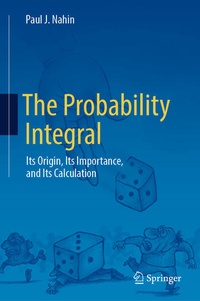
The Probability Integral
Description

This book tells the story of the probability integral, the approaches to analyzing it throughout history, and the many areas of science where it arises. The so-called probability integral, the integral over the real line of a Gaussian function, occurs ubiquitously in mathematics, physics, engineering and probability theory. Stubbornly resistant to the undergraduate toolkit for handling integrals, calculating its value and investigating its properties occupied such mathematical luminaries as De Moivre, Laplace, Poisson, and Liouville. This book introduces the probability integral, puts it into a historical context, and describes the different approaches throughout history to evaluate and analyze it. The author also takes entertaining diversions into areas of math, science, and engineering where the probability integral arises: as well as being indispensable to probability theory and statistics, it also shows up naturally in thermodynamics and signal processing. Designed to be accessible to anyone at the undergraduate level and above, this book will appeal to anyone interested in integration techniques, as well as historians of math, science, and statistics.
More details
Other editions
Additional editions
Person
Paul J. Nahin is professor emeritus of electrical engineering at the University of New Hampshire. He is the author of 21 books on mathematics, physics, and the history of science, published by Springer, and the university presses of Princeton and Johns Hopkins. He received the 2017 Chandler Davis Prize for Excellence in Expository Writing in Mathematics (for his paper "The Mysterious Mr. Graham," The Mathematical Intelligencer , Spring 2016). He gave the invited 2011 Sampson Lectures in Mathematics at Bates College, Lewiston, Maine.
Content
Chapter 1. De Moivre and the Discovery of the Probability Integral.- Chapter 2. Laplace's First Derivation.- Chapter 3. How Euler Could Have Done It Before Laplace (but did he?).- Chapter 4. Laplace's Second Derivation.- Chapter 5. Generalizing the Probability Integral.- Chapter 6. Poisson's Derivation.- Chapter 7. Rice's Radar Integral.- Chapter 8. Liouville's Theorem that Has No Finite Form.- Chapter 9. How the Error Function Appeared in the Electrical Response of the Trans-Atlantic Telegraph Cable.- Chapter 10. Doing the Probability Integral with Differentiation.- chapter 11. The Probability Integral as a Volume.- Chapter 12. How Cauchy Could Have Done It (but didn't).- Chapter 13. Fourier Has the Penultimate Technical Word.- Chapter 14. Finbarr Holland Has the Last Technical Word.- Chapter 15. A Final Comment on Mathematical Proofs.
