

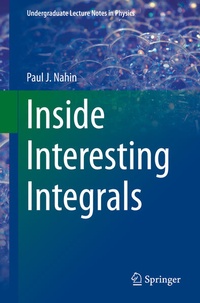
Inside Interesting Integrals
Description

What's the point of calculating definite integrals since you can't possibly do them all?.
What makes doing the specific integrals in this book of value aren't the specific answers we'll obtain, but rather the methods we'll use in obtaining those answers; methods you can use for evaluating the integrals you will encounter in the future.
This book is written in a light-hearted manner for students who have completed the first year of college or high school AP calculus and have just a bit of exposure to the concept of a differential equation. Every result is fully derived. If you are fascinated by definite integrals, then this is a book for you.
Reviews / Votes
"The main purpose of the author is not to calculate specific integrals and obtain specific answers, but to present several tricks and methods which are used to obtain those answers. . The book is published in the series Undergraduate Lecture Notes in Physics and it will probably be physicists and students of physics who will be the majority of its readers. . mathematicians also may find many interesting things there." (Krzysztof Ciesielski, Mathematical Reviews, July, 2015)
More details
Other editions
Additional editions
Person
Paul Nahin was born in California, and did all of his schooling there (Brea-Olinda High 1958, Stanford BS 1962, Caltech MS 1963 and - as a Howard Hughes Staff Doctoral Fellow - UC/Irvine PhD 1972, with all degrees in electrical engineering). He has taught at Harvey Mudd College, the Naval Postgraduate School and the Universities of New Hampshire (where he is now emeritus professor of electrical engineering) and Virginia.
Prof. Nahin has published a couple of dozen short science fiction stories in ANALOG, OMNI and TWILIGHT ZONE magazines, and has written 14 books on mathematics and physics. He has given invited talks on mathematics at Bowdoin College, the Claremont Graduate School, the University of Tennessee and Caltech, has appeared on National Public Radio's "Science Friday" show (discussing time travel) as well as on New Hampshire Public Radio's "The Front Porch" show (discussing imaginary numbers) and advised Boston's WGBH Public Television's "Nova" program on the script for their time travel episode. He gave the invited Sampson Lectures for 2011 in Mathematics at Bates College (Lewiston, Maine).
