

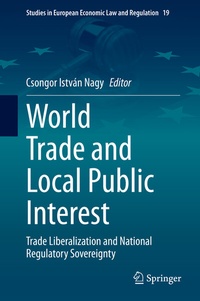
World Trade and Local Public Interest
Description

Trade liberalization has shaped international economic relations since the conclusion of the GATT 1947. The last few decades have seen a significant shift in the focus of this process: multilateralism seems to have reached its limits, giving way to regionalism, and the focus of trade liberalization has shifted to non-tariff barriers. While these developments have attracted considerable attention, exploring them from comparative perspectives has been largely neglected. Trading systems - the WTO, regional economic integrations and federal systems - are all based on the same dichotomy of free trade and local public interest: they generally prohibit the constituent parties (states) from restricting trade, but exempt them from this limitation if the restriction is warranted by a legitimate local end.
The purpose of this volume is to contribute to filling the above-mentioned research gap by exploring central issues in regional economic integrations from a comparativeperspective. It provides a general economic analysis of the costs and benefits of trade liberalization and the role and function of normative values in commercial policy. This is followed by a comparative analysis of the approaches used in various regional economic integrations (in North America, Europe and Latin America) and federal markets (the United States, Australia and India) regarding the balance between free trade and local public interest. Key issues in investment law, one of the most contentious elements of next-generation free trade agreements, are also addressed.
More details
Other editions
Additional editions
Person
Csongor István Nagy is professor of law at and head of the Department of Private International Law at the University of Szeged. He is recurrent visiting professor at the Central European University (Budapest/New York), the Sapientia University of Transylvania (Romania) and the Riga Graduate School of Law (Latvia) and associate member at the Centre for Private International Law at the University of Aberdeen. He is admitted to the Budapest Bar and arbitrator at the Court of Arbitration attached to the Hungarian Chamber of Commerce and Industry, Budapest.
