

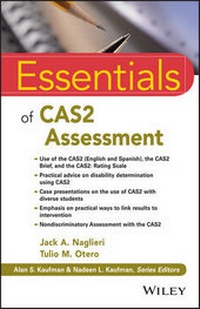
Essentials of CAS2 Assessment
Description

Essentials of CAS2 Assessment is a comprehensive guide to the successful administration of the updated CAS2. Written by leading cognitive assessment experts, the book discusses the latest research and thinking on PASS (Planning, Attention-Arousal, Simultaneous and Successive) theory and includes case studies that demonstrate the use of CAS2 with several types of diagnostic groups and integration with other instruments. A companion website offers additional tools and information to help busy professionals make optimal use of the CAS2.
This is the first book to provide comprehensive, step-by-step guidelines for administering, scoring, and interpreting the latest edition of the Cognitive Assessment System (CAS2). While the outcome of the test depends upon the child's performance, the reliability and accuracy of the analysis depends largely upon the performance of the test administrator. Essentials of CAS2 Assessment offers detailed insight on topics such as:
* Fair assessment of diverse populations
* Assessment of children with comorbid conditions
* Changes to the CAS2 rating scale and form
* Nuances of the three-tier model
Each chapter in the book highlights key concepts, bulleted points, and actual test questions. The CAS2 is a valuable tool in the detection of learning disabilities, ADHD, TBI, retardation, and giftedness. Essentials of CAS2 Assessment is the guidebook professionals need to ensure the CAS2 test is applied and analyzed accurately so that the results can be applied to the maximum benefit of the child.
All prices
More details
Other editions
Additional editions
Persons
TULIO M. OTERO, PHD, is Associate Professor at The Chicago School of Professional Psychology, where he teaches in both the school psychology and clinical psychology programs. He is a practicing school psychologist and consultant with a specialization in clinical neuropsychology, is past president of the Hispanic Neuropsychological Society, and co-author of the Spanish edition of the Cognitive Assessment System, 2nd Edition.
Content
Preface xv
Acknowledgments xix
One Overview 1
Introduction to CAS2 7
Description of the CAS2 Measures 9
CAS2 9
Uses of the CAS2 19
Theoretical Foundation 20
Standardization, Reliability, and Validity 29
Operationalization of PASS Theory in the
Three CAS2 Measures 33
PASS Relationship to Achievement 33
Race and Ethnic Differences 36
Detecting Learning Problems 39
PASS and Academic Interventions 41
Planning Facilitation 42
PREP and COGENT 44
Test Yourself 46
Two Administration and Scoring of the CAS2, CAS2: Brief, and CAS2: Rating Scale 49
Appropriate Testing Conditions 49
Administration of CAS2 61
Scoring the CAS2 71
Administration of CAS2: Brief 81
Scoring the CAS2: Brief 85
Administration of CAS2: Rating Scale 86
Scoring the CAS2: Rating Scale 86
Test Yourself 88
Three Interpretation 93
CAS2 Interpretation 94
Essential Steps for CAS2, CAS2: Brief, and CAS2: Rating Scale 97
Advanced Steps for CAS2 Interpretation 106
Using CAS2 Online 119
Test Yourself 128
Four Assessment of English Language Learners 129
Context for Understanding the Need for Fair Assessment with English Language Learners 129
Understanding Language Development and ELLs 130
The Challenges of ELL Assessment 132
Current Options for Testing ELL Students 134
Case Illustration 141
Test Yourself 145
Five Intervention 147
Jack A. Naglieri and Steven Feifer
Intervention's Essential Components 148
Assessment of Reading 159
CAS2 and Mathematics 164
Test Yourself 179
Six Strengths and Weaknesses of CAS2 181
Theoretical 182
Specific Learning Disability Eligibility 185
Practical Issues 186
Nondiscriminatory Assessment 188
Test Yourself 191
Seven Clinical Applications of the CAS2 193
Specific Learning Disabilities 193
Attention-Deficit/Hyperactivity Disorder 211
Autism 229
Traumatic Brain Injury 234
Gifted and Talented Students 240
Intellectual Disability 244
Test Yourself 255
Appendix A CAS2 KTEA-3 Comparisons 257
Appendix B CAS2 and WIAT-III Comparisons 261
Appendix C CAS2 and WJ-IV Achievement Comparisons 265
Appendix D CAS2 and Feifer Assessment of Reading (FAR) 269
Appendix E CAS2 and Feifer Assessment of Math (FAM) 271
Appendix F CAS2 and Bateria III 273
References 277
About the Authors 289
Index 291
Chapter One
OVERVIEW
In 1905 Alfred Binet published the first edition of what would become, about 100 years later, the Stanford-Binet V (Roid, 2003). Fifteen years after the first Binet scale, Yoakum and Yerkes published the Army Mental Tests (1920), on which the Wechsler Intelligence scales (originally published in 1939) were largely based. These measures of IQ all contained test questions that have verbal, quantitative, and nonverbal (spatial) content. The view that an intelligence test should include measures that require knowledge of vocabulary and quantitative concepts has been the basis of both group as well as individually administered IQ tests for a century (Naglieri, 2015).
IQ tests took an important evoluationary step when Alan and Nadeen Kaufman published the K-ABC in 1983. Their approach was revolutionary: take verbal and quantitative measures out of the measurment of ability and use a conceptualization of intelligence to guide the inclusion of subtests. A second evolutionary step in the advancement of intelligence and its measurement was provided in 1997 when Naglieri and Das published the Cognitive Assessment System (CAS). That approach was simlar to the one taken by the Kaufmans in so far as subtests requiring knowledge of vocabulary and arithmetic were excluded. The CAS was unique in that it contained four scales following Luria's (1973) view of four brain-based abilities. The goal was to provide a new way of defining ability based on a cognitive and neuropsychological theory and develop a test to measure these basic psychological processing abilities. The K-ABC and the CAS departed from the traditional approach to IQ because of content differences and their strong conceptual basis.
There has been an evolution in thinking about what a test of ability should be. First, there are traditional IQ tests in which verbal and quantiative test questions are an intergral part of the scales. In these instruments, vocabulary, block building, and arithmetic are considered fundamental and important ways to measure ability. More recently these tests have been partitioned in more subscales based on combining subtests into new categories conceptualized from a varieity of models. For example, although Wechsler originally had Verbal and Performance IQ scales, now the Wechsler Intelligence Scale for Children, Fifth Edition (Wechsler, 2014), has scales labeled Verbal Comprehension, Visual Spatial, Fluid Reasoning, Working Memory, and Processing Speed (see Naglieri, 2016a, for a review of the WISC-V). The content of the test, however, remains remarkably the same as what was in the Wechsler-Bellevue 1939 edition.
DON'T FORGET 1.1
Psychology advanced considerably during the 20th century, especially in the knowledge of specific abilities and the essential cognitive processes that make up intelligence. Our tests of ability should reflect that evolution.
Rapid Reference 1.1
Stanford-Binet Scales
1905 First Binet scale is published by Binet and Simon, subsequently revised in 1908. 1909 Goddard translates Binet-Simon from French to English. 1916 Terman publishes the Stanford revision and extension of the Binet-Simon scale that is normed on American children and adolescents and is widely used. 1937 Terman and Merrill publish a revision of the 1916 scale called the Stanford-Binet Intelligence Scale. 1960 Stanford-Binet, Form LM (Second Edition) 1972 Stanford-Binet, Form LM (Third Edition) 1986 Stanford-Binet, Fourth Edition (by Thorndike, Hagen, & Sattler) 2003 Stanford-Binet, Fifth Edition
There is a stark contrast between traditional IQ tests and the CAS (Naglieri & Das, 1997) and CAS2 as well as the K-ABC (Kaufman & Kaufman, 1983) and K-ABC-II. The essential difference between CAS (and CAS2) and traditional IQ tests relies on two main points. First, PASS (Planning, Attention, Simultaneous, and Successive) theory (see following discussion) was used to build the test and, second, CAS2 (similar to the CAS) does not have test questions that are better described as knowledge (i.e., information, similarities, vocabulary, comprehension, arithmetic) (see Naglieri & Bornstein, 2003). For these two reasons, CAS2 is not the same as a traditional IQ tests exemplified by the Binet and Wechsler scales. This raises the question: "Why use the CAS and CAS2?"
Rapid Reference 1.2
Wechsler Scales
1939 Wechsler-Bellevue, Form I 1946 Wechsler-Bellevue, Form II 1949 Wechsler Intelligence Scale for Children (WISC) 1955 Wechsler Adult Intelligence Scale (WAIS) 1967 Wechsler Preschool and Primary Scale of Intelligence 1974 WISC-Revised 1981 WAIS-Revised 1989 WPPSI-Revised 1991 WISC-III 1997 WAIS-III 2003 WISC-IV 2008 WAIS-IV 2014 WISC-V
One of the most important services professionals in this field provide is a thorough assessment of a person's abilities to answer important questions such as, "Why is the student having trouble learning?" and "How can instruction be modified to improve the student's learning?" IQ tests have been used with varying degrees of effectiveness to determine, for example,?if a learning disability exists and to explain poor performance in school. Researchers have found that traditional IQ tests have three main weaknesses. First, because the content of the verbal and quantitative questions is so similar to academic skills taught in the classroom, these tests unfairly penalize students or adults with limited educational opportunity, especially to acquire the English language (Naglieri, 2008a). Second, IQ tests have been shown to be insensitive to the cognitive problems experienced by those with, for example, specific learning disability (SLD), traumatic brain injury (TBI), and attention-deficit/hyperactivity disorder (ADHD) (Naglieri & Goldstein, 2009). Finally, attempts to use the information from IQ tests to design academic instruction have been disappointing. These limitations of traditional IQ tests provided the impetus to consider an alternative view of intelligence, which led us to the PASS theory as measured by CAS2.
DON'T FORGET 1.2
The test you select has a profound impact on what you learn about a student and what you can do to help that student.
When Naglieri and Das (1997) published the first edition of the CAS, they stated clearly that this test was based on one theory of ability. This was the first time a test of ability was built on a specific theory. That theory was chosen because of its relationship to neuropsychology as described by A. R. Luria (1973) (see Naglieri & Otero, 2011). The genius of Luria has been widely recognized and demonstrated by the considerable volume of his writings and the application of his ideas in numerous settings and places around the world.
In his book The Working Brain: An Introduction to Neuropsychology (1973), Luria described four neurocognitive processing abilities associated with three functional units of the brain. The first ability is Planning, which is a mental activity that provides cognitive control; use of processes, knowledge, and skills; intentionality; organization; and self-monitoring and self-regulation. This processing ability is closely aligned with frontal lobe functioning (third functional unit). Attention is the ability to demonstrate focused, selective, sustained, and effortful activity over time and resist distraction associated with the brain stem and other subcortical aspects (first functional unit). Simultaneous processing ability provides a person with the ability to integrate stimuli into interrelated groups or a whole usually found (but not limited to) on tasks with strong visual-spatial demands. Successive processing ability involves working with stimuli in a specific serial order, including the perception of stimuli in sequence and the linear execution of sounds and movements. It is clear from this brief explanation that PASS is very different from traditional IQ assessment, which is why researchers have found it to be more effective.
Since the publication of the first edition of the CAS there has been considerable research on the theory and the test. Naglieri (2012) and Naglieri and Otero (2011) suggested that the PASS theory has a very strong research foundation that continues to grow. For example, researchers have?shown the following:
- Individuals with distinct...
