

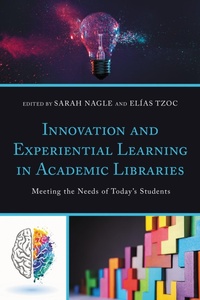
Innovation and Experiential Learning in Academic Libraries
Meeting the Needs of Today's Students
1st Edition
Published on 15. March 2022
222 pages
978-1-5381-5185-3 (ISBN)
Description

As technology advances and the skills required for the future workforce continue to change rapidly, academic libraries have begun to expand the definition of information literacy and the type of library services they provide to better prepare students for the constantly-developing world they will face upon graduation. More than teaching the newest technologies, information literacy is expanding to help students develop enduring skills such as critical thinking, creativity, problem solving, communication, teamwork, and more. Innovation and Experiential Learning in Academic Libraries: Meeting the Needs of 21st Century Students addresses the multitude of ways that academic librarians are collaborating with faculty and helping students develop these enduring skills by developing and integrating active and experiential learning approaches into teaching activities.
This book is divided into three sections. The first section explores the role that library leaders play in supporting and advocating for innovation in information literacy and library services. The second section features case studies from librarians who are implementing novel and multidisciplinary approaches to information literacy and innovative services, such as maker scholarship, digital humanities, undergraduate research experiences, and new active learning strategies. These case studies also highlight how the COVID-19 pandemic has transformed teaching and learning in academic libraries. The final section looks to the future, providing guidance to information professionals on the issues and technologies that will drive transformations of information literacy in the coming years, such as artificial intelligence and new information literacy applications. As such, library administrators, academic librarians, information literacy practitioners, and technologists will benefit from this book.
This book is divided into three sections. The first section explores the role that library leaders play in supporting and advocating for innovation in information literacy and library services. The second section features case studies from librarians who are implementing novel and multidisciplinary approaches to information literacy and innovative services, such as maker scholarship, digital humanities, undergraduate research experiences, and new active learning strategies. These case studies also highlight how the COVID-19 pandemic has transformed teaching and learning in academic libraries. The final section looks to the future, providing guidance to information professionals on the issues and technologies that will drive transformations of information literacy in the coming years, such as artificial intelligence and new information literacy applications. As such, library administrators, academic librarians, information literacy practitioners, and technologists will benefit from this book.
More details
Series
Edition
1. Auflage
Language
English
Place of publication
New York
United States
Publishing group
Bloomsbury Publishing Plc
Illustrations
13 b/w photos; 4 tables
ISBN-13
978-1-5381-5185-3 (9781538151853)
Copyright in bibliographic data and cover images is held by Nielsen Book Services Limited or by the publishers or by their respective licensors: all rights reserved.
Schweitzer Classification
Other editions
Additional editions
Sarah Nagle | Elias Tzoc
Innovation and Experiential Learning in Academic Libraries
Meeting the Needs of Today's Students
Book
03/2022
Rowman & Littlefield Publishers
€83.80
Shipment within 3-4 weeks
Persons
After earning her MSLIS from the University of Illinois Urbana-Champaign in 2015, Sarah Nagle spent 3 years as a librarian at Pikes Peak Library District in Colorado where she worked to provide engaging programming for all ages and ability levels in the district's makerspaces. Sarah now serves as Creation and Innovation Services Librarian at Miami University in Ohio. After opening a Makerspace at Miami's King Library with her colleagues in 2019, Sarah supports learning in the space with one-on-one and group instruction on a variety of maker and innovation topics. She works with faculty from a wide range of disciplines to incorporate maker-centered learning into courses.
Elias Tzoc is a 2007 graduate of the University of Texas at Austin, School of Information. He joined Miami University in August 2007. He is currently the Head of the Create and Innovate Department, where he leads a group of seven creative librarians and technologists working on innovative and entrepreneurial library services that support transdisciplinary research and scholarship at Miami University. His publications include articles related to innovation and digital scholarship.
Elias Tzoc is a 2007 graduate of the University of Texas at Austin, School of Information. He joined Miami University in August 2007. He is currently the Head of the Create and Innovate Department, where he leads a group of seven creative librarians and technologists working on innovative and entrepreneurial library services that support transdisciplinary research and scholarship at Miami University. His publications include articles related to innovation and digital scholarship.
Content
Series Editor's Foreword - Trudi Jacobson
Introduction - Jerome Conley
Section 1: Innovation and Leadership
Chapter 1: Planning, Advocating and Fostering Creativity and Innovation - Elías Tzoc
Chapter 2: Leadership for Innovation: Strategies and Considerations - Bohyun Kim
Chapter 3: Bringing Experiential Learning to Campus: How to Develop Partnerships and Implement Immersive Learning Experiences - Andrew See and Chris Holthe
Section 2: Examples and Case Studies
Chapter 4: Leading by Design: Building an Experiential Studio to Support Interdisciplinary Learning - Emily S. Darowski, Matt Armstrong, and Leanna Fry
Chapter 5: Creative Deconstruction: Using Zines to Teach the ACRL Framework - Stefanie Hilles
Chapter 6: LEGOTM, the Library, and a Mastodon Tusk: Undergraduate Research Partnerships in Chemistry - Anne Marie Gruber and Dr. Joshua Sebree
Chapter 7: Out of the Archives: Making Collections Accessible through the Implementation of a 3D Scanning Lab - Kristi Wyatt and Dr. Zenobie S. Garrett
Chapter 8: Collaborative Implementation of a Semi-Automated 3D Printing Service - Amy Van Epps, Matt Cook, and Susan Berstler
Chapter 9: Making Space for Non-Traditional Makers - Annalise Philips and Jen Brown
Section 3: Future Literacy Developments
Chapter 10: Maker Literacy, Metaliteracy, and the ACRL Framework - Sarah Nagle
Chapter 11: Off the Cutting Edge: Lessons Learned From Centering People in Creative Technology Spaces - Kelsey Sheaffer, Oscar K. Keyes, Eric Johnson, Jason Evans Groth, Vanessa Rodriguez, and Emily Thompson
Chapter 12: Developing an Engati-based Library Chatbot to Improve Reference Services - Shu Wan
About the Editors and the Contributors
Introduction - Jerome Conley
Section 1: Innovation and Leadership
Chapter 1: Planning, Advocating and Fostering Creativity and Innovation - Elías Tzoc
Chapter 2: Leadership for Innovation: Strategies and Considerations - Bohyun Kim
Chapter 3: Bringing Experiential Learning to Campus: How to Develop Partnerships and Implement Immersive Learning Experiences - Andrew See and Chris Holthe
Section 2: Examples and Case Studies
Chapter 4: Leading by Design: Building an Experiential Studio to Support Interdisciplinary Learning - Emily S. Darowski, Matt Armstrong, and Leanna Fry
Chapter 5: Creative Deconstruction: Using Zines to Teach the ACRL Framework - Stefanie Hilles
Chapter 6: LEGOTM, the Library, and a Mastodon Tusk: Undergraduate Research Partnerships in Chemistry - Anne Marie Gruber and Dr. Joshua Sebree
Chapter 7: Out of the Archives: Making Collections Accessible through the Implementation of a 3D Scanning Lab - Kristi Wyatt and Dr. Zenobie S. Garrett
Chapter 8: Collaborative Implementation of a Semi-Automated 3D Printing Service - Amy Van Epps, Matt Cook, and Susan Berstler
Chapter 9: Making Space for Non-Traditional Makers - Annalise Philips and Jen Brown
Section 3: Future Literacy Developments
Chapter 10: Maker Literacy, Metaliteracy, and the ACRL Framework - Sarah Nagle
Chapter 11: Off the Cutting Edge: Lessons Learned From Centering People in Creative Technology Spaces - Kelsey Sheaffer, Oscar K. Keyes, Eric Johnson, Jason Evans Groth, Vanessa Rodriguez, and Emily Thompson
Chapter 12: Developing an Engati-based Library Chatbot to Improve Reference Services - Shu Wan
About the Editors and the Contributors
