

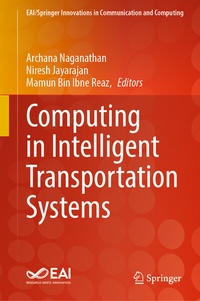
Computing in Intelligent Transportation Systems
Description

This book presents various application areas of computing in the automotive sector. The authors explain how computing enhances the performance of vehicles, covering the applications of computing in smart transportation and the future scope. The authors focus on computing for vehicle safety in conjunction with the latest technologies in Internet of Things (IoT). The book provides a holistic approach to computing in an inter-disciplinary and unified view. Topics covered include driverless automated navigation systems, smart transportation, self-learning systems, in-vehicle intelligent systems, and off-road vehicle diagnosis and maintenance, among others. The authors include simulated examples and case studies for better understanding of the technologies and applications. The book is intended for a wide range of readers from students to researchers and industry practitioners and is a useful resource for those planning to pursue research in the area of computing and autonomous driving vehicles.
More details
Other editions
Additional editions
Persons
Archana Naganathan is an Assistant Professor in the Department of Electrical and Electronics Engineering, PSG College of Technology, Coimbatore, India. Her research interests cover the areas of Power Electronics, Optimisation techniques and Hybrid Electric Vehicles. She has completed a DST sponsored project in the area of deep learning. She is a member of the Institute of Engineers, India. She holds a PhD from Anna University, Chennai, India.
Niresh Jayarajan is an Assistant Professor in the Department of Automobile Engineering, PSG College of Technology, and Coimbatore, India. His research interests are in Electric & Hybrid Vehicles, Drone Technologies, and Energy Management Systems. He is a member of the Society of Automotive Engineers and Institute of Engineers, India. He holds a PhD Degree from Anna University, Chennai, India.
Mamun Bin Ibne Reaz was born in Bangladesh, in December 1963. He received his B.Sc. and M.Sc. degree in Applied Physics and Electronics, both from University of Rajshahi, Bangladesh, in 1985 and 1986, respectively. He received his D.Eng. degree in 2007 from Ibaraki University, Japan. He is currently a Professor in the Dept. of Electrical, Electronic and Systems Engineering, Faculty of Engineering and Built Environment, Universiti Kebangsaan Malaysia, Malaysia involving in teaching, research and industrial consultation. He is a Senior Associate of the Abdus Salam International Centre for Theoretical Physics (ICTP), Italy since 2008. He is also a Senior Member of IEEE. He has vast research experiences in Japan, Italy and Malaysia. He has published extensively in the area of IC Design, Biomedical application IC and Smart Home. He is author and co-author of more than 300 research articles in design automation, IC design for biomedical applications and Smart Home. He is also the recipients of more than 50 research grants(national and international).
