

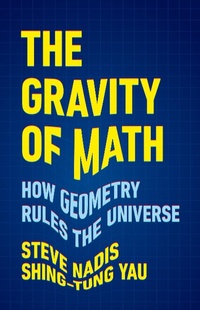
The Gravity of Math
How Geometry Rules the Universe
Published on 16. April 2024
272 pages
978-1-5416-0430-8 (ISBN)
Description

"A must-read."―Avi Loeb, New York Times-bestselling author of Extraterrestrial
One of the preeminent mathematicians of the past half century shows how physics and math were combined to give us the theory of gravity and the dizzying array of ideas and insights that has come from it
Mathematics is far more than just the language of science. It is a critical underpinning of nature. The famed physicist Albert Einstein demonstrated this in 1915 when he showed that gravity-long considered an attractive force between massive objects-was actually a manifestation of the curvature, or geometry, of space and time. But in making this towering intellectual leap, Einstein needed the help of several mathematicians, including Marcel Grossmann, who introduced him to the geometrical framework upon which his theory rest.
In The Gravity of Math, Steve Nadis and Shing-Tung Yau consider how math can drive and sometimes even anticipate discoveries in physics. Examining phenomena like black holes, gravitational waves, and the Big Bang, Nadis and Yau ask: Why do mathematical statements, derived solely from logic, provide the best descriptions of our physical world?
The Gravity of Math offers an insightful and compelling look into the power of mathematics-whose reach, like that of gravity, can extend to the edge of the universe.
One of the preeminent mathematicians of the past half century shows how physics and math were combined to give us the theory of gravity and the dizzying array of ideas and insights that has come from it
Mathematics is far more than just the language of science. It is a critical underpinning of nature. The famed physicist Albert Einstein demonstrated this in 1915 when he showed that gravity-long considered an attractive force between massive objects-was actually a manifestation of the curvature, or geometry, of space and time. But in making this towering intellectual leap, Einstein needed the help of several mathematicians, including Marcel Grossmann, who introduced him to the geometrical framework upon which his theory rest.
In The Gravity of Math, Steve Nadis and Shing-Tung Yau consider how math can drive and sometimes even anticipate discoveries in physics. Examining phenomena like black holes, gravitational waves, and the Big Bang, Nadis and Yau ask: Why do mathematical statements, derived solely from logic, provide the best descriptions of our physical world?
The Gravity of Math offers an insightful and compelling look into the power of mathematics-whose reach, like that of gravity, can extend to the edge of the universe.
More details
Other editions
Additional editions
Book
05/2024
Basic Books
€31.50
Shipment within 3-4 weeks
Persons
Steve Nadis, a contributing editor to Discover magazine and a contributing writer to Quanta, lives in Cambridge, Massachusetts. Shing-Tung Yau is a mathematics professor at Tsinghua University and professor emeritus at Harvard University. The recipient of the Fields Medal, National Medal of Science, and a MacArthur Fellowship, he lives in Beijing. This is the fifth book that Nadis and Yau have written together.
