

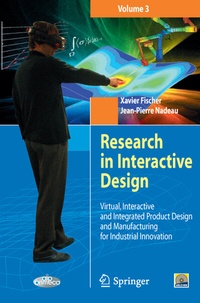
Research in Interactive Design (Vol. 3)
Virtual, Interactive and Integrated Product Design and Manufacturing for Industrial Innovation
1st Edition
Published on 23. April 2011
XI, 146 pages
978-2-8178-0169-8 (ISBN)
Description

This book provides an accurate overview of the recent research or industrial application in interactive design. The different arguments, taken from the international conference Virtual Concept 2005, will provide the reader with some advanced solutions concerning new methods and tools by discussing modelling techniques, design solution space exploration and interactive process organization.
More details
Other editions
Additional editions
Jean-Pierre Nadeau | Xavier Fischer
Research in Interactive Design (Vol. 3)
Virtual, Interactive and Integrated Product Design and Manufacturing for Industrial Innovation
Book
10/2010
1st Edition
Springer
€160.49
Shipment within 7-9 days
Persons
Xavier Fischer is engineer in mechanical engineering, professor at the Ecole supérieure des technologies industrielles avancées (ESTIA), associate researcher at Lab. TREFLE (UMR CNRS 8508) and editor in chief of the International Journal on Interactive Design and Manufacturing (IJIDeM) published by Springer France.
Content
1 - Title Page [Seite 4]
2 - Copyright Page [Seite 5]
3 - Instructions [Seite 6]
4 - Acknowledgement [Seite 7]
5 - Table of Contents [Seite 8]
6 - 1 Interactive Design: Then and Now [Seite 11]
6.1 - 1.1 Short History of Creation [Seite 11]
6.2 - 1.2 Knowledge Modelling [Seite 12]
6.3 - 1.3 Interactive Support to Decision Making: a Virtual Way [Seite 13]
7 - 2 Integrated Design and Manufacturing in Mechanical Engineering [Seite 16]
7.1 - 2.1 Product Design Process [Seite 16]
7.2 - 2.2 Multidisciplinary Approach [Seite 18]
7.3 - 2.3 Conceptual Design [Seite 20]
7.4 - 2.4 Collaborative Product Design and Manufacturing [Seite 22]
7.5 - 2.5 Knowledge in Engineering [Seite 25]
7.6 - 2.6 Advanced Manufacturing [Seite 28]
7.7 - 2.7 Inspection and Reverse Engineering Technique [Seite 35]
7.8 - 2.8 Product Lifecycle Management [Seite 38]
7.9 - 2.9 Creativity [Seite 40]
7.10 - 2.10 Tolerancing in Design and Manufacturing [Seite 42]
7.11 - 2.11 DFA and DFM [Seite 45]
7.12 - 2.12 Process and Production Management [Seite 47]
7.13 - 2.13 Re-Design [Seite 50]
8 - 3 Interactive Product Design [Seite 53]
8.1 - 3.1 Introduction [Seite 53]
8.1.1 - 3.1.1 Interactive product design through the lifecycle [Seite 54]
8.1.2 - 3.1.2 Needed requirements for the interactive design [Seite 56]
8.1.2.1 - Evolutionary model of product [Seite 56]
8.1.2.2 - Interactions of product with human and environment [Seite 57]
8.1.2.3 - Interactive simulation of product behavior [Seite 58]
8.1.2.4 - Decision support systems [Seite 59]
8.1.3 - 3.1.3 Feedback of the industrial engineering support systems and outlooks [Seite 60]
8.2 - 3.2 Interactive Simulation for Design [Seite 61]
8.3 - 3.3 Interfaces for Interactive Design [Seite 63]
8.4 - 3.4 Team and Process Interactive Management [Seite 65]
8.5 - 3.5 Interactive Virtual Representation [Seite 68]
8.6 - 3.6 Virtual and Geometric Models [Seite 71]
8.7 - 3.7 Human Centred Design [Seite 73]
8.8 - 3.8 Models for Interactive Design: Techniques and Qualification [Seite 76]
8.9 - 3.9 Interactive Exploration of Design Spaces [Seite 78]
8.10 - 3.10 CAE, CAD and Virtual Reality [Seite 81]
8.11 - 3.11 Behavioural Simulation [Seite 83]
8.12 - 3.12 Assistance and Virtual Reality [Seite 85]
8.13 - 3.13 Robust Manufacturing [Seite 88]
8.14 - 3.14 Risk Prevention [Seite 91]
9 - 4 Green Engineering, Design and Innovation [Seite 93]
10 - 5 Global Design and Manufacturing [Seite 101]
10.1 - 5.1 Introduction [Seite 101]
10.1.1 - 5.1.1 Prologue [Seite 101]
10.1.2 - 5.1.2 Current academic and industrial solutions [Seite 102]
10.1.3 - 5.1.3 Design rationale issue and expected trends [Seite 102]
10.2 - 5.2 Global Design Tools, Methods and Techniques [Seite 103]
10.3 - 5.3 Extended and Virtual Factory [Seite 106]
10.4 - 5.4 Information Technology for Global Design and Manufacture [Seite 108]
11 - 6 Virtual environments and prototyping for human health and safety [Seite 111]
11.1 - 6.1 Introduction [Seite 111]
11.2 - 6.2 Human Factors in Virtual Maintenance and Manufacturing [Seite 113]
11.3 - 6.3 Interactive Robotic Simulation in Cooperation Scenarios [Seite 116]
11.4 - 6.4 Virtual Prototyping in Medicine [Seite 118]
12 - 7 Product and Interaction Design Environments for the Future [Seite 121]
12.1 - 7.1 Introduction [Seite 121]
12.2 - 7.2 Advanced Prototyping for Interaction Design [Seite 122]
12.3 - 7.3 Virtual and Mixed Reality for Design [Seite 124]
12.4 - 7.4 Advanced Tools for Early Product Design [Seite 126]
13 - 8 TRIZ and Intellectual Property Management [Seite 130]
13.1 - 8.1 Introduction [Seite 130]
13.2 - 8.2 Developments on Creativity [Seite 132]
14 - 9 Methods and Simulation Tools for Assembly Design and Manufacturing [Seite 136]
14.1 - 9.1 Introduction [Seite 136]
14.2 - 9.2 Developments on Tools for Assembly Design and Manufacturing [Seite 137]
15 - 10 European Qualification and Certification for the Lifelong Learning [Seite 141]
15.1 - 10.1 Introduction [Seite 141]
15.2 - 10.2 ECQA and EMIRAcle for Lifelong Learning [Seite 142]
15.2.1 - 10.2.1 EMIRAcle [Seite 142]
15.2.2 - 10.2.2 ECQA [Seite 143]
15.2.3 - 10.2.3 The ECQA Qualification and Certification Schema [Seite 144]
15.3 - 10.3 Modern Job Roles in Innovative Product Development [Seite 145]
15.3.1 - 10.3.1 ECQA Certified Integrated Design Engineer [Seite 145]
15.3.2 - 10.3.2 ECQA Certified Lean Six Sigma Expert [Seite 146]
15.3.3 - 10.3.3 ECQA Certified EU Researcher-Entrepreneur [Seite 146]
15.4 - 10.4 Training and Certification System [Seite 148]
15.4.1 - 10.4.1 Training Process [Seite 149]
15.4.2 - 10.4.2 Training Material [Seite 150]
15.5 - 10.5 Involvement of AIP-PRIMECA Network [Seite 151]
15.6 - 10.6 Conclusions [Seite 152]
2 - Copyright Page [Seite 5]
3 - Instructions [Seite 6]
4 - Acknowledgement [Seite 7]
5 - Table of Contents [Seite 8]
6 - 1 Interactive Design: Then and Now [Seite 11]
6.1 - 1.1 Short History of Creation [Seite 11]
6.2 - 1.2 Knowledge Modelling [Seite 12]
6.3 - 1.3 Interactive Support to Decision Making: a Virtual Way [Seite 13]
7 - 2 Integrated Design and Manufacturing in Mechanical Engineering [Seite 16]
7.1 - 2.1 Product Design Process [Seite 16]
7.2 - 2.2 Multidisciplinary Approach [Seite 18]
7.3 - 2.3 Conceptual Design [Seite 20]
7.4 - 2.4 Collaborative Product Design and Manufacturing [Seite 22]
7.5 - 2.5 Knowledge in Engineering [Seite 25]
7.6 - 2.6 Advanced Manufacturing [Seite 28]
7.7 - 2.7 Inspection and Reverse Engineering Technique [Seite 35]
7.8 - 2.8 Product Lifecycle Management [Seite 38]
7.9 - 2.9 Creativity [Seite 40]
7.10 - 2.10 Tolerancing in Design and Manufacturing [Seite 42]
7.11 - 2.11 DFA and DFM [Seite 45]
7.12 - 2.12 Process and Production Management [Seite 47]
7.13 - 2.13 Re-Design [Seite 50]
8 - 3 Interactive Product Design [Seite 53]
8.1 - 3.1 Introduction [Seite 53]
8.1.1 - 3.1.1 Interactive product design through the lifecycle [Seite 54]
8.1.2 - 3.1.2 Needed requirements for the interactive design [Seite 56]
8.1.2.1 - Evolutionary model of product [Seite 56]
8.1.2.2 - Interactions of product with human and environment [Seite 57]
8.1.2.3 - Interactive simulation of product behavior [Seite 58]
8.1.2.4 - Decision support systems [Seite 59]
8.1.3 - 3.1.3 Feedback of the industrial engineering support systems and outlooks [Seite 60]
8.2 - 3.2 Interactive Simulation for Design [Seite 61]
8.3 - 3.3 Interfaces for Interactive Design [Seite 63]
8.4 - 3.4 Team and Process Interactive Management [Seite 65]
8.5 - 3.5 Interactive Virtual Representation [Seite 68]
8.6 - 3.6 Virtual and Geometric Models [Seite 71]
8.7 - 3.7 Human Centred Design [Seite 73]
8.8 - 3.8 Models for Interactive Design: Techniques and Qualification [Seite 76]
8.9 - 3.9 Interactive Exploration of Design Spaces [Seite 78]
8.10 - 3.10 CAE, CAD and Virtual Reality [Seite 81]
8.11 - 3.11 Behavioural Simulation [Seite 83]
8.12 - 3.12 Assistance and Virtual Reality [Seite 85]
8.13 - 3.13 Robust Manufacturing [Seite 88]
8.14 - 3.14 Risk Prevention [Seite 91]
9 - 4 Green Engineering, Design and Innovation [Seite 93]
10 - 5 Global Design and Manufacturing [Seite 101]
10.1 - 5.1 Introduction [Seite 101]
10.1.1 - 5.1.1 Prologue [Seite 101]
10.1.2 - 5.1.2 Current academic and industrial solutions [Seite 102]
10.1.3 - 5.1.3 Design rationale issue and expected trends [Seite 102]
10.2 - 5.2 Global Design Tools, Methods and Techniques [Seite 103]
10.3 - 5.3 Extended and Virtual Factory [Seite 106]
10.4 - 5.4 Information Technology for Global Design and Manufacture [Seite 108]
11 - 6 Virtual environments and prototyping for human health and safety [Seite 111]
11.1 - 6.1 Introduction [Seite 111]
11.2 - 6.2 Human Factors in Virtual Maintenance and Manufacturing [Seite 113]
11.3 - 6.3 Interactive Robotic Simulation in Cooperation Scenarios [Seite 116]
11.4 - 6.4 Virtual Prototyping in Medicine [Seite 118]
12 - 7 Product and Interaction Design Environments for the Future [Seite 121]
12.1 - 7.1 Introduction [Seite 121]
12.2 - 7.2 Advanced Prototyping for Interaction Design [Seite 122]
12.3 - 7.3 Virtual and Mixed Reality for Design [Seite 124]
12.4 - 7.4 Advanced Tools for Early Product Design [Seite 126]
13 - 8 TRIZ and Intellectual Property Management [Seite 130]
13.1 - 8.1 Introduction [Seite 130]
13.2 - 8.2 Developments on Creativity [Seite 132]
14 - 9 Methods and Simulation Tools for Assembly Design and Manufacturing [Seite 136]
14.1 - 9.1 Introduction [Seite 136]
14.2 - 9.2 Developments on Tools for Assembly Design and Manufacturing [Seite 137]
15 - 10 European Qualification and Certification for the Lifelong Learning [Seite 141]
15.1 - 10.1 Introduction [Seite 141]
15.2 - 10.2 ECQA and EMIRAcle for Lifelong Learning [Seite 142]
15.2.1 - 10.2.1 EMIRAcle [Seite 142]
15.2.2 - 10.2.2 ECQA [Seite 143]
15.2.3 - 10.2.3 The ECQA Qualification and Certification Schema [Seite 144]
15.3 - 10.3 Modern Job Roles in Innovative Product Development [Seite 145]
15.3.1 - 10.3.1 ECQA Certified Integrated Design Engineer [Seite 145]
15.3.2 - 10.3.2 ECQA Certified Lean Six Sigma Expert [Seite 146]
15.3.3 - 10.3.3 ECQA Certified EU Researcher-Entrepreneur [Seite 146]
15.4 - 10.4 Training and Certification System [Seite 148]
15.4.1 - 10.4.1 Training Process [Seite 149]
15.4.2 - 10.4.2 Training Material [Seite 150]
15.5 - 10.5 Involvement of AIP-PRIMECA Network [Seite 151]
15.6 - 10.6 Conclusions [Seite 152]
