

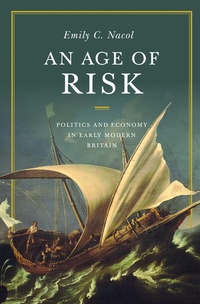
An Age of Risk
Politics and Economy in Early Modern Britain
1st Edition
Published on 11. January 2017
184 pages
978-1-4008-8301-1 (ISBN)
Description

In An Age of Risk, Emily Nacol shows that risk, now treated as a permanent feature of our lives, did not always govern understandings of the future. Focusing on the epistemological, political, and economic writings of Thomas Hobbes, John Locke, David Hume, and Adam Smith, Nacol explains that in seventeenth- and eighteenth-century Britain, political and economic thinkers reimagined the future as a terrain of risk, characterized by probabilistic calculation, prediction, and control.
In these early modern sources, Nacol contends, we see three crucial developments in thought on risk and politics. While early modern thinkers differentiated uncertainty about the future from probabilistic calculations of risk, they remained attentive to the ways uncertainty and risk remained in a conceptual tangle, a problem that constrained good decision making. They developed sophisticated theories of trust and credit as crucial background conditions for prudent risk-taking, and offered complex depictions of the relationships and behaviors that would make risk-taking more palatable. They also developed two narratives that persist in subsequent accounts of risk-risk as a threat to security, and risk as an opportunity for profit. Looking at how these narratives are entwined in early modern thought, Nacol locates the origins of our own ambivalence about risk-taking. By the end of the eighteenth century, she argues, a new type of political actor would emerge from this ambivalence, one who approached risk with fear rather than hope.
By placing a fresh lens on early modern writing, An Age of Risk demonstrates how new and evolving orientations toward risk influenced approaches to politics and commerce that continue to this day.
In these early modern sources, Nacol contends, we see three crucial developments in thought on risk and politics. While early modern thinkers differentiated uncertainty about the future from probabilistic calculations of risk, they remained attentive to the ways uncertainty and risk remained in a conceptual tangle, a problem that constrained good decision making. They developed sophisticated theories of trust and credit as crucial background conditions for prudent risk-taking, and offered complex depictions of the relationships and behaviors that would make risk-taking more palatable. They also developed two narratives that persist in subsequent accounts of risk-risk as a threat to security, and risk as an opportunity for profit. Looking at how these narratives are entwined in early modern thought, Nacol locates the origins of our own ambivalence about risk-taking. By the end of the eighteenth century, she argues, a new type of political actor would emerge from this ambivalence, one who approached risk with fear rather than hope.
By placing a fresh lens on early modern writing, An Age of Risk demonstrates how new and evolving orientations toward risk influenced approaches to politics and commerce that continue to this day.
All prices
More details
Other editions
Additional editions
Book
09/2016
Princeton University Press
€52.08
Article not available at the moment
Person
Emily C. Nacol is assistant professor of political science at Vanderbilt University.
Content
Acknowledgments ix
Chapter 1 Introduction 1
Chapter 2 "Experience Concludeth Nothing Universally"
Hobbes and the Groundwork for a Political Theory of Risk 9
Chapter 3 The Risks of Political Authority
Trust, Knowledge, and Political Agency in Locke's Politics and Economy 41
Chapter 4 Hume's Fine Balance
On Probability, Fear, and the Risks of Trade 69
Chapter 5 Adventurous Spirits and Clamoring Sophists
Smith on the Problem of Risk in Political Economy 98
Chapter 6 An Age of Risk, a Liberalism of Anxiety 124
Notes 131
References 157
Index 167
Chapter 1 Introduction 1
Chapter 2 "Experience Concludeth Nothing Universally"
Hobbes and the Groundwork for a Political Theory of Risk 9
Chapter 3 The Risks of Political Authority
Trust, Knowledge, and Political Agency in Locke's Politics and Economy 41
Chapter 4 Hume's Fine Balance
On Probability, Fear, and the Risks of Trade 69
Chapter 5 Adventurous Spirits and Clamoring Sophists
Smith on the Problem of Risk in Political Economy 98
Chapter 6 An Age of Risk, a Liberalism of Anxiety 124
Notes 131
References 157
Index 167

