

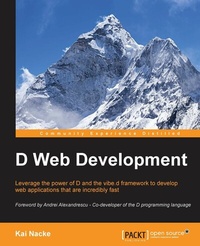
D Web Development
Leverage the power of D and the vibe.d framework to develop web applications that are incredibly fast
Published on 8. July 2025
196 pages
978-1-78528-010-8 (ISBN)
Description

Leverage the power of D and the vibe.d framework to develop web applications that are incredibly fast
Key Features
[*] Utilize the elegant vibe.d framework to build web applications easily and REST backends with the D programming language
[*] Learn about all components of vibe.d to enhance your web development with D
[*] A hands-on guide to the vibe.d framework; from static web pages to template-based, interactive and localized web applications with database access and REST backends
Book DescriptionD is a programming language with C-like syntax and static typing. The vibe.d framework builds on powerful D concepts like template meta-programming and compile-time function execution to provide an easy-to-use environment for web applications. The combination of a feature-rich web programming framework with a language compiling to native code solves two common issues in web development today: it accelerates your development and it results in fast, native web applications. Learning the vibe.d framework before you start your application will help you to choose the right features to reach your goal. This book guides you through all aspects of web development with D and the vibe.d framework. Covering the popular operating systems today, this guide starts with the setup of your development system. From the first Hello World-style application you will move on to building static web pages with templates. The concise treatment of web forms will give you all the details about form handling and web security. Using the abstractions of the web framework you will learn how to easily validate user input. Next, you will add database access to your application, providing persistent storage for your data. Building on this foundation, you will expose your component and integrate other components via REST. Learning about the internals of vibe.d you will be able to use low-level techniques such as raw TCP access. The vibe.d concepts can also be used for GUI clients, which is the next topic that you will learn. vibe.d is supported by an active community, which adds new functionality. This comprehensive guide concludes with an overview of the most useful vibe.d extensions and where to find them. It also shows you how to integrate these extensions in your application. The concepts are always illustrated with source code, giving you an insight into how to apply them in your application.What you will learn
[*] Create amazingly fast web applications with D
[*] Use Diet templates to easily create a web user interface
[*] Utilize the web framework for interactive applications with input validation and internationalization
[*] Access a database to provide persistent storage for your application
[*] Extend your application with a REST interface and access other applications via REST
[*] Understand vibe.d's fiber-based approach to asynchronous I/O and use it for integration of existing components
[*] Create GUI applications with vibe.d
Who this book is forWhether you are new to the world of D, or already have developed applications in D, or if you want to leverage the power of D for web development, then this book is ideal for you. Basic knowledge of core web technologies like HTML 5 is helpful but not required. This book explains the difficult details to speed your web development.
Key Features
[*] Utilize the elegant vibe.d framework to build web applications easily and REST backends with the D programming language
[*] Learn about all components of vibe.d to enhance your web development with D
[*] A hands-on guide to the vibe.d framework; from static web pages to template-based, interactive and localized web applications with database access and REST backends
Book DescriptionD is a programming language with C-like syntax and static typing. The vibe.d framework builds on powerful D concepts like template meta-programming and compile-time function execution to provide an easy-to-use environment for web applications. The combination of a feature-rich web programming framework with a language compiling to native code solves two common issues in web development today: it accelerates your development and it results in fast, native web applications. Learning the vibe.d framework before you start your application will help you to choose the right features to reach your goal. This book guides you through all aspects of web development with D and the vibe.d framework. Covering the popular operating systems today, this guide starts with the setup of your development system. From the first Hello World-style application you will move on to building static web pages with templates. The concise treatment of web forms will give you all the details about form handling and web security. Using the abstractions of the web framework you will learn how to easily validate user input. Next, you will add database access to your application, providing persistent storage for your data. Building on this foundation, you will expose your component and integrate other components via REST. Learning about the internals of vibe.d you will be able to use low-level techniques such as raw TCP access. The vibe.d concepts can also be used for GUI clients, which is the next topic that you will learn. vibe.d is supported by an active community, which adds new functionality. This comprehensive guide concludes with an overview of the most useful vibe.d extensions and where to find them. It also shows you how to integrate these extensions in your application. The concepts are always illustrated with source code, giving you an insight into how to apply them in your application.What you will learn
[*] Create amazingly fast web applications with D
[*] Use Diet templates to easily create a web user interface
[*] Utilize the web framework for interactive applications with input validation and internationalization
[*] Access a database to provide persistent storage for your application
[*] Extend your application with a REST interface and access other applications via REST
[*] Understand vibe.d's fiber-based approach to asynchronous I/O and use it for integration of existing components
[*] Create GUI applications with vibe.d
Who this book is forWhether you are new to the world of D, or already have developed applications in D, or if you want to leverage the power of D for web development, then this book is ideal for you. Basic knowledge of core web technologies like HTML 5 is helpful but not required. This book explains the difficult details to speed your web development.
All prices
More details
Edition
Digital original
Language
English
Place of publication
Birmingham
United Kingdom
Target group
Professional and scholarly
US School Grade: College Graduate Student
Edition type
Digital original
File size
1,03 MB
ISBN-13
978-1-78528-010-8 (9781785280108)
Copyright in bibliographic data and cover images is held by Nielsen Book Services Limited or by the publishers or by their respective licensors: all rights reserved.
Schweitzer Classification
Other editions
Additional editions
Person
Nacke Kai :
Kai Nacke is a professional IT architect currently residing in Toronto, Canada. He holds a diploma in computer science from the Technical University of Dortmund, Germany. and his diploma thesis on universal hash functions was recognized as the best of the semester. With over 20 years of experience in the IT industry, Kai has extensive expertise in the development and architecture of business and enterprise applications. In his current role, he evolves an LLVM/clang-based compiler. For several years, Kai served as the maintainer of LDC, the LLVM-based D compiler. He is the author of D Web Development and Learn LLVM 12, both published by Packt. In the past, he was a speaker in the LLVM developer room at the Free and Open Source Software Developers' European Meeting (FOSDEM).
Kai Nacke is a professional IT architect currently residing in Toronto, Canada. He holds a diploma in computer science from the Technical University of Dortmund, Germany. and his diploma thesis on universal hash functions was recognized as the best of the semester. With over 20 years of experience in the IT industry, Kai has extensive expertise in the development and architecture of business and enterprise applications. In his current role, he evolves an LLVM/clang-based compiler. For several years, Kai served as the maintainer of LDC, the LLVM-based D compiler. He is the author of D Web Development and Learn LLVM 12, both published by Packt. In the past, he was a speaker in the LLVM developer room at the Free and Open Source Software Developers' European Meeting (FOSDEM).
Content
Table of Contents
Getting started with your first web application
Using templates for your web pages
Get interactive ? forms and flow control
Easy forms with the web framework
Accessing a database
Using the REST interface
vibe.d internals
Using vibe.d with a GUI client
Power your application with vibe.d extensions
Getting started with your first web application
Using templates for your web pages
Get interactive ? forms and flow control
Easy forms with the web framework
Accessing a database
Using the REST interface
vibe.d internals
Using vibe.d with a GUI client
Power your application with vibe.d extensions

