

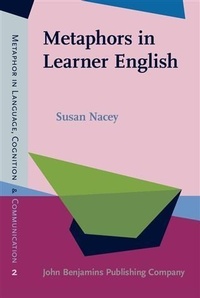
Metaphors in Learner English
1st Edition
Published on 21. November 2013
XI, 279 pages
978-90-272-7156-3 (ISBN)
Description

This volume presents results from a corpus-based investigation into the metaphorical production of foreign language learners, comparing texts written by Norwegian (L2) learners of English with those written by British (L1) students. Three types of questions are addressed. The first has empirically measured answers: For example, do L2 English writers produce more metaphors than L1 novice writers? How frequent are novel metaphors in an L2, as compared with an L1? The second type has more subjective answers: How creatively do L2 English learners employ metaphor? Are they even expected to be able to produce metaphor at all? The third type combines theoretical and methodological perspectives: How is metaphorical creativity identified? What is the potential role of metaphoric competence? Most importantly, how are metaphors identified? To this end, the newly-developed 'Metaphor Identification Procedure' is tested and critiqued. This book is intended for metaphor researchers, corpus linguists, applied linguists and language educators.
More details
Other editions
Additional editions
Susan Nacey
Metaphors in Learner English
Book
11/2013
John Benjamins Publishing Co
€95.40
Shipment within 10-15 days
Person
Content
- Metaphors in Learner English
- Editorial page
- Title page
- LCC data
- Dedication page
- Table of contents
- Acknowledgements
- Introduction
- Part 1
- 1. Foundations
- 1.1 Metaphor in language
- 1.2 Metaphor in thought
- 1.2.1 Metaphor processing
- 1.2.2 Metaphor vs. metonymy
- 1.3 Conceptual metaphor vs. linguistic metaphor
- 1.3.1 Metaphor vs. simile
- 1.3.2 Typology of metaphor
- 1.4 Metaphor in communication
- 1.4.1 Novel metaphor
- 1.4.2 Deliberate metaphor
- 1.5 Metaphoric competence
- 1.5.1 Metaphoric competence and pedagogical applications
- 1.6 Concluding remarks
- 2. Metaphor in Europe
- 2.1 Communicative competence
- 2.2 Communicative competence and the CEFR
- 2.3 Metaphor in the CEFR
- 2.3.1 Metaphor in metalanguage
- 2.3.2 Metaphor and communicative competence
- 2.3.3 Metaphor in the Norwegian version of the CEFR
- 2.3.4 'Idiomatic expressions and colloquialisms'
- 2.3.5 Figurative language in assessment scales
- 2.4 The Norwegian context
- 2.5 Concluding remarks
- Part 2
- 3. Introduction to MIP(VU)
- 3.1 Overview of MIP
- 3.2 Pragglejaz versus MIP
- 3.3 MIP versus MIPVU
- 3.4 Concluding remarks
- 4. MIP(VU) in practice
- 4.1 Step 1: Understanding the general context
- 4.2 Step 2: Lexical units
- 4.2.1 Phrasal verbs
- 4.2.2 Polywords
- 4.2.3 Compounds
- 4.2.4 Proper nouns
- 4.3 Step 3a: Contextual meaning
- 4.4 Step 3b: Basic meaning
- 4.4.1 Role of dictionaries
- 4.4.2 The role of etymology
- 4.5 Step 3c: Sufficient distinction
- 4.6 Step 3d: Relation of comparison
- 4.7 Step 4: Final decision: What has really been identified?
- 5. Evaluation of MIP(VU)
- 5.1 Reliability
- 5.2 Overall evaluation
- 5.2.1 MIP(VU) and learner language
- 5.2.2 Drawbacks of MIP(VU)
- 5.2.3 Benefits of MIP(VU)
- 5.3 Concluding remarks
- Part 3
- 6. Quantitative portrait of metaphors in learner language
- 6.1 Previous studies
- 6.2 Primary material: NICLE and LOCNESS
- 6.3 Metaphor frequency in the learner corpora
- 6.4 Interaction between metaphor, word class and L1
- 6.4.1 Word class and L1
- 6.4.2 Distribution of metaphor within word classes and L1
- 6.4.3 Metaphor across word classes and L1
- 6.5 Metaphor and degree of conventionality
- 6.5.1 Metaphor conventionality in the open and closed word classes
- 6.5.2 Metaphor conventionality, word class, and L1
- 6.6 Concluding remarks
- 7. Metaphorical creativity
- 7.1 What is creativity?
- 7.2 Metaphorical creativity
- 7.3 Bilinguals' creativity
- 7.3.1 Bilinguals' creativity in ESL English
- 7.3.2 Bilinguals' creativity in EFL English
- 7.3.3 Deficiency (in EFL/ESL English)
- 7.3.4 Difference (in ELF English)
- 7.4 Deliberate metaphors
- 7.4.1 Identifying deliberate metaphors
- 7.4.2 NICLE Deliberate metaphors: An overview
- 7.4.3 Extended metaphors
- 7.4.4 Mflags
- 7.4.5 Defective 'A = B' metaphors
- 7.4.6 Bridge metaphors
- 7.4.7 S-quotes
- 7.5 Novel metaphors
- 7.5.1 NICLE novel metaphors: An overview
- 7.5.2 L1 transfer and novelty
- 7.5.3 L1 transfer in NICLE
- 7.5.4 Other motivations for novel metaphor production
- 7.6 Concluding remarks
- 8. Prepositions
- 8.1 Traditional perspectives on prepositions and learner acquisition
- 8.2 Prepositions and metaphorical analysis
- 8.2.1 Crosslinguistic perspective on metaphorical use of prepositions
- 8.3 The basic meaning of prepositions
- 8.4 Crosslinguistic correspondence of basic meanings
- 8.5 Overview of prepositions in NICLE and LOCNESS
- 8.5.1 Congruence between L1 and L2
- 8.6 Case studies: 'to' and 'on'
- 8.7 Concluding remarks
- Conclusions
- Appendix
- References
- Non-English references
- Corpora and corpus tools
- Dictionaries
- Documents
- Miscellaneous
- Name index
- Subject index
