

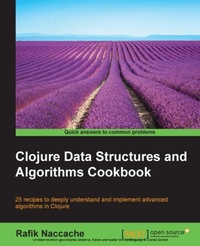
Clojure Data Structures and Algorithms Cookbook
25 recipes to deeply understand and implement advanced algorithms in Clojure
Published on 7. October 2025
216 pages
978-1-78528-782-4 (ISBN)
Description

Key Features
Book DescriptionData-structures and algorithms often cross your path when you compress files, compile programs, access databases, or simply use your favourite text editor. Understanding and implementing them can be daunting. Curious learners and industrial developers can find these complex, especially if they focus on the detailed implementation of these data structures. Clojure is a highly pragmatic and expressive language with efficient and easy data manipulation capabilities. As such, it is great for implementing these algorithms. By abstracting away a great share of the unnecessary complexity resulting from implementation, Clojure and its contrib libraries will help you address various algorithmic challenges, making your data exploration both profitable and enjoyable. Through 25 recipes, you'll explore advanced algorithms and data-structures, well served by a sound Clojure implementation. This book opens with an exploration of alternative uses of the array data-structure, covering LZ77 compression, drawing fractals using Pascal's triangles, simulating a multi-threaded program execution, and implementing a call-stack winding and un-winding operations. The book elaborates on linked lists, showing you how to construct doubly linked ones, speed up search times over the elements of such structures, use a linked-list as the foundation of a shift-reduce parser, and implement an immutable linked-list using skew binary numbers representation. After that, the tree data-structure is explored, focusing on building self-balancing Splay Trees, designing a B-Tree backing-up an efficient key-value data-store, constructing an undo capable Rope, and showing how Tries can make for an auto-completing facility. Next, some optimization and machine learning techniques are discussed, namely for building a co-occurrence-based recommendation engine, using branch-and-bound to optimize integral cost and profit problems, using Dijkstra's algorithm to determine optimal paths and summarizing texts using the LexRank algorithm. Particular attention is given to logic programming, you will learn to use this to discover interesting relations between social website data, by designing a simple type inferencer for a mini Java-like language, and by building a simple checkers game engine. Asynchronous programming will be addressed and you will design a concurrent web-crawler, an interactive HTML5 game, and an online taxi booking platform. Finally, you'll explore advanced cases for higher order functions in Clojure while implementing a recursive descent parser using efficient mutual resucrsion, devising a mini resusable firewall simulator thanks to Clojure 1.7 new tansducers feature or building a simple unification engine with the help of Continuation Passing Style.What you will learn
Explore alternative uses of classical data structures such as arrays and linked lists
Explore advanced machine learning and optimization techniques
Utilize the Clojure libraries, such as Instaparse for parsing, core.match for pattern matching, clojure.zip for zippers, and clojure.matrix for matrix operations
Learn logic programming through the core.logic library
Master asynchronous programming using the core.async library
Observe transducers while resolving realworld use cases
Who this book is forThis book is for intermediate Clojure developers who can read and write in this language quite comfortably. Besides, it is assumed that you have some knowledge of how to set up Clojure projects, include dependencies, how to run REPLs, and so on through Leiningen and Figwheel. No prior awareness of any of the algorithms covered in this book is needed, and, when appropriate, pointers are given to the explanation material about any theory related to them.
Book DescriptionData-structures and algorithms often cross your path when you compress files, compile programs, access databases, or simply use your favourite text editor. Understanding and implementing them can be daunting. Curious learners and industrial developers can find these complex, especially if they focus on the detailed implementation of these data structures. Clojure is a highly pragmatic and expressive language with efficient and easy data manipulation capabilities. As such, it is great for implementing these algorithms. By abstracting away a great share of the unnecessary complexity resulting from implementation, Clojure and its contrib libraries will help you address various algorithmic challenges, making your data exploration both profitable and enjoyable. Through 25 recipes, you'll explore advanced algorithms and data-structures, well served by a sound Clojure implementation. This book opens with an exploration of alternative uses of the array data-structure, covering LZ77 compression, drawing fractals using Pascal's triangles, simulating a multi-threaded program execution, and implementing a call-stack winding and un-winding operations. The book elaborates on linked lists, showing you how to construct doubly linked ones, speed up search times over the elements of such structures, use a linked-list as the foundation of a shift-reduce parser, and implement an immutable linked-list using skew binary numbers representation. After that, the tree data-structure is explored, focusing on building self-balancing Splay Trees, designing a B-Tree backing-up an efficient key-value data-store, constructing an undo capable Rope, and showing how Tries can make for an auto-completing facility. Next, some optimization and machine learning techniques are discussed, namely for building a co-occurrence-based recommendation engine, using branch-and-bound to optimize integral cost and profit problems, using Dijkstra's algorithm to determine optimal paths and summarizing texts using the LexRank algorithm. Particular attention is given to logic programming, you will learn to use this to discover interesting relations between social website data, by designing a simple type inferencer for a mini Java-like language, and by building a simple checkers game engine. Asynchronous programming will be addressed and you will design a concurrent web-crawler, an interactive HTML5 game, and an online taxi booking platform. Finally, you'll explore advanced cases for higher order functions in Clojure while implementing a recursive descent parser using efficient mutual resucrsion, devising a mini resusable firewall simulator thanks to Clojure 1.7 new tansducers feature or building a simple unification engine with the help of Continuation Passing Style.What you will learn
Explore alternative uses of classical data structures such as arrays and linked lists
Explore advanced machine learning and optimization techniques
Utilize the Clojure libraries, such as Instaparse for parsing, core.match for pattern matching, clojure.zip for zippers, and clojure.matrix for matrix operations
Learn logic programming through the core.logic library
Master asynchronous programming using the core.async library
Observe transducers while resolving realworld use cases
Who this book is forThis book is for intermediate Clojure developers who can read and write in this language quite comfortably. Besides, it is assumed that you have some knowledge of how to set up Clojure projects, include dependencies, how to run REPLs, and so on through Leiningen and Figwheel. No prior awareness of any of the algorithms covered in this book is needed, and, when appropriate, pointers are given to the explanation material about any theory related to them.
All prices
More details
Edition
Digital original
Language
English
Place of publication
Birmingham
United Kingdom
Target group
US School Grade: College Graduate Student
Edition type
Digital original
File size
1,58 MB
ISBN-13
978-1-78528-782-4 (9781785287824)
Copyright in bibliographic data and cover images is held by Nielsen Book Services Limited or by the publishers or by their respective licensors: all rights reserved.
Schweitzer Classification
Other editions
Additional editions
Rafik Naccache
Clojure Data Structures and Algorithms Cookbook
Book
08/2015
Packt Publishing
€43.50
Shipment within 3-4 weeks
Person
Naccache Rafik :
Rafik Naccache is a Tunisian experienced software architect and emergent technologies enthusiast. He earned his bachelors degree in computer science engineering from Tunis University of Science in 2001. Rafik fell in love with Clojure back in 2012, and he has been developing it professionally since 2013. He has occupied various positions in telecoms and banking, and he has launched some innovative internet startups in which he has been able to deploy Clojure apps. He also founded the Tunisian Clojure users community. He contributes to Open Source projects, such as Cryogen (https://github.com/cryogen-project/cryogen/graphs/contributors), Milestones (https://github.com/automagictools/milestones), and Scheje (https://github.com/turbopape/scheje). You can reach him as @turbopape on GitHub and Twitter.
Rafik Naccache is a Tunisian experienced software architect and emergent technologies enthusiast. He earned his bachelors degree in computer science engineering from Tunis University of Science in 2001. Rafik fell in love with Clojure back in 2012, and he has been developing it professionally since 2013. He has occupied various positions in telecoms and banking, and he has launched some innovative internet startups in which he has been able to deploy Clojure apps. He also founded the Tunisian Clojure users community. He contributes to Open Source projects, such as Cryogen (https://github.com/cryogen-project/cryogen/graphs/contributors), Milestones (https://github.com/automagictools/milestones), and Scheje (https://github.com/turbopape/scheje). You can reach him as @turbopape on GitHub and Twitter.
Content
Table of Contents
Revisiting the Arrays
Building on Linked Lists
Walking Down Forests of Data
Making Decisions with Science
Programming with Logic
Sharing by Communicating
Transformations as First-Class Citizens
Revisiting the Arrays
Building on Linked Lists
Walking Down Forests of Data
Making Decisions with Science
Programming with Logic
Sharing by Communicating
Transformations as First-Class Citizens

