

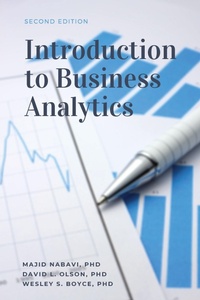
Introduction to Business Analytics, Second Edition
Published on 14. December 2020
192 pages
978-1-953349-75-0 (ISBN)
Description

This book presents key concepts related to quantitative analysis in business.
It is targeted at business students (both undergraduate and graduate) taking an introductory core course. Business analytics has grown to be a key topic in business curricula, and there is a need for stronger quantitative skills and understanding of fundamental concepts.
This second edition adds material on Tableau, a very useful software for business analytics. This supplements the tools from Excel covered in the first edition, to include Data Analysis Toolpak and SOLVER.
More details
Other editions
Additional editions
Majid Nabavi | David L. Olson
Introduction to Business Analytics
Book
12/2020
2nd Edition
Business Expert Press
€25.30
Shipment within 3-4 weeks
Persons
Majid Nabavi has published in Quality Management Journal, and presented research in regional and national conferences. His teaching areas include operations management, management science, database systems, and business analytics.
Content
- Cover
- Introduction to Business Analytics
- Contents
- Chapter 1 Business Analytics
- Chapter 2 Visualization
- Chapter 3 Sampling
- Chapter 4 Hypothesis Testing
- Chapter 5 Linear Regression
- Chapter 6 Multiple Regression
- Chapter 7 Logistic Regression
- Chapter 8 Linear Programming
- Chapter 9 Business Analytic Modeling Tools
- References
- About the Authors
- Index
- Ad Page
- Back Cover
