

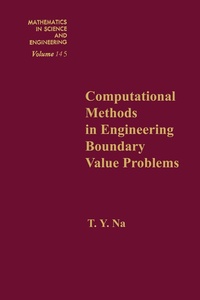
Computational Methods in Engineering Boundary Value Problems
Published on 14. May 2014
321 pages
978-0-08-095653-4 (ISBN)
Description

Computational Methods in Engineering Boundary Value Problems
More details
Series
Language
English
Place of publication
Oxford
United States
ISBN-13
978-0-08-095653-4 (9780080956534)
Copyright in bibliographic data and cover images is held by Nielsen Book Services Limited or by the publishers or by their respective licensors: all rights reserved.
Schweitzer Classification
Other editions
Additional editions

Book
01/1979
Academic Press
€102.14
Article exhausted; check different version
Content
- Front Cover
- Computational Methods in Engineering Boundary Value Problems
- Copyright Page
- Contents
- Preface
- Chapter 1. Introduction
- 1.1 Introduction
- 1.2 Methods of Solution
- 1.3 Numerical Integration of Initial Value Problems
- 1.4 Concluding Remarks
- References
- Chapter 2. Method of Superposition
- 2.1 Introduction
- 2.2 Reduction of Linear Boundary Value Problems to Initial Value Problems
- 2.3 Reduction of Third-Order Boundary Value Problems to Initial Value Problems
- 2.4 Concluding Remarks
- Problems
- References
- Chapter 3. Method of Chasing
- 3.1 Introduction
- 3.2 Derivation of Equations of Chasing By Jones-Second-Order Differential Equations
- 3.3 Application of the Method
- 3.4 Third-Order Differential Equations
- 3.5 Concluding Remarks
- Problems
- References
- Chapter 4. The Adjoint Operator Method
- 4.1 Introduction
- 4.2 Second-Order Differential Equations
- 4.3 Third-Order Differential Equations
- 4.4 Concluding Remarks
- Problems
- References
- Chapter 5. Iterative Methods-The Shooting Methods
- 5.1 Introduction
- 5.2 Newton's Method
- 5.3 Parallel Shooting
- 5.4 Quasi Linearization
- 5.5 Concluding Remarks
- Problems
- References
- Chapter 6. Iterative Methods-The Finite-Difference Method
- 6.1 Introduction
- 6.2 Finite Differences
- 6.3 Solution of Boundary Value Problems by Finite Difference
- 6.4 Second-Order Differential Equations
- 6.5 Third-Order Differential Equations
- 6.6 First-Order System and Newton's Method
- 6.7 Concluding Remarks
- Problems
- References
- Chapter 7. Method of Transformation-Direct Transformation
- 7.1 Introduction
- 7.2 Transformation for a Given Group of Transformations
- 7.3 Extension of the Transformation Method for a Given Group of Transformations
- 7.4 Uniqueness of the Solution
- Problems
- References
- Chapter 8. Method of Transformation-Reduced Physical Parameters
- 8.1 Introduction
- 8.2 Reduced Physical Parameters
- 8.3 Application to Simultaneous Differential Equations
- 8.4 Application to an Eigenvalue Problem
- 8.5 Concluding Remarks
- Problems
- References
- Chapter 9. Method of Transformation-Invariance of Physical Parameters
- 9.1 Introduction
- 9.2 Boundary Value Problem with Two or More Parameters
- 9.3 Systematic Search of Multiple Solutions
- 9.4 Thin Struts with Large Elastic Displacement
- Problems
- References
- Chapter 10. Method of Parameter Differentiation
- 10.1 Introduction
- 10.2 Nonlinear Algebraic Equations
- 10.3 Parameter Differentiation Applied to Differential Equations
- 10.4 Application to Simultaneous Equations
- 10.5 The General Parameter Mapping (GPM) of Kubicek and Hlavecek
- 10.6 Method of Continuation of Roberts and Shipman
- 10.7 Concluding Remarks
- Problems
- References
- Chapter 11. Method of Invariant Imbedding
- 11.1 Introduction
- 11.2 Concept of Invariant Imbedding
- 11.3 Isothermal Packed-Bed Chemical Reactor
- 11.4 Radiation Fins
- 11.5 Solution of Falkner-Skan Equation
- 11.6 Concluding Remarks
- Problems
- References
- Chapter 12. Integral Equation Method
- 12.1 Introduction
- 12.2 Linear Boundary Value Problems
- 12.3 Nonlinear Boundary Value Problems
- 12.4 Concluding Remarks
- Problems
- References
- Index
