

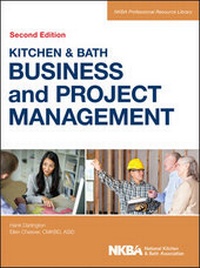
Kitchen and Bath Business and Project Management
Description

More details
Other editions
Additional editions
Person
Content
introduction xv
Acknowledgements xxi
CHAPTER 1 Getting Started 1
Do You have What it Takes? 2
Evaluate Yourself 4
Before You Start 8
Why Many Companies Do Not Make It 10
Avoid These Common Mistakes 11
Getting Help from Advisors and Mentors 12
Summary 12
Review Questions 12
CHAPTER 2 Planning Your Business 15
What Type of Kitchen and Bath Business are You Going to Operate? 15
Your Business Selection Criteria 17
Deciding on the Right Business 17
Choosing a Name for Your Business 18
Stages of Company Growth 18
Short- and Long-Term Planning 20
How to Create a Strategic Business Plan for a Kitchen/Bath Dealer 21
Researching the Market 33
Preparing Your Business Plan 35
Reviewing Your Plan 40
Summary 40
Review Questions 41
CHAPTER 3 Business Start-up Issues .43
Choosing the Business Legal Structure 43
Other Requirements and Considerations 50
Location, Location, Location 51
Financing the Business 55
A Look at Taxes 60
Selecting Vendor Partners 61
Buying Groups-Sharing Expertise 63
Joining the Business Community 64
Taking Advantage of Outside Help 65
Summary 66
Review Questions 66
CHAPTER 4 Accounting and Record Keeping 67
Why You Need to Keep Good Records 69
Establishing Bookkeeping Procedures 70
Choosing an Accounting System 70
What to Keep Track of 71
Accounting Software for Your Business 73
Record-Keeping and Administrative Needs 74
Hiring an Accountant or Bookkeeper 76
Budgeting for Profit and Cash Flow 76
Summary 83
Review Questions 83
CHAPTER 5 Financial Controls 85
Understanding Financial Statements 85
Chart of Accounts 86
Balance Sheet 95
Cash Flow Analysis 98
Financial Ratio Analysis 103
Gross Margin 105
Ideas on How to Improve Gross Margins 108
Summary 120
Review Questions 120
CHAPTER 6 Protecting Your Business 121
Business Legal Structure 122
Professional Advice 122
Contractual Agreements and Personal Guarantees 122
Extension of Credit to Your Customers 123
Copyrighting Your Drawings 123
Developing an Insurance Program 124
Protecting Your Business from Theft 129
Summary 130
Review Questions 130
CHAPTER 7 Basic Ta x Management 131
Small Business Tax Management 131
Special Rules for Small Businesses 132
Tax Responsibilities 134
Specific Substantiation Requirements for Certain Expenses 134
Hints on Preventing an Audit 135
Help from the IRS 135
Other Taxes 136
Summary 137
Review Questions 137
CHAPTER 8 The Basics of Human Resource (People) Management .139
The Broad Picture of Human Resources 141
Future Human Resource Trends 142
Determining Your Needs 144
Deciding on the Right Compensation System for Your Sales Team 151
Examples of Compensation Plans 155
Resourceful Recruiting 159
Narrowing Down the List: Applications, Résumés, and Testing 162
Art of Interviewing 164
Making the Final Hiring Decision 167
Summary 171
Review Questions 171
CHAPTER 9 Human Resource Management-after the Decision Is Made ..173
The Orientation Period 173
Training and Development 175
Policy and Procedures Manual 177
Creating an Employee-Friendly Work Environment 180
Alternate Working Arrangements 181
Keep Tabs on Company Morale 182
Conduct Regular Meetings 182
Measuring Employee Performance 184
Developing Disciplinary Procedures 188
Defining at-will Employment 189
Terminating an Employee 189
Termination for "Just Cause" 190
Summary 208
Review Questions 208
CHAPTER 10 Marketing .209
Marketing and Sales are not the Same 210
The Big Picture: The Marketing "Wheel of Fortune" 210
Make the Time 214
Your Marketing Plan and Budget 215
Marketing Budgets 217
Knowing Who Your Customers are 222
Are You Offering the Right Product/Service Package? 224
Knowing Who Your Competitors are 227
Business Image and Branding 230
Establishing Your Brand 235
Finding and Filling a Meaningful Market Position 236
Why It's Important to Have a Great Web Site 237
Develop an Advertising Campaign 238
Getting Your Work Published 240
Social Media Marketing 244
Sales and Selling 247
How to Get Started 247
Your Sales Team Needs a Strong Leader 254
Summary of How to Build a Marketing Plan 256
In Closing . . . 257
Summary 258
Review Questions 258
CHAPTER 11 Professional and Profitable Project Management 259
Introduction 259
Project Management Fundamentals: From Information Gathering to Visiting the Finished Room 260
Summary 265
Review Questions 266
CHAPTER 12 Responsibilities of the Business Owner/Manager 267
The Installation Delivery System 267
Job Site Dynamics: New House versus Old House 268
Job Site Dynamics: Single-Family Dwelling versus Multifamily 269
Installation Service Business Models 269
Key Competencies of Installation Specialists 271
Developing Successful Working Relationships 272
Systematic Approach to Project Management 274
Role of a Manfacturer's Representative 286
Importance of Job Costing 288
Summary 289
Review Questions 289
CHAPTER 13 Responsibilities of Designer of Record 291
"Win-Win" Strategy 291
Designer's Role during Project Documentation Process 292
Successful Designers are Detail Oriented 293
Understanding Construction Constraints 293
Summary 311
Review Questions 311
CHAPTER 14 Managing Client Expectations and the Job Site 313
Understanding "Remodeling Fever" 313
Managing the Client and the Project 314
Summary 331
Review Questions 331
CHAPTER 15 Industry Standards for Molding Order Procedures and Cabinet Installation .333
Ordering Molding 333
How to Install Kitchen Cabinets 336
Summary 344
Review Questions 344
index 345
1
Getting Started
Millions of people start their own businesses every year. Possibly you’ve already started yours, or you’re giving it serious thought. Whatever the case, many skeptics may try to scare you with the statistics on how many new businesses fail every year, how hard you’ll have to work, and how long it will take before you show a profit. But, if everyone listened to the skeptics… John Michael Kohler would not have started Kohler Company, Paul Wellborn would not have expanded Wellborn Cabinet, Inc., and the seven Jacuzzi brothers would not have started the now multiproduct Jacuzzi, Inc.
Learning Objective 1: Compare the pros and cons of owning your own business.
Learning Objective 2: Compare your personal leadership traits to the traits and characteristics listed in the chapter.
Learning Objective 3: Review the entrepreneurial innovation assessment and define your personal strengths and weaknesses.
Learning Objective 4: Recognize the characteristics of failed and successful entrepreneurs.
Learning Objective 5: Analyze common mistakes to avoid as an owner/manager of a business.
Pros and Cons of Owning Your Own Business Pros- You are your own boss. The sky’s the limit.
- You can prove yourself.
- You will have a hand in all aspects of the business.
- You will be able to take pride in promoting and marketing your own business.
- You will be in control.
- You will have creative freedom.
- The more the company makes, the more you make.
- You cannot be fired, laid off, or forced to retire.
- You will have the ultimate satisfaction of knowing you started and ran a successful business.
- There is no guaranteed paycheck.
- It’s all on your shoulders.
- You cannot please everyone.
- You will work harder and longer than ever before.
- You will assume the risk of investment.
- There will be constant stress and pressure.
- You will have to adhere to all the laws and regulations.
DO YOU HAVE WHAT IT TAKES?
It All Starts with an Idea
At some point it hits you that, like so many others, you could own and run your own business. You want to step out on your own and take control of your work and financial future. You are confident that you have what it takes to buck the odds and succeed. You also know that owning your own business comes with risks.
Mrs. Fields Cookies 1/4 cup Passion 1/4 cup Perfection 1/4 cup Perseverance 1/4 cup PeopleDebbi Fields Rose, the founder and owner of Mrs. Fields Cookies, had her recipe for success called “the 4 P’s.” Mrs. Fields defines each “P” this way:
- Passion. You have to absolutely and passionately love what you do. In your case, you will have to love designing and selling kitchen and bath (K&B) projects. Never go into business if your first priority is to make money. Money will be the by-product of doing something you love and doing it well.
- Perfection. You must constantly strive for perfection because, for your business to succeed and have staying power, you have to do it better than anyone else. Stay focused on constantly improving while stamping out mediocrity.
- Perseverance. Stick with it. You’ll need guts. Guts to start and guts to believe in yourself. Guts to take on many challenges, guts to face failure, and guts to stick it out.
- People. No business can succeed without its greatest asset—people—no matter how good the products and services are. You’re not designing and building kitchens and baths, you’re helping turn dreams into reality. To achieve this, you will need a team that loves designing, selling, and installing dream projects as much as you do.
Four Keys to a Successful Kitchen/Bath Business
Business Foundation 1. A qualified entrepreneur 2. A researched business opportunity 3. A detailed written plan 4. A sufficient capital fundPut all four of these together and you have a wonderful chance of success in owning and operating your own business.
Evaluating Yourself
While it is true that starting and running a business is difficult, it’s successfully done all the time by many individuals and partners who have built both large and small K&B businesses. You probably know some of these people. If not, you can meet them by actively participating in National Kitchen & Bath Association (NKBA) chapter events or those of other associations. Develop networking opportunities for yourself: Introduce yourself and ask questions to learn what others’ keys to success are.
Would You Hire You?
If you’ve just begun to think about starting your own business or you’ve been running one for a number of years, you might want to determine if you are the right person for the job.
The position in question is one of being your own boss and running the whole show, which includes bookkeeping, sales and marketing, customer service, supervising employees, vendor relations, and so much more. Most important, your job hinges on your ability to make key decisions (some on short notice) and to utilize your people skills, because most business involves interaction with others. You may not be skilled in all of these key areas. If you’re not, you’ll have to find others who can assist you by providing strength in areas where you are lacking.
Here is a checklist of traits and characteristics you may need to run a business successfully:
Ability to make important decisions Ability to stay motivated, even when the business has slow times and is not running as smoothly as it might Knack for organization Good time management skills Good communication skills Stick-to-itiveness, or the drive that keeps you working long hours to get the job done Good physical health and stamina to survive the long hours and little sleep that may be part of the job Ability to get along well with many different types of personalities Ability to harness and manage anger and frustration Confidence in your skills, knowledge, and abilities to run a K&B business Ability to find answers to questions you cannot answer easily Ability to be firm or flexible so you can make adjustments or changes in your plans Ability to do research and weigh options before jumping into a situation or making a hasty decision Ability to balance a business and a personal life successfully Ability to put money aside for difficult times Ability to network and spread the word about yourself and your businessEVALUATE YOURSELF
Be honest with yourself. Identify how many of the listed skills and talents you possess. How many will you commit to learning? How much of the description just is not you? How many people will you need to hire to fill the void? If you need help with 40 percent or more of the listed items, perhaps you should reconsider starting your own business.
As you analyze yourself, keep in mind that although businesses do fail for a variety of reasons outside of the owner’s control, more often actions (or lack of actions) on the owner’s part lead to an unsuccessful venture. That’s why entrepreneurs need to have a clear picture of both their skills and their shortcomings in order to build on their strengths and shore up their weaknesses.
Complete the next Entrepreneurial Innovation Assessment to help identify your entrepreneurial potential.
Entrepreneurial Innovation Assessment Read each statement carefully, then mark the answer that most accurately describes your behavior, feelings, and attitude as it actually is—not as you would like it to be or think it should be. Try to mark your first reaction.Scoring Instructions
To score the test, circle and add up the values for your answers. 40. These characteristics score 2 points each: energetic, observant, persevering, resourceful, independent, dedicated, original, perceptive, enthusiastic, innovative, curious, involved, and flexible. These characteristics score 1 point each: self-confident, forward looking, informal, courageous, thorough, open minded, alert, dynamic, self-demanding, and absentminded. Interpreting Your Score 125–186 If you scored in this range, you are probably a highly innovative person. Ideas come readily to you. On the whole, you take an innovative approach to solving problems. You also discern possibilities and opportunities in areas where others find little potential. You are original and individualistic, and you have no problem resisting pressures to conform. You have the courage to pit yourself against uncertain circumstances. 77–124 A score in this range indicates that you are moderately innovative. While you lack some of the autonomy,...