
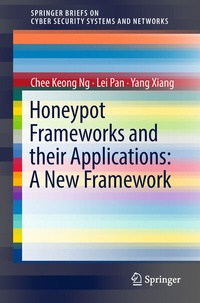
Honeypot Frameworks and Their Applications: A New Framework
Description
Alles über E-Books | Antworten auf Fragen rund um E-Books, Kopierschutz und Dateiformate finden Sie in unserem Info- & Hilfebereich.
This book presents the latest research on honeypots and their applications. After introducing readers to the basic concepts of honeypots and common types, it reviews various honeypot frameworks such as web-server-based, client-based, shadow and artificially intelligent honeypots. In addition, it offers extensive information on the contribution of honeypots in some of the most popular malware research area such as DDoS, Worm, APT, forensics and Bot attacks.
The book subsequently tackles the issue of honeypot countermeasures, shows many of the tricks often used by hackers to discover honeypots, and proposes a counter-countermeasure to help conceal them. It then puts forward a new framework that integrates various novel concepts, and which can feasibly be used for the detection of potential ransomware and bitcoin. As such, the book provides non-experts with a concise guide to honeypots, and will also benefit practitioners working on security systems.
All prices
More details
Other editions
Additional editions
Persons
Chee Keong NG completed his Master of IT at Deakin University, Australia. He is now pursuing his PHD in Philosophy (IT). His research interests include honeypots, ransomware and deep learning.
Dr Lei Pan received his Ph.D. in Computer Forensics from Deakin University, Melbourne, Australia, in 2008. He currently teaches at Deakin University, Burwood, Victoria, Australia, where he offers courses on cybersecurity. His research interests include cybersecurity and privacy, software security testing, and the applications of analytics in security and privacy. He is also an active cybersecurity educator on futurelearn.com.
Professor Yang Xiang received his PhD in Computer Science from Deakin University, Australia and is currently the Dean of the Digital Research & Innovation Capability Platform at Swinburne University of Technology, Australia. His research interests include network and system security, data analytics, distributed systems, and networking. Further, he is a Senior Member of the IEEE.Content
1 Honeypot Introductory.- 2 Honeypot.- 3 The Application of Honeypot.- 4 Detecting Honeypots and their Counter-measure.- 5 Ramsonware and Honeypot.- 6 Honeypot Frameworks.- 7 Conclusion and Future Work.

System requirements
File format: PDF
Copy protection: Watermark-DRM (Digital Rights Management)
System requirements:
- Computer (Windows; MacOS X; Linux): Use the free software Adobe Reader, Adobe Digital Editions, or any other PDF viewer of your choice (see eBook Help).
- Tablet/Smartphone (Android; iOS): Install the free app Adobe Digital Editions or another reading app for eBooks, e.g., PocketBook (see eBook Help).
- E-reader: Bookeen, Kobo, Pocketbook, Sony, Tolino and many more (only limited: Kindle).
The file format PDF always displays a book page identically on any hardware. This makes PDF suitable for complex layouts such as those used in textbooks and reference books (images, tables, columns, footnotes). Unfortunately, on the small screens of e-readers or smartphones, PDFs are rather annoying, requiring too much scrolling.
This eBook uses Watermark-DRM, a „soft” copy protection. This means that there are no technical restrictions to prevent illegal distribution. However, there is a personalised watermark embedded in the eBook that can be used to identify the purchaser of the eBook in the event of misuse and to provide evidence for legal purposes.
For more information, see our eBook Help page.
File format: PDF
Copy-Protection: Adobe-DRM (Digital Rights Management)
System requirements:
- Computer (Windows; MacOS X; Linux): Install the free reader Adobe Digital Editions prior to download (see eBook Help).
- Tablet/smartphone (Android; iOS): Install the free app Adobe Digital Editions or the app PocketBook before downloading (see eBook Help).
- E-reader: Bookeen, Kobo, Pocketbook, Sony, Tolino and many more (only limited: Kindle).
The file format PDF always displays a book page identically on any hardware. This makes PDF suitable for complex layouts such as those used in textbooks and reference books (images, tables, columns, footnotes). Unfortunately, on the small screens of e-readers or smartphones, PDFs are rather annoying, requiring too much scrolling.
This eBook uses Adobe-DRM, a „hard” copy protection. If the necessary requirements are not met, unfortunately you will not be able to open the eBook. You will therefore need to prepare your reading hardware before downloading.
Please note: We strongly recommend that you authorise using your personal Adobe ID after installation of any reading software.
For more information, see our eBook Help page.