

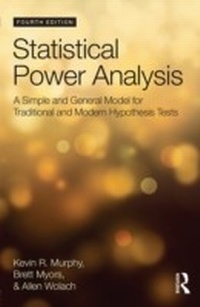
Statistical Power Analysis
A Simple and General Model for Traditional and Modern Hypothesis Tests, Fourth Edition
4th Edition
Published on 16. May 2014
244 pages
978-1-317-68056-7 (ISBN)
Description

Noted for its accessible approach, this text applies the latest approaches of power analysis to both null hypothesis and minimum-effect testing using the same basic unified model. Through the use of a few simple procedures and examples, the authors show readers with little expertise in statistical analysis how to obtain the values needed to carry out the power analysis for their research. Illustrations of how these analyses work and how they can be used to choose the appropriate criterion for defining statistically significant outcomes are sprinkled throughout. The book presents a simple and general model for statistical power analysis based on the F statistic and reviews how to determine: the sample size needed to achieve desired levels of power; the level of power needed in a study; the size of effect that can be reliably detected by a study; and sensible criteria for statistical significance. The book helps readers design studies, diagnose existing studies, and understand why hypothesis tests come out out the way they do.
The fourth edition features:
-New Boxed Material sections provide examples of power analysis in action and discuss unique issues that arise as a result of applying power analyses in different designs.
-Many more worked examples help readers apply the concepts presented.
-Expanded coverage of power analysis for multifactor analysis of variance (ANOVA) to show readers how to analyze up to four factors with repeated measures on any or all of the factors.
-Re-designed and expanded web based One Stop F Calculator software and data sets that allow users to perform all of the book's analyses and conduct significance tests, power analyses, and assessments of N and alpha needed for traditional and minimum-effects tests.
-Easy to apply formulas for approximating the number of subjects required to reach adequate levels of power in a wide range of studies.
Intended as a supplement for graduate/advanced undergraduate courses in research methods or experimental design, intermediate, advanced, or multivariate statistics, statistics II, or psychometrics, taught in psychology, education, business, and other social and health sciences, researchers also appreciate the book's applied approach.
The fourth edition features:
-New Boxed Material sections provide examples of power analysis in action and discuss unique issues that arise as a result of applying power analyses in different designs.
-Many more worked examples help readers apply the concepts presented.
-Expanded coverage of power analysis for multifactor analysis of variance (ANOVA) to show readers how to analyze up to four factors with repeated measures on any or all of the factors.
-Re-designed and expanded web based One Stop F Calculator software and data sets that allow users to perform all of the book's analyses and conduct significance tests, power analyses, and assessments of N and alpha needed for traditional and minimum-effects tests.
-Easy to apply formulas for approximating the number of subjects required to reach adequate levels of power in a wide range of studies.
Intended as a supplement for graduate/advanced undergraduate courses in research methods or experimental design, intermediate, advanced, or multivariate statistics, statistics II, or psychometrics, taught in psychology, education, business, and other social and health sciences, researchers also appreciate the book's applied approach.
Reviews / Votes
"The detailed coverage of conducting a full power analysis, as well as the simple estimates ... allows students to not only understand the benefit of power analysis, but also gives them a good guideline for adequate sample sizes to ensure that they at least come close to the adequate sample. ... Faculty members who are teaching quantitative research courses ... should expose their students ... to this book. ... It is written in a way that is approachable to graduate level students." - Brigitte Vittrup, Texas Women's University, USA"The explanation of how power can be estimated using a unified method of F transformations ... helps readers understand the workings behind the mysterious tables that are available elsewhere ... and ... behind ... power calculators. ... I use this book in my research design course. ... I intend to continue using this book. ... The sections on determining sensitivity and decision criteria are important, well written and frequently missed in other texts. ... The authors write clearly. ... The boxed examples are one of the best features." - Patricia Newcomb, University of Texas at Arlington, USA
"I have always liked the critical discussion of the traditional null hypothesis, and the minimum effect size alternative central to this book. ... The [new edition] ... benefits from adding discussion about various designs such as multifactorial ANOVA ... [which] offer ideas [on] how to plan more complex experiments, and expand the applicability of power analysis." - Andres Kriete, Drexel University, USA
"This concise yet detailed text fills a vital niche for graduate students and seasoned researchers alike, providing an understanding of the basic tenets of statistical power, and its application to a variety of hypothesis testing scenarios." - Chris Stride, University of Sheffield, UK "The detailed coverage of conducting a full power analysis, as well as the simple estimates ... allows students to not only understand the benefit of power analysis, but also gives them a good guideline for adequate sample sizes to ensure that they at least come close to the adequate sample. ... Faculty members ...should expose their students ... to this book. ...It is written in a way that is approachable to graduate level students." - Brigitte Vittrup, Texas Women's University, USA
"This concise yet detailed text fills a vital niche for graduate students and seasoned researchers alike, providing an understanding of the basic tenets of statistical power, and its application to a variety of hypothesis testing scenarios."- Chris Stride, University of Sheffield, UK
"The explanation of how power can be estimated using a unified method of F transformations ... helps readers understand the workings behind the mysterious tables that are available elsewhere. ... I use this book in my research design course. ... The sections on determining sensitivity and decision criteria are... frequently missed in other texts. ... The authors write clearly." - Patricia Newcomb, University of Texas at Arlington, USA
"I have always liked the critical discussion of the traditional null hypothesis, and the minimum effect size alternative central to this book. ... The [new edition] ... benefits from adding discussion about various designs such as multifactorial ANOVA ... [which] offer ideas [on] how to plan more complex experiments and expand the applicability of power analysis." - Andres Kriete, Drexel University, USA
More details
Edition
4th edition
Language
English
Place of publication
London
United Kingdom
Publishing group
Taylor & Francis Ltd
Target group
College/higher education
Edition type
Revised edition
Illustrations
12 s/w Abbildungen, 19 s/w Tabellen, 2 s/w Photographien bzw. Rasterbilder, 10 s/w Zeichnungen
19 Tables, black and white; 10 Line drawings, black and white; 2 Halftones, black and white; 12 Illustrations, black and white
ISBN-13
978-1-317-68056-7 (9781317680567)
Copyright in bibliographic data and cover images is held by Nielsen Book Services Limited or by the publishers or by their respective licensors: all rights reserved.
Schweitzer Classification
Other editions
Additional editions
Brett Myors | Kevin R. Murphy | Allen Wolach
Statistical Power Analysis
A Simple and General Model for Traditional and Modern Hypothesis Tests, Fourth Edition
Book
05/2014
4th Edition
Routledge
€237.70
Article exhausted; check for reprint
Brett Myors | Kevin R. Murphy | Allen Wolach
Statistical Power Analysis
A Simple and General Model for Traditional and Modern Hypothesis Tests, Fourth Edition
Book
05/2014
4th Edition
Routledge
€84.36
Article exhausted; check for reprint
Persons
Kevin R. Murphy is an Affiliate Faculty member at Colorado State University.
Brett Myors is an Adjunct Professor of Psychology at Griffith University in Australia.
Allen Wolach is a retired Professor of Psychology from Illinois Institute of Psychology.
Brett Myors is an Adjunct Professor of Psychology at Griffith University in Australia.
Allen Wolach is a retired Professor of Psychology from Illinois Institute of Psychology.
Content
1. The Power of Statistical Tests. 2. A Simple and General Model for Power Analysis. 3. Power Analyses for Minimum-Effect Tests. 4. Using Power Analyses. 5. Correlation and Regression. 6. t-Tests and the One-Way Analysis of Variance. 7. Multi-Factor ANOVA Designs. 8. Studies with Multiple Observations for Each Subject: Repeated-Measures and Multivariate Analyses. 9. The Implications of Power Analyses. Appendix A. Translating Statistics into F and Calculating the Percentage of Variance Explained. Appendix B. One Stop F Table. Appendix C. One Stop PV Table. Appendix D. Working With the Noncentral F Distribution. Appendix E. The dfErr Needed for Power = .80 (Alpha = 0.05) in Tests of Traditional Null Hypothesis. Appendix F. The dfErr Needed for Power = .80 (Alpha = 0.05) in Tests of the Hypothesis That Treatments Account for 1% or Less in the Variance of Outcomes.
