

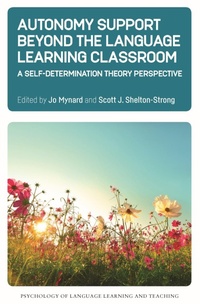
Autonomy Support Beyond the Language Learning Classroom
A Self-Determination Theory Perspective
Published on 4. April 2022
280 pages
978-1-78892-906-6 (ISBN)
Description

Through the application of self-determination theory (SDT) to research and practice, this book deepens our understanding of how autonomous language learning can be supported and understood within environments outside of the classroom. Theoretical, empirical and practice-focused chapters examine autonomy support in a range of contexts and settings, dealing with learning environments and open spaces, communities and relationships, and advising and self-access language learning. They reveal what occurs beyond the classroom, how socializing agents support autonomous motivation and wellness, and how SDT can enhance our understanding of supporting language learner autonomy. It will be of interest to language teachers, university lecturers and learning advisors who are providing support outside the classroom, as well as to graduate students and researchers who are working in the fields of applied linguistics and TESOL.
Reviews / Votes
This is the most authoritative book yet applying self-determination theory to language learning. Chapters written by top practitioners and expert researchers provide ideas on how to motivate language students both in and out of the classroom. An incredible resource for language teachers and for educators more generally. * Richard M. Ryan, Australian Catholic University, Australia * This volume provides rich insights into how students can be supported in their language learning beyond the classroom. It uses self-determination theory as a valuable conceptual lens to deepen our understanding of language learner autonomy, and of the relationship between the individual and the (social) environment. The book is an excellent resource for all those involved in supporting and researching language learners beyond the classroom. * Ema Ushioda, University of Warwick, UK * This compilation of theoretical and empirical articles is a much-needed contribution, insofar as it seeks to find solutions to dealing with changing language learning scenarios. * David Rixham, EFL Teacher, White Rose, Spain, IATEFL Voices, Issue 289 *More details
Series
Language
English
Place of publication
Bristol
United Kingdom
Target group
College/higher education
Product notice
Reflowable
ISBN-13
978-1-78892-906-6 (9781788929066)
Copyright in bibliographic data and cover images is held by Nielsen Book Services Limited or by the publishers or by their respective licensors: all rights reserved.
Schweitzer Classification
Other editions
Additional editions
Jo Mynard | Scott J. Shelton-Strong
Autonomy Support Beyond the Language Learning Classroom
A Self-Determination Theory Perspective
Book
04/2022
Multilingual Matters
€56.20
Shipment within 3-4 weeks
Persons
Jo Mynard is a Professor, Director of the Self-Access Learning Center and Director of the Research Institute for Learner Autonomy Education at Kanda University of International Studies, Japan. She is the lead author of Dynamics of a Social Language Learning Community: Beliefs, Membership and Identity (2020, Multilingual Matters).
Scott J. Shelton-Strong is a Learning Advisor and Lecturer at Kanda University of International Studies, Japan. His research focuses on advising in language learning, self-determination theory, reflection as autonomy support, emotions in language learning and the connections which interlink these to learner well-being and engagement.
Scott J. Shelton-Strong is a Learning Advisor and Lecturer at Kanda University of International Studies, Japan. His research focuses on advising in language learning, self-determination theory, reflection as autonomy support, emotions in language learning and the connections which interlink these to learner well-being and engagement.
Content
Tables and Figures
Contributors
Jo Mynard and Scott J. Shelton-Strong: Introduction: Autonomy Support Beyond the Language Learning Classroom: A Self-Determination Theory Perspective
Part 1: Theoretical Underpinnings
1. Johnmarshall Reeve: A Brief but Comprehensive Overview of Self-Determination Theory
2. Johnmarshall Reeve: What it Means to 'Take Ownership over One's Own Learning' in a Self-Determination Theory Analysis
Part 2: Autonomy Support in Learning Environments and Open Spaces
3. Ali Dincer and Tuba Isik: Understanding the Inner Motivational Resources of Language Learners' Out-of-class Technology Use for Language Learning
4. Xuan Hoang, Alice Chik, Ruth French and Sue Ollerhead: Vietnamese EFL Students' Out-of-classroom Motivation Viewed through Self-Determination Theory
5. Yanling Li, Jiaxiu Zhang and Pingying Hu: Autonomy-supportive Online EFL Writing: A Self-Determination Theory Perspective
6. Satoko Watkins: Creating Social Learning Opportunities Outside the Classroom: How Interest-based Learning Communities Support Learners' Basic Psychological Needs
Part 3: Autonomy Support in Communities and Relationships
7. Mustafa Firat, Kimberly A. Noels and Nigel Mantou Lou: Self-Determined Motivation in Language Learning beyond the Classroom: Interpersonal, Intergroup and Intercultural Processes
8. W.L. Quint Oga-Baldwin: The Quality of Our Connections Matters: Relationships Motivation Theory in Independent Language Learning
9. Satoko Kato: Establishing High-Quality Relationships through a Mentoring Programme: Relationships Motivation Theory
Part 4: Autonomy Support in Advising and Self-Access for Language Learning
10. Scott J. Shelton-Strong and Maria Giovanna Tassinari: Facilitating an Autonomy-Supportive Learning Climate: Advising in Language Learning and Basic Psychological Needs
11. Micol Beseghi: Mindfulness and Advising in Language Learning: A Self-Determination Theory Perspective
12. Jo Mynard: Reimagining the Self-Access Centre as a Place to Thrive
Scott J. Shelton-Strong: Conclusion: Where to Go from Here?
Index
Contributors
Jo Mynard and Scott J. Shelton-Strong: Introduction: Autonomy Support Beyond the Language Learning Classroom: A Self-Determination Theory Perspective
Part 1: Theoretical Underpinnings
1. Johnmarshall Reeve: A Brief but Comprehensive Overview of Self-Determination Theory
2. Johnmarshall Reeve: What it Means to 'Take Ownership over One's Own Learning' in a Self-Determination Theory Analysis
Part 2: Autonomy Support in Learning Environments and Open Spaces
3. Ali Dincer and Tuba Isik: Understanding the Inner Motivational Resources of Language Learners' Out-of-class Technology Use for Language Learning
4. Xuan Hoang, Alice Chik, Ruth French and Sue Ollerhead: Vietnamese EFL Students' Out-of-classroom Motivation Viewed through Self-Determination Theory
5. Yanling Li, Jiaxiu Zhang and Pingying Hu: Autonomy-supportive Online EFL Writing: A Self-Determination Theory Perspective
6. Satoko Watkins: Creating Social Learning Opportunities Outside the Classroom: How Interest-based Learning Communities Support Learners' Basic Psychological Needs
Part 3: Autonomy Support in Communities and Relationships
7. Mustafa Firat, Kimberly A. Noels and Nigel Mantou Lou: Self-Determined Motivation in Language Learning beyond the Classroom: Interpersonal, Intergroup and Intercultural Processes
8. W.L. Quint Oga-Baldwin: The Quality of Our Connections Matters: Relationships Motivation Theory in Independent Language Learning
9. Satoko Kato: Establishing High-Quality Relationships through a Mentoring Programme: Relationships Motivation Theory
Part 4: Autonomy Support in Advising and Self-Access for Language Learning
10. Scott J. Shelton-Strong and Maria Giovanna Tassinari: Facilitating an Autonomy-Supportive Learning Climate: Advising in Language Learning and Basic Psychological Needs
11. Micol Beseghi: Mindfulness and Advising in Language Learning: A Self-Determination Theory Perspective
12. Jo Mynard: Reimagining the Self-Access Centre as a Place to Thrive
Scott J. Shelton-Strong: Conclusion: Where to Go from Here?
Index
