

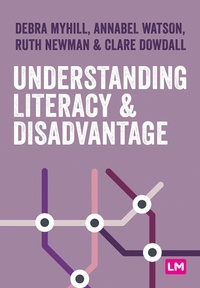
Understanding Literacy and Disadvantage
1st Edition
Published on 2. June 2022
152 pages
978-1-5297-8766-5 (ISBN)
Description

Addressing literacy and disadvantage requires high-quality teaching, first and foremost: there are no quick fixes, simplistic solutions or silver bullets.
Both research and professional evidence from schools have revealed a strong association between social disadvantage and achievement in literacy: in fact, it has been a concern for over 70 years. Yet, many trainee teachers, and teachers in general, feel ill-equipped to deal with the issue. This book supports trainee teachers to explore the complex relationships between literacy achievement and social background. It offers practical strategies for teaching and supports trainee teachers to understand that:
*children's individual backgrounds need to be valued and drawn upon;
*deficit descriptions of disadvantaged children and low expectations must be avoided and challenged;
*schools, teachers and classrooms must provider rich literacy environments for learning.
Both research and professional evidence from schools have revealed a strong association between social disadvantage and achievement in literacy: in fact, it has been a concern for over 70 years. Yet, many trainee teachers, and teachers in general, feel ill-equipped to deal with the issue. This book supports trainee teachers to explore the complex relationships between literacy achievement and social background. It offers practical strategies for teaching and supports trainee teachers to understand that:
*children's individual backgrounds need to be valued and drawn upon;
*deficit descriptions of disadvantaged children and low expectations must be avoided and challenged;
*schools, teachers and classrooms must provider rich literacy environments for learning.
More details
Series
Edition
1. Auflage
Language
English
Place of publication
London
United Kingdom
Publishing group
Sage Publications Ltd
Target group
College/higher education
Product notice
Reflowable
ISBN-13
978-1-5297-8766-5 (9781529787665)
Copyright in bibliographic data and cover images is held by Nielsen Book Services Limited or by the publishers or by their respective licensors: all rights reserved.
Schweitzer Classification
Other editions
Additional editions
Debra Myhill | Annabel Watson | Ruth Newman
Understanding Literacy and Disadvantage
Book
06/2022
1st Edition
Learning Matters Ltd
€103.20
Shipment within 15-20 days
Debra Myhill | Annabel Watson | Ruth Newman
Understanding Literacy and Disadvantage
Book
06/2022
1st Edition
Learning Matters Ltd
€56.60
Shipment within 15-20 days
Persons
Debra Myhill is Professor of Education at the University of Exeter, UK, and Director of the Centre for Research in Writing, which promotes inter-disciplinary research, drawing on psychological, socio-cultural and linguistic perspectives on writing. Her research interests focus principally on writing and the teaching of writing, particularly linguistic and metalinguistic development, the composing processes involved in writing, the talk-writing relationship, and creative writing. Underpinning this research is the principle that literacy, especially writing, is a pathway to empowerment. Over the past twenty years, she has led a series of research projects in these areas, in both primary and secondary schools.
Key Publications
Chen, H. Myhill, D. A and Lewis, H. (2020) Developing writers across primary and secondary years: Growing into Writing. London: Routledge
Annabel Watson is Programme Director for Exeter School Direct initial teacher training courses and lead the Exeter Secondary English PGCE. Her research interests focus primarily on the teaching of writing. She is a member of the Graduate School of Education's Centre for Research in Writing. Annabel is interested in the relationship between traditional and digital literacy and the development of students' writing ability in relation to digital texts and technologies. Her PhD examined Teacher's Beliefs and Practices in Grammar Teaching. Ruth Newman is Senior Lecturer in Language Education at the Graduate School of Education, University of Exeter. Her research interests focus on the role of talk in the teaching of language and literacy, including the role of dialogic metatalk in the development of metalinguistic understanding and writing. Ruth is a member of the Centre for Research in Writing and teach primarily on the Secondary English PGCE programme and MA Language and Literacy. Before joining Exeter, I worked as a secondary English teacher. Clare Dowdall is a Lecturer in Education (Language and Literacy) at Exeter's Graduate School of Education. Prior to this, Clare was Lecturer in Language and Literacy Education at University of Plymouth. Clare has a range of experiences in teaching and researching literacy education. She graduated from Exeter University with a BA(Ed) in English and Drama in 1997, worked in Devon as a teacher and literacy subject leader, and then completed an MA(Ed) in Language and Literacy with University of Plymouth. Clare completed her PhD in children's text production in online social networking sites, also with University of Plymouth.
Key Publications
Chen, H. Myhill, D. A and Lewis, H. (2020) Developing writers across primary and secondary years: Growing into Writing. London: Routledge
Annabel Watson is Programme Director for Exeter School Direct initial teacher training courses and lead the Exeter Secondary English PGCE. Her research interests focus primarily on the teaching of writing. She is a member of the Graduate School of Education's Centre for Research in Writing. Annabel is interested in the relationship between traditional and digital literacy and the development of students' writing ability in relation to digital texts and technologies. Her PhD examined Teacher's Beliefs and Practices in Grammar Teaching. Ruth Newman is Senior Lecturer in Language Education at the Graduate School of Education, University of Exeter. Her research interests focus on the role of talk in the teaching of language and literacy, including the role of dialogic metatalk in the development of metalinguistic understanding and writing. Ruth is a member of the Centre for Research in Writing and teach primarily on the Secondary English PGCE programme and MA Language and Literacy. Before joining Exeter, I worked as a secondary English teacher. Clare Dowdall is a Lecturer in Education (Language and Literacy) at Exeter's Graduate School of Education. Prior to this, Clare was Lecturer in Language and Literacy Education at University of Plymouth. Clare has a range of experiences in teaching and researching literacy education. She graduated from Exeter University with a BA(Ed) in English and Drama in 1997, worked in Devon as a teacher and literacy subject leader, and then completed an MA(Ed) in Language and Literacy with University of Plymouth. Clare completed her PhD in children's text production in online social networking sites, also with University of Plymouth.
Content
Understanding the relationship between literacy and social disadvantage
Building foundations for literacy in the Early Years
Talk for learning and democratic participation
Reading the world
Words and worlds: the challenge of vocabulary
Creating a community of writers
Enriching literacy with digital resources
Literacy environments, culture and experience
Building foundations for literacy in the Early Years
Talk for learning and democratic participation
Reading the world
Words and worlds: the challenge of vocabulary
Creating a community of writers
Enriching literacy with digital resources
Literacy environments, culture and experience
