

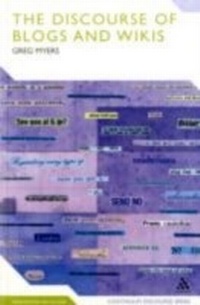
The Discourse of Blogs and Wikis
1st Edition
Published on 10. November 2009
192 pages
978-1-4411-4623-6 (ISBN)
Description

Blogs and Wikis have not been with us for long, but have made a huge impact on society. Wikipedia is the best known exemplar of the wiki, a collaborative site that leads to a single text claimed by no-one; blogs, or web-logs, have exploded into the mainstream through novelisations, film adaptations and have gathered huge followings. Blogs and wikis also serve to provide a coherent basis for a discourse analysis of specific web language.
What makes these forms distinctive as genres, and what ramifications does the technology have on the language? Myers looks at how blogs and wikis:
*allow for easier than ever publication
*can claim to challenge institutional hierarchies
*provide alternate perspectives on events
*exemplify globalization
*challenge demarcations between the personal and the public
*construct new communities and more
Drawing on a wide range of popular blogs and wikis, the book works alongside an author blog that contains regularly updated links, references and a glossary. An essential textbook for upper level undergraduates on linguistics and language studies courses, it elucidates, informs and offers insights into a major new type of discourse. This coursebook will include a companion website.
What makes these forms distinctive as genres, and what ramifications does the technology have on the language? Myers looks at how blogs and wikis:
*allow for easier than ever publication
*can claim to challenge institutional hierarchies
*provide alternate perspectives on events
*exemplify globalization
*challenge demarcations between the personal and the public
*construct new communities and more
Drawing on a wide range of popular blogs and wikis, the book works alongside an author blog that contains regularly updated links, references and a glossary. An essential textbook for upper level undergraduates on linguistics and language studies courses, it elucidates, informs and offers insights into a major new type of discourse. This coursebook will include a companion website.
Reviews / Votes
... makes a valuable contribution to the burgeoning literature that has been produced over the last few years on social web technologies... particularly useful for both students and teachers of language studies, who are interested in the study of the newly emerging communicative forms that are occurring in the interactions that blogs and wikis are enabling... The format of the book is reader-friendly and its methodological approach clearly explained... ... informs and offers insights into two major newtypes of discourse, weblogs (or blogs) and wikis, which have made a huge impact on electronic communication and provide a basis for the analysis of discourse and genres on the internet. The online genres of blogs and wikis like Wikipedia can help focus on some taken-for-granted aspects of language in social interaction becoming important in political, social and economic spheres--aspects often eclipsed by a fixation on the technology. Myers analyzes the dimensions of these distinctive types of text, devices used to address an intended audience and convey stances, and debates, e.g., over whether Wikipedia should have a 'Neutral Point of View' (NPOV). The book includes examples, notes on student projects, blog addresses, and a glossary. * Book News Inc *More details
Series
Edition
1. Auflage
Language
English
Place of publication
New York
United States
ISBN-13
978-1-4411-4623-6 (9781441146236)
Copyright in bibliographic data and cover images is held by Nielsen Book Services Limited or by the publishers or by their respective licensors: all rights reserved.
Schweitzer Classification
Other editions
Additional editions
Greg Myers
The Discourse of Blogs and Wikis
Book
11/2009
Continuum International Publishing Group Ltd.
€232.00
Shipment within 3-4 weeks
Greg Myers
The Discourse of Blogs and Wikis
Book
11/2009
Continuum International Publishing Group Ltd.
€63.50
Shipment within 3-4 weeks
Person
Greg Myers is Professor of Rhetoric and Communication at Lancaster University, UK. Visit his blog: The Language of Blogs [http://thelanguageofblogs.typepad.com/]
Content
Preface
1. Introduction: A Linguist in the Blogosphere
2 . Genre: What is a Blog? What is a Wiki?
3. Text: What's in a Link?
4. Spaces: Where is the Blogger?
5. Time: Writing for the Moment
6. Audience: Who Reads this Stuff?
7. Opinions: Where Do I Stand?
8. Evidence: How Do We Know?
9. Facts: How Wikipedia Grows
10. Collaboration: Revision and Interaction in Wikipedia
11. Studying Blogs and Wikis: Where Do I Start?
Glossary
References
Links
Index
1. Introduction: A Linguist in the Blogosphere
2 . Genre: What is a Blog? What is a Wiki?
3. Text: What's in a Link?
4. Spaces: Where is the Blogger?
5. Time: Writing for the Moment
6. Audience: Who Reads this Stuff?
7. Opinions: Where Do I Stand?
8. Evidence: How Do We Know?
9. Facts: How Wikipedia Grows
10. Collaboration: Revision and Interaction in Wikipedia
11. Studying Blogs and Wikis: Where Do I Start?
Glossary
References
Links
Index
