

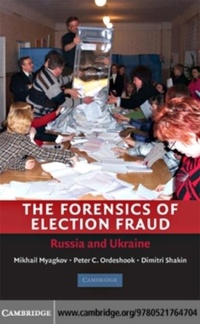
The Forensics of Election Fraud
Russia and Ukraine
1st Edition
Published on 13. July 2009
978-0-511-53711-0 (ISBN)
Description

This volume offers a number of forensic indicators of election fraud applied to official election returns, and tests and illustrates their application in Russia and Ukraine. Included are the methodology's econometric details and theoretical assumptions. The applications to Russia include the analysis of all federal elections between 1996 and 2007 and, for Ukraine, between 2004 and 2007. Generally, we find that fraud has metastasized within the Russian polity during Putin's administration with upwards of 10 million or more suspect votes in both the 2004 and 2007 balloting, whereas in Ukraine, fraud has diminished considerably since the second round of its 2004 presidential election where between 1.5 and 3 million votes were falsified. The volume concludes with a consideration of data from the United States to illustrate the dangers of the application of our methods without due consideration of an election's substantive context and the characteristics of the data at hand.
Reviews / Votes
"The Forensics of Election Fraud by Myagkov, Ordeshook and Shakin presents a novel, creative and powerful methodology to detect the possibility of vote fraud using aggregate precinct data from several elections. Their approach is to detect patterns that flag vote fraud. They do not use standard statistical methodology because it is not appropriate for their problem but instead their method presents evidence that may be due to fraud. I consider this book to be one of the best three book manuscripts in political methodology that I have ever read. I believe that it will be considered to be a masterpiece in the field."-Melvin J. Hinich, University of Texas at Austin "This book is a milestone accomplishment: original, compelling and of utmost and immediate policy relevance. It brings the latest in social science theory and methodology to bear on the detection of electoral fraud in post-communist states. As a control, it then applies the techniques to US elections. The result is a seminal forensics toolkit for methodologists and policy makers alike."
-George Breslauer, University of California at Berkeley "The Forensics of Election Fraud is powerful, persuasive, and vigorously written. The book is important, not only for its substantive findings about Russia and Ukraine, but, perhaps even more, for the ingenious methodology its authors have devised for uncovering large-scale vote fraud. One of their major findings is that in recent years in Russia, the practice of vote fraud has spread from a relatively small number of ethnic republics, which are dominated by authoritarian leaders, to a much larger number of regions. So by the time of the 2004 presidential election and the 2007 Duma election, fraud was widespread. They also argue that the 2008 presidential election was so heavily manipulated that it is not worth applying their methods to it. Myagkov, Ordeshook and Shakin also analyze fraud in the famous 2004 Ukrainian presidential election, where massive falsifications provoked the 'Orange Revolution.' They show the very different patterns of voting from the (corrupted) run-off election in November 2004 to the (largely free and fair) new run-off in December, which followed the massive popular protest over election falsification and the world-wide condemnation of the attempt to steal the election. This book makes a major contribution to the literature on the methods by which authoritarian rulers manipulate election outcomes, and offers an ingenious set of tools for detecting them."
-Thomas Remington, Emory University
More details
Language
English
Place of publication
Cambridge
United Kingdom
Publishing group
Cambridge University Press
Target group
Professional and scholarly
Illustrations
35 Tables, unspecified; 162 Line drawings, unspecified
File size
6,19 MB
ISBN-13
978-0-511-53711-0 (9780511537110)
Copyright in bibliographic data and cover images is held by Nielsen Book Services Limited or by the publishers or by their respective licensors: all rights reserved.
Schweitzer Classification
Other editions
Additional editions
Mikhail Myagkov | Peter C. Ordeshook | Dimitri Shakin
The Forensics of Election Fraud
Russia and Ukraine
Book
05/2009
Cambridge University Press
€45.40
Shipment within 15-20 days
Mikhail Myagkov | Peter C. Ordeshook | Dimitri Shakin
The Forensics of Election Fraud
Russia and Ukraine
Book
04/2009
Cambridge University Press
€77.60
Shipment within 15-20 days
Persons
Mikhail Myagkov is a graduate of the Moscow Institute of Physics and Technology and holds a PhD from the California Institute of Technology. A specialist in Russian politics, political methodology and laboratory experiments in political economy; published extensively in Post Soviet Affairs. Peter C. Ordeshook is a member of the American Academy of Arts and Sciences and has published over 120 papers in professional journals, including the American Political Science Review, Post-Soviet Affairs, Constitutional Political Economy and Post-Soviet Geography and Economics. His authored and coauthored books include An Introduction to Positive Political Theory; Game Theory and Political Theory; The Balance of Power; Designing Federalism; A Political Theory Primer; Endogenous Time Preferences in Social Networks; and Lessons for Citizens of a New Democracy (in English, Italian and Ukrainian). Dmitry Shakin holds a PhD in mathematics from Moscow State University. He is a specialist in commutative algebra, financial econometrics and Russian politics.
Content
Introduction; 1. A forensics approach to detecting election fraud; 2. The fingerprints of fraud; 3. Russia; 4. Ukraine, 2004; 5. Ukraine, 2006, 2007; 6. The United States.
