

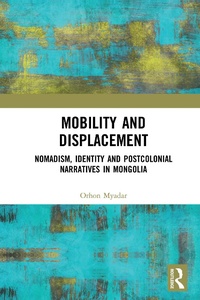
Mobility and Displacement
Nomadism, Identity and Postcolonial Narratives in Mongolia
1st Edition
Published on 29. September 2020
136 pages
978-1-000-19059-5 (ISBN)
Description

This book explores and contests both outsiders' projections of Mongolia and the self-objectifying tropes Mongolians routinely deploy to represent their own country as a land of nomads.
It speaks to the experiences of many societies and cultures that are routinely treated as exotic, romantic, primitive or otherwise different and Other in Euro-American imaginaries, and how these imaginaries are also internally produced by those societies themselves. The assumption that Mongolia is a nomadic nation is largely predicated upon Mongolia's environmental and climatic conditions, which are understood to make Mongolia suitable for little else than pastoral nomadism. But to the contrary, the majority of Mongolians have been settled in and around cities and small population centers. Even Mongolians who are herders have long been unable to move freely in a smooth space, as dictated by the needs of their herds, and as they would as free-roaming "nomads." Instead, they have been subjected to various constraints across time that have significantly limited their movement. The book weaves threads from disparate branches of Mongolian studies to expose various visible and invisible constraints on population mobility in Mongolia from the Qing period to the post-socialist era.
With its in-depth analysis of the complexities of the relationship between land rights, mobility, displacement, and the state, the book makes a valuable contribution to the fields of cultural geography, political geography, heritage and culture studies, as well as Eurasian and Inner-Asian Studies.
Winner of the Julian Minghi Distinguished Book Award (AAG, 2022)
It speaks to the experiences of many societies and cultures that are routinely treated as exotic, romantic, primitive or otherwise different and Other in Euro-American imaginaries, and how these imaginaries are also internally produced by those societies themselves. The assumption that Mongolia is a nomadic nation is largely predicated upon Mongolia's environmental and climatic conditions, which are understood to make Mongolia suitable for little else than pastoral nomadism. But to the contrary, the majority of Mongolians have been settled in and around cities and small population centers. Even Mongolians who are herders have long been unable to move freely in a smooth space, as dictated by the needs of their herds, and as they would as free-roaming "nomads." Instead, they have been subjected to various constraints across time that have significantly limited their movement. The book weaves threads from disparate branches of Mongolian studies to expose various visible and invisible constraints on population mobility in Mongolia from the Qing period to the post-socialist era.
With its in-depth analysis of the complexities of the relationship between land rights, mobility, displacement, and the state, the book makes a valuable contribution to the fields of cultural geography, political geography, heritage and culture studies, as well as Eurasian and Inner-Asian Studies.
Winner of the Julian Minghi Distinguished Book Award (AAG, 2022)
Reviews / Votes
"Myadar contributes a finely argued introduction to how 'nomadism' as the lynchpin of Mongolian identity is both a persistent illusion and an ambivalent slogan. Mobility and Displacement raises crucial questions related to how this concept functions in a world of international brands and images. Answering those questions is a vital task." Christopher Atwood, Nomadic Peoples 26 No.1 (2022)"One of the book's impressive features, among many, is how Myadar reflexively questions her own experiences, attachments and trajectory as someone who grew up in Mongolia and has spent the last several decades living and working as a scholar in the US....It is to the book's tremendous credit that it opens up a space in which such questions can be asked by displacing the figure of the nomad, which, contrary to its evocation, has become frozen in time." Christian Sorace, Inner Asia 23 (20 21) 351-360 (2022)
"The book is a concise, readable, thought-provoking contribution to the literature on Mongolia. But it is more than that. It well illustrates the power and consequences of particular narratives about places, as well as the way those narratives reflect and shape cultural understandings/stereotypes that are driven by the culturally and politically driven impulses of outsiders and insiders alike. The latter point has particular significance for how we approach the "sense of place" concept. As Myadar makes clear, the dominant narrative about Mongolia is not just a product of external stereotyping; it is also reflected and reinforced internally as Mongolia seeks to carve out its independence from its powerful neighbors and promote nation-building. There is, in short, a synergistic external-internal dynamic at work in the development of Mongolia's sense of place - a point with obvious significance for work in cultural geography focused on the emotive and imaginary dimensions of place." Murphy, Alexander B. (2022): 474-475.
More details
Edition
1. Auflage
Language
English
Place of publication
London
United Kingdom
Publishing group
Taylor & Francis Ltd
Target group
College/higher education
Illustrations
10 Halftones, black and white; 10 Illustrations, black and white
ISBN-13
978-1-000-19059-5 (9781000190595)
Copyright in bibliographic data and cover images is held by Nielsen Book Services Limited or by the publishers or by their respective licensors: all rights reserved.
Schweitzer Classification
Other editions
Additional editions
Book
04/2022
1st Edition
Routledge
€64.60
Shipment within 15-20 days
Book
09/2020
1st Edition
Routledge
€205.70
Shipment within 15-20 days
Person
Orhon Myadar is a political geographer at the University of Arizona. She studies the intersection of geography and politics at various scales, specifically how borders of belonging or exclusion shape everyday struggles of underserved and marginalized individuals and communities.
Content
1. Mongolia, Environment, and Nomadism 2. Making of Nomads: The Nomad Figure and Habitus 3. The Nomad Figure as the Imagined "Other" 4. Performing the Nomadic Identity 5. Mobility, Displacement, and Colonial Violence: The Qing Colonial Period (1650-1911) 6. In the Soviet Shadow (1921-1991) 7. Fenced Land: Discourse of Land in Post-Socialist Mongolia (1990-Present) Conclusion: Whence the Land of Nomads
