

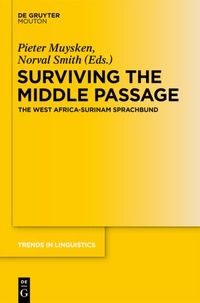
Surviving the Middle Passage
The West Africa-Surinam Sprachbund
1st Edition
Published on 12. December 2014
X, 532 pages
978-3-11-034397-7 (ISBN)
Available for download
Description

This book is about the close historical and linguistic relationship between the languages of Surinam and Benin, a relationship which can be viewed in terms of a Trans Atlantic Sprachbund or linguistic area. It consists of a detailed analysis of various possible substrate and adstrate effects in a number of components of the grammar, in the Surinam Creole languages, primarily from the Gbe languages of Benin but also from Kikongo.
More details
Other editions
Additional editions
Book
06/2017
1st Edition
De Gruyter Mouton
€29.95
Shipment within 7-9 days
E-Book
12/2014
1st Edition
De Gruyter Mouton
€189.95
Available for download
Book
11/2014
1st Edition
De Gruyter Mouton
€189.95
Shipment within 7-9 days
Persons
Pieter Muysken, Radboud University, Nijmegen, The Netherlands; Norval Smith, University of Amsterdam, The Netherlands.
Content
- Intro
- Acknowledgements
- Introduction: Creole studies and Contact Linguistics
- Part 1. Setting the Scene
- The early history of Surinam: Why is Surinam different?
- Migrations, ethno-dynamics and geolinguistics in the Eastern Aja-Tado cultural Area
- Ingredient X: The shared African lexical element in the English- lexifier Atlantic Creoles, and the theory of rapid creolization
- Relexification, and other language contact scenarios for explaining substrate effects
- Part II. Language structures: a Sprachbund?
- Trans-Atlantic patterns: the relexification of locative constructions in Sranan
- Verb Semantics and Argument Structure in the Gbe and Sranan
- Morphology, cross-linguistic effects, and Creole formation
- Non-iconic reduplications in Eastern Gbe and Surinam
- Substrate phonology, superstrate phonology and adstrate phonology in creole languages
- The left periphery in the Surinamese creoles and Gbe: on the modularity of substrate transfer
- Relexification and clause-embedding predicates
- Part III. Wrapping up
- Conclusion: feature distribution in the West Africa-Surinam Trans-Atlantic Sprachbund
- Bibliography of work resulting from the Trans-Atlantic Sprachbund project
- A preliminary list of probable Kikongo lexical items in the Surinam Creole languages
- A preliminary list of probable Gbe lexical items in the Surinam Creole languages
- References
- Indices

