

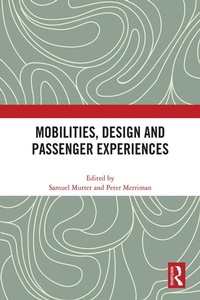
Mobilities, Design and Passenger Experiences
Published on 4. May 2026
164 pages
978-1-040-91791-6 (ISBN)
Description

This book examines different aspects of public transport design and its relationship to passenger experiences, reflecting the growing concern with approaching mobility through the lens of the arts and humanities and social sciences.
The chapters in this book explore how transport environments, mobility infrastructures, and embodied movement practices have been shaped and 'designed' by a whole host of experts, professionals and political actors for different ends. Examples focus on a range of transport modes in different parts of the world, including buses in urban Chile, underground metro railways in China and the UK, and railways in Sweden and Japan. The book examines the role of architecture and design features in shaping, affording and hindering passenger flows, behaviour and experience, resulting in infrastructures which may include or exclude certain groups of passengers in different ways.
This book will be of interest to scholars and students in geography, urban planning, architecture, design studies, sociology, and mobility studies. It will also appeal to practitioners in transport planning, urban design, and public policy who are concerned with creating more inclusive and effective mobility infrastructures.
The chapters in this book were originally published as a special issue of Mobilities.
The chapters in this book explore how transport environments, mobility infrastructures, and embodied movement practices have been shaped and 'designed' by a whole host of experts, professionals and political actors for different ends. Examples focus on a range of transport modes in different parts of the world, including buses in urban Chile, underground metro railways in China and the UK, and railways in Sweden and Japan. The book examines the role of architecture and design features in shaping, affording and hindering passenger flows, behaviour and experience, resulting in infrastructures which may include or exclude certain groups of passengers in different ways.
This book will be of interest to scholars and students in geography, urban planning, architecture, design studies, sociology, and mobility studies. It will also appeal to practitioners in transport planning, urban design, and public policy who are concerned with creating more inclusive and effective mobility infrastructures.
The chapters in this book were originally published as a special issue of Mobilities.
More details
Language
English
Place of publication
London
United Kingdom
Publishing group
Taylor & Francis Ltd
Target group
College/higher education
File size
13,55 MB
ISBN-13
978-1-040-91791-6 (9781040917916)
Copyright in bibliographic data and cover images is held by Nielsen Book Services Limited or by the publishers or by their respective licensors: all rights reserved.
Schweitzer Classification
Other editions
Additional editions
Samuel Mutter | Peter Merriman
Mobilities, Design and Passenger Experiences
Book
05/2026
1st Edition
Routledge
€193.50
Shipment within 15-20 days
Persons
Samuel Mutter is Postdoctoral Researcher on the Data Stories project at Maynooth University, Ireland. He is the author of several articles on the politics of mobilities, public transport, and urban infrastructure, including in the journals Mobilities, Progress in Human Geography, and City.
Peter Merriman is Professor of Human Geography at Aberystwyth University in Wales, UK. He is the author or editor of 11 books, including The Routledge Handbook of Mobilities (co-edited 2014), Mobility and the Humanities (co-edited 2018), Space (2022), and The Routledge Handbook of Cultural Geographies (co-edited 2026).
Peter Merriman is Professor of Human Geography at Aberystwyth University in Wales, UK. He is the author or editor of 11 books, including The Routledge Handbook of Mobilities (co-edited 2014), Mobility and the Humanities (co-edited 2018), Space (2022), and The Routledge Handbook of Cultural Geographies (co-edited 2026).
Content
Introduction: Mobilities, design and passenger experiences 1. 'Watch the closing doors'- material interpellation, mobility affordance, and passenger sensations 2. Are airports like cities? Affordances and people's micro embodied interactions during the arrival experience 3. A passenger service revolution? Transport design and passenger experience on Tokyo's urban railway network, c. 1945-2010 4. 'Squeezing in': body, affect, infrastructure and everyday passenger mobilities in contemporary China 5. Turnstile politics: practices of care and mobility justice in Santiago's public transport system 6. Breaking the continuum: network aesthetics, infrastructural violence, and media responses to London Underground sexual harassment posters 7. Border controls and (im)mobilities: experiences from a public transport node Afterword: 'Designing' mobilities
