

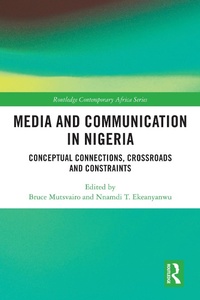
Media and Communication in Nigeria
Conceptual Connections, Crossroads and Constraints
1st Edition
Published on 30. December 2021
288 pages
978-1-000-51180-2 (ISBN)
Description

Communication is changing rapidly around the world, particularly in Africa, where citizens are embracing digital technologies not only to improve not only interpersonal communication but also the state of their financial well-being. This book investigates these transformations in Nigeria's booming communication industry.
The book traces communications in Nigeria back to pre-colonial indigenous communications, through the development of telecommunication, broadcasting networks, the press, the Nigerian film industry ('Nollywood') and on to the digital era. At a time when Western voices still dominate the academic literature on communication in Africa, this book is noteworthy in drawing almost exclusively on the expertise of Nigerian-based authors, critiquing the discipline from their own lens and providing an important contribution to the decolonisation of communication studies. The authors provide a holistic analysis of the sector, encompassing print journalism, broadcast journalism, public relations, advertising, film, development communication, organisational communication and strategic communication. Analysis of the role of digital technologies is woven throughout the book, concluding with a final section theorising the future of communication studies in Nigeria in the light of the digital media revolution.
Robust in its theoretical and methodological underpinnings, this book will be an important reference for researchers of media and communication studies, and those working on Africa specifically.
The book traces communications in Nigeria back to pre-colonial indigenous communications, through the development of telecommunication, broadcasting networks, the press, the Nigerian film industry ('Nollywood') and on to the digital era. At a time when Western voices still dominate the academic literature on communication in Africa, this book is noteworthy in drawing almost exclusively on the expertise of Nigerian-based authors, critiquing the discipline from their own lens and providing an important contribution to the decolonisation of communication studies. The authors provide a holistic analysis of the sector, encompassing print journalism, broadcast journalism, public relations, advertising, film, development communication, organisational communication and strategic communication. Analysis of the role of digital technologies is woven throughout the book, concluding with a final section theorising the future of communication studies in Nigeria in the light of the digital media revolution.
Robust in its theoretical and methodological underpinnings, this book will be an important reference for researchers of media and communication studies, and those working on Africa specifically.
More details
Series
Edition
1. Auflage
Language
English
Place of publication
London
United Kingdom
Publishing group
Taylor & Francis Ltd
Target group
College/higher education
Illustrations
12 Tables, black and white
ISBN-13
978-1-000-51180-2 (9781000511802)
Copyright in bibliographic data and cover images is held by Nielsen Book Services Limited or by the publishers or by their respective licensors: all rights reserved.
Schweitzer Classification
Other editions
Additional editions
Bruce Mutsvairo | Nnamdi T. Ekeanyanwu
Media and Communication in Nigeria
Conceptual Connections, Crossroads and Constraints
Book
08/2024
1st Edition
Routledge
€63.40
Shipment within 10-20 days
Bruce Mutsvairo | Nnamdi T. Ekeanyanwu
Media and Communication in Nigeria
Conceptual Connections, Crossroads and Constraints
Book
12/2021
1st Edition
Routledge
€206.70
Shipment within 10-20 days
Persons
Bruce Mutsvairo was most recently a Professor of Journalism at Auburn University in Alabama, USA before joining the Department of Media and Culture Studies at Utrecht University in August 2021.
Nnamdi T. Ekeanyanwu is a Professor of Communication at University of Uyo, Nigeria
Nnamdi T. Ekeanyanwu is a Professor of Communication at University of Uyo, Nigeria
Content
1. Introduction: Rethinking Communication Studies in Nigeria Part I: History and Evolution of Communication and Journalism Studies in Nigeria 2. The Nigerian Media of Communication 3. Historical and Contemporary Exploration of the Nigerian Media Landscape: Conventional to Cyber Critiques 4. Appraising the Development of the Nigerian Press: A Historical Analysis of Socio-Political, Economic and Cultural Factors 5. Historical Development and Transformation of the Nigerian Indigenous Communication Media 6. History and Evolution of Nigeria's National Broadcasting Commission (NBC) 7. Nollywood and the History of Film-Making in Nigeria: Closing the Gaps in the Narratives 8. Probing the Integration of Health Communication in Disciplinary Programmes of Nigerian Universities 9. Evolution of Organisational Communication in Nigeria: From Interpersonal to Digital Communication Part II: Technologies, Digitization and Transformation in the Nigerian Communication Industry 10. The Impact of Digital Technologies on Journalism in Nigeria 11. The Impact of the Internet on Content and Journalistic Practices Within Traditional Newspapers in Northern Nigeria 12. Digital Media and the Transformation of Traditional Medical Communication in Nigeria 13. Technologies, Media and the Transmutation of Public Relations and Advertising in Nigerian Societies 14. Evolution of Digital Media: Citizen Journalism, Ethics and Self-censorship in the Nigerian Media Industry 15. Technological Determinism and the Evolution of Nollywood Part III: Theorizing the Future of Communication Studies 16. Digitization and the Future of Communication Policy in Nigeria 17. Technological Innovations and the Future of Communication Research and Theories in Nigeria 18. Mass Communication Education in Nigeria: A Critical Appraisal of Historical and Contemporary Issues 19. Digital Media Revolution and Information Overload in Nigerian Cyberspace: The Challenges and Prospects 20. Digital Media and the Future of Development Communication in Nigeria
