

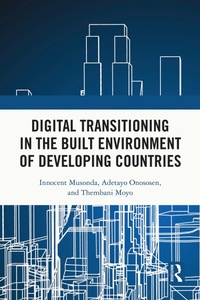
Digital Transitioning in the Built Environment of Developing Countries
Published on 21. February 2025
198 pages
978-1-040-31424-1 (ISBN)
Description

This book serves as a helpful guide for anyone interested in understanding and implementing Building Information Modelling (BIM) in developing countries. It focuses on the construction industry and how digital technologies can improve the way buildings and infrastructure projects are planned, designed, and built. The book starts by explaining what BIM is and why it's important. It then explores the challenges that developing countries face when adopting BIM, such as limited resources and lack of infrastructure. The authors provide practical solutions to overcome these challenges based on real-world examples and case studies. The book takes readers through a step-by-step process to create a roadmap for BIM adoption. It helps readers understand the necessary steps and strategies involved, such as setting clear goals, involving all relevant stakeholders, and managing changes in the way things are done.
One of the book's unique features is that it focuses specifically on the needs and circumstances of developing countries. It recognises that these countries have different challenges compared to more developed nations. By addressing these specific challenges, the book provides tailored advice that readers can apply in their own contexts. The book also emphasises the need for training and capacity building. It acknowledges that many professionals in developing countries may not have the necessary skills and knowledge to fully utilise BIM. Therefore, it introduces an approach called the dynamic capacity model, which helps ensure that people receive the training they need to successfully implement BIM. Overall, this book is a practical and accessible resource for anyone interested in implementing BIM in the construction industry of a developing country. It is important reading for professionals and academics in construction management, engineering, architecture, infrastructure development, urban planning, and governance in developing nations.
One of the book's unique features is that it focuses specifically on the needs and circumstances of developing countries. It recognises that these countries have different challenges compared to more developed nations. By addressing these specific challenges, the book provides tailored advice that readers can apply in their own contexts. The book also emphasises the need for training and capacity building. It acknowledges that many professionals in developing countries may not have the necessary skills and knowledge to fully utilise BIM. Therefore, it introduces an approach called the dynamic capacity model, which helps ensure that people receive the training they need to successfully implement BIM. Overall, this book is a practical and accessible resource for anyone interested in implementing BIM in the construction industry of a developing country. It is important reading for professionals and academics in construction management, engineering, architecture, infrastructure development, urban planning, and governance in developing nations.
More details
Language
English
Place of publication
London
United Kingdom
Publishing group
Taylor & Francis Ltd
Target group
College/higher education
Professional and scholarly
Illustrations
8 Tables, black and white; 24 Halftones, black and white; 24 Illustrations, black and white
File size
2,29 MB
ISBN-13
978-1-040-31424-1 (9781040314241)
Copyright in bibliographic data and cover images is held by Nielsen Book Services Limited or by the publishers or by their respective licensors: all rights reserved.
Schweitzer Classification
Other editions
Additional editions
Innocent Musonda | Adetayo Onososen | Thembani Moyo
Digital Transitioning in the Built Environment of Developing Countries
Book
approx. 07/2026
1st Edition
Routledge
€66.00
Not yet published

Innocent Musonda | Adetayo Onososen | Thembani Moyo
Digital Transitioning in the Built Environment in Developing Countries
Book
12/2025
Routledge
Unfortunately, price unknown
Article exhausted; check different version
Innocent Musonda | Adetayo Onososen | Thembani Moyo
Digital Transitioning in the Built Environment of Developing Countries
Book
02/2025
1st Edition
Routledge
€241.50
Shipment within 10-20 days
Persons
Innocent Musonda holds a PhD in Engineering Management and qualifications in construction management and civil engineering. He is a registered civil engineer (Zambia), a construction manager (South Africa), and a full member of the Chartered Institute of the Building (CIOB-UK) and the International Council for Research and Innovation in Building and Construction (CIB). He has worked for both the public and private sectors in Southern Africa. He is currently a Professor in Construction Project Management, researcher, invited speaker, founder, and director of the Centre for Applied Research and Innovation in the Built Environment (CARINBE) based at the University of Johannesburg.
Adetayo Onososen holds a PhD in Construction Management and qualifications in quantity surveying. His research focuses on Sustainable Infrastructure delivery, emerging technologies in AEC, BIM, and human-robot teams in construction at the Centre of Applied Research and Innovation in the Built Environment (CARINBE). He is the sub-editor of the Journal of Construction Innovation and Cost Management (JCICM) and co-organiser of the DII conference.
Dr Thembani Moyo holds a PhD in Urban and Regional Planning and qualifications in Operations Management and Town and Regional Planning. His research interests leverage a combination of experimental and empirical approaches to continue making a significant contribution in the pursuit of merging the Fourth Industrial Revolution (4IR) and urban planning. He currently serves on various forums and scientific committees as a reviewer, facilitator, keynote speaker, and panel discussant.
Adetayo Onososen holds a PhD in Construction Management and qualifications in quantity surveying. His research focuses on Sustainable Infrastructure delivery, emerging technologies in AEC, BIM, and human-robot teams in construction at the Centre of Applied Research and Innovation in the Built Environment (CARINBE). He is the sub-editor of the Journal of Construction Innovation and Cost Management (JCICM) and co-organiser of the DII conference.
Dr Thembani Moyo holds a PhD in Urban and Regional Planning and qualifications in Operations Management and Town and Regional Planning. His research interests leverage a combination of experimental and empirical approaches to continue making a significant contribution in the pursuit of merging the Fourth Industrial Revolution (4IR) and urban planning. He currently serves on various forums and scientific committees as a reviewer, facilitator, keynote speaker, and panel discussant.
Content
Chapter 1-Introduction
Chapter 2- Digital Transitioning
Chapter 3- Building information modelling: A digitalisation platform
Chapter 4- Technology Adoption: BIM & Digital Twin Technologies
Chapter 5- Organisational Digital Workflows Towards Digital Transitioning
Chapter 6- Common data environment (CDE): Key to collaboration digital transitioning in the construction industry
Chapter 7- The critical role of data quality and Standards in the construction industry towards digital transformation
Chapter 8- Digital Transitioning Maturity and Digitalisation Impediments
Chapter 9- Digital Transitioning Implementation Roadmaps
Chapter 10- Recommendation and Implication
Chapter 2- Digital Transitioning
Chapter 3- Building information modelling: A digitalisation platform
Chapter 4- Technology Adoption: BIM & Digital Twin Technologies
Chapter 5- Organisational Digital Workflows Towards Digital Transitioning
Chapter 6- Common data environment (CDE): Key to collaboration digital transitioning in the construction industry
Chapter 7- The critical role of data quality and Standards in the construction industry towards digital transformation
Chapter 8- Digital Transitioning Maturity and Digitalisation Impediments
Chapter 9- Digital Transitioning Implementation Roadmaps
Chapter 10- Recommendation and Implication
