

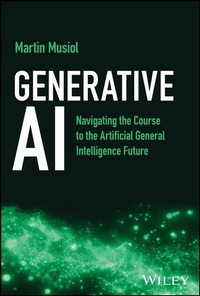
Generative AI
Description

An engaging and essential discussion of generative artificial intelligence
In Generative AI: Navigating the Course to the Artificial General Intelligence Future, celebrated author Martin Musiol-founder and CEO of generativeAI.net and GenAI Lead for Europe at Infosys-delivers an incisive and one-of-a-kind discussion of the current capabilities, future potential, and inner workings of generative artificial intelligence. In the book, you'll explore the short but eventful history of generative artificial intelligence, what it's achieved so far, and how it's likely to evolve in the future. You'll also get a peek at how emerging technologies are converging to create exciting new possibilities in the GenAI space.
Musiol analyzes complex and foundational topics in generative AI, breaking them down into straightforward and easy-to-understand pieces. You'll also find:
- Bold predictions about the future emergence of Artificial General Intelligence via the merging of current AI models
- Fascinating explorations of the ethical implications of AI, its potential downsides, and the possible rewards
- Insightful commentary on Autonomous AI Agents and how AI assistants will become integral to daily life in professional and private contexts
Perfect for anyone interested in the intersection of ethics, technology, business, and society-and for entrepreneurs looking to take advantage of this tech revolution-Generative AI offers an intuitive, comprehensive discussion of this fascinating new technology.
All prices
More details
Other editions
Additional editions
Person
MARTIN MUSIOL is the founder of generativeAI.net and the publisher of Generative AI: Short & Sweet, a popular artificial intelligence newsletter. He is a frequent speaker at conferences, podcasts, and panel discussions where he addresses the technological advancements, practical applications, and ethical considerations of generative AI. He is a data scientist by training and a former IBM Data Science Manager and Generative AI lead for Infosys.
Content
Introduction ix
Chapter 1 AI in a Nutshell 1
Chapter 2 Innovative Approaches for High-Quality Data Generation 23
Chapter 3 Generative AI's Broad Spectrum of Applications 119
Chapter 4 Generative AI's Exponential Growth 219
Chapter 5 Ethical Concerns and Social Implications of Generative AI 285
Chapter 6 Artificial General Intelligence in Sight 337
Acknowledgments 405
About the Author 407
Index 409
