

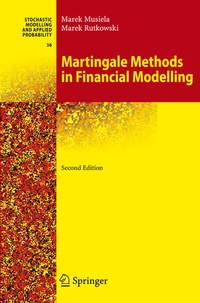
Martingale Methods in Financial Modelling
Description

In the 2 nd edition some sections of Part I are omitted for better readability, and a brand new chapter is devoted to volatility risk. As a consequence, hedging of plain-vanilla options and valuation of exotic options are no longer limited to the Black-Scholes framework with constant volatility.
In the 3 rd printing of the 2 nd edition, the second Chapter on discrete-time markets has been extensively revised. Proofs of several results are simplified and completely new sections on optimal stopping problems and Dynkin games are added. Applications to the valuation and hedging of American-style and game options are presented in some detail.
The theme of stochastic volatility also reappears systematically in the second part of the book, which has been revised fundamentally, presenting much more detailed analyses of the various interest-rate models available: the authors' perspective throughout is that the choice of a model should be basedon the reality of how a particular sector of the financial market functions, never neglecting to examine liquid primary and derivative assets and identifying the sources of trading risk associated. This long-awaited new edition of an outstandingly successful, well-established book, concentrating on the most pertinent and widely accepted modelling approaches, provides the reader with a text focused on practical rather than theoretical aspects of financial modelling.
Reviews / Votes
From the reviews:
" .This book is an impressive work of scholarship in mathematical finance in the area of option pricing. .contains the latest results and references. .The presence of many explicit formulae, for various types of derivatives, will make this book attractive to practitioners; and its breadth of content will make it useful for anyone who considers research in mathematical finance." (The Australian and New Zealand Journal of Statistics)
" .On the whole, this book presents a very wide range of topics and will appeal to both practitioners and mathematicians. .the second part gives an excellent overview of the state of the art in term structure research and will set a clear standard for some time to come." (MathSciNet)
" ...The book contains a wealth of material expressed in a clear mathematical way. A definite bonus is the very extensive list of references which gives the reader a most welcome basis from which to explore further the realm of mathematical finance. .The book can be used ideally both as an introductory and as an advanced text on mathematical finance." (Short Book Reviews)
" .This book is a comprehensive and up-to-date presentation of the martingale approach for pricing and hedging derivative securities. .provides a wide range of topics and will appeal to both practitioners and mathematicians. When only special cases or models are provided, the authors give useful references that will help researchers to obtain even more insight in the topics." (ZentralblattMATH)
From the reviews of the second edition:
"The book starts at an elementary level of mathematics as well as of market and product knowledge. . In summary, the book gives a very broad insight into advanced modern financial mathematics, in particular fixed income models. . It will serve as a basic source of knowledge of the described topics in financial mathematics." (Ludger Overbeck, Mathematical Reviews, Issue 2005 m)
More details
Other editions
Additional editions
Previous edition
Persons
.
Content
In contrast to the holder of a European option, the holder of an American op- tion is allowed to exercise his right to buy (or sell) the underlying asset at any time before or at the expiry date. This special feature of American-style op- tions - and more generally of American claims - makes the arbitrage pricing of American options much more involved than the valuation of standard Eu- ropean claims. We know already that arbitrage valuation of American claims is closely related to specific optimal stopping problems. Intuitively, one might expect that the holder of an American option will choose her exercise policy in such a way that the expected payoff from the option will be maximized. Maximization of the expected discounted payoff under subjective probability would lead, of course, to non-uniqueness of the price. It appears, however, that for the purpose of arbitrage valuation, the maximization of the expected discounted payoff should be done under the martingale measure (that is, un- der risk-neutral probability). Thus, the uniqueness of the arbitrage price of an American claim holds. One of the earliest works to examine the rela- tionship between the early exercise feature of American options and optimal stopping problems was the paper by McKean (1965).
As the arbitrage valu- ation of derivative securities was not yet discovered at this time, the optimal stopping problem associated with the optimal exercise of American put was studied by McKean (1965) under an actual probability IP, rather than under the martingale measure IP*, as is done nowadays. For further properties of the optimal stopping boundary, we refer the reader toVan Moerbeke (1976). Ba- sic features of American options, within the framework of arbitrage valuation theory, were already examined in Merton (1973). However, mathematically rigorous valuation results for American claims were first established by means of arbitrage arguments in Bensoussan (1984) and Karatzas (1988, 1989). An exhaustive survey of results and techniques related to the arbitrage pricing of American options was given by Myneni (1992). For an innovative approach to American options and related issues, see Bank and Follmer (2003).
The purpose of this chapter is to provide the most fundamental results concerning the arbitrage valuation of American claims within the continuous- time framework of the Black-Scholes financial model. Firstly, we discuss the concept of the arbitrage price of American contingent claims and its ba- sic properties. As a consequence, we present the well-known result that an American call option with a constant strike price, written on a non-dividend- paying stock, is equivalent to the corresponding European call option. Sub- sequently, we focus on the features of the optimal exercise policy associ- ated with the American put option. Next, the analytical approach to the pricing of American options is presented. The free boundary problem as- sociated with the optimal exercise of American put options was studied by, among others, McKean (1965) and Van Moerbeke (1976). More recently, Jaillet et al. (1990) applied the general theory of variational inequalities to study the optimal stopping problem associated with American claims.
Finally, the most widely used numerical procedures related to the ap- proximate valuation of American contingent claims are reviewed. An an- alytic approximation of the American put price on a non-dividend-paying stock was examined by Brennan and Schwartz (1977a), Johnson (1983) and MacMillan (1986). We close this chapter with an analysis of an American call written on a dividend-paying stock (this was examined in Roll (1977)).
