

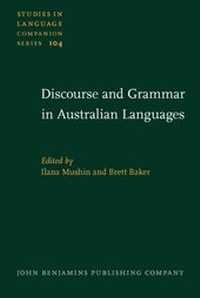
Discourse and Grammar in Australian Languages
1st Edition
Published on 16. October 2008
X, 239 pages
978-90-272-9034-2 (ISBN)
Description

Discourse and Grammar in Australian Languages is the first major survey to address the issue of the effects of information packaging on Australian languages, widely known for nonconfigurationality. The papers are based on individual fieldwork and describe a wide range of Australian languages of different types, ranging from the polysynthetic languages of Arnhem Land and the Kimberley to the classical types represented by Walpiri. Topics covered include the pragmatics of information exchange, the interaction of noun class marking with polarity and referentiality, the effects of specificity on argument indexing, the discourse uses of the ergative case, the contribution of pronouns to NP reference, the interaction of tense and aspect clitics with information structure, clause-initial position, and discourse and grammar in Australian languages. The volume will appeal to scholars interested in discourse, typology, syntax, semantics, and pragmatics.
More details
Other editions
Additional editions
Ilana Mushin | Brett Baker
Discourse and Grammar in Australian Languages
Book
10/2008
John Benjamins Publishing Co
€111.30
Shipment within 10-15 days
Persons
Content
- Discourse and Grammar in Australian Languages
- Editorial page
- Title page
- LCC data
- Table of contents
- Forword
- Maps
- Discourse and grammar in Australian languages
- 1. Introduction
- 2. Australian languages
- 3. The sensitivity of Australian language grammar to discourse pressures: A survey
- 3.1 Word order
- 3.2 Referring expressions
- 3.3 Ellipsis
- 3.4 Morphological markers of information status
- 3.5 Prosody
- 4. A final note on terminology
- References
- Clause-initial position in four Australian languages
- 1. Introduction
- 1.1 Word order and information packaging in Australian languages
- 2. The data
- 3. General features of clause initial position
- 4. Obligatory initial position
- 4.1 Interrogatives
- 4.2 Negation
- 4.3 Conjunctions and complementisers
- 4.4 Summary
- 5. Nominal expressions in initial position
- 6. Summary and conclusions
- References
- Bardi arguments
- 1. Introduction
- 2. Background on Bardi and the Nyulnyulan languages
- 3. Summary of Bardi verb agreement
- 4. Nonconfigurationality
- 5. Constituent order
- 6. Reference and agreement
- 6.1 Subject marking
- 6.2 Object and oblique marking
- 6.3 Third person object quantification and definiteness
- 6.4 Summary
- 7. Definiteness and referentiality in overt nominal material
- 7.1 Character introduction and continuity
- 7.2 Jarri "this"
- 7.3 Ginyinggi "he, she, it" and irr "they"
- 8. Summary and conclusions
- References
- Appendix: Girrgij, Giido and Ganbaliny
- Diverging paths
- 1. Introduction
- 2. Word order, information structure and the second position clitic complex
- 3. Variation in TA attachment
- 3.1 Grammatical status of variation
- 3.2 Variations with =yili
- 3.3 Variations with =yi
- 3.4 Summary
- 4. Discourse functions of TA-clitic placement variation
- 4.1 Perspective shifts
- 4.2 Elaboration
- 5. Conclusions
- References
- Pragmatically case-marked
- 1. Introduction
- 1.1 Language background
- 1.2 Data
- 2. Case vs case-form
- 3. Pragmatic case
- 3.1 Marked intransitive subject
- 3.2 Unmarked transitive subject
- 4. Analysis
- 5. Theoretical implications
- 6. Pragmatic case marking in other languages
- 7. Conclusion
- References
- The interpretation of complex nominal expressions in Southeast Arnhem Land languages
- 1. Introduction
- 2. The article systems of Ngalakgan, Wubuy and Marra
- 2.1 Characteristics of articles
- 3. Non-specific referents in Ngalakgan, Wubuy and Marra
- 3.1 Negative contexts
- 3.2 Content questions
- 3.3 Polarity in English
- 4. Number and quantification of nouns
- 5. Generics
- 6. Topics as restrictors
- 7. Complex nominal expressions in Southeast Arnhem languages
- 7.1 Indefiniteness operators derive complex nominal expressions
- 7.2 Other complex nominal expressions
- 7.3 Complements of nonspecific operators in English
- 8. Conclusion
- Abbreviations
- References
- "Double reference" in Kala Lagaw Ya narratives
- 1. Introduction
- 2. Background
- 3. Reference tracking in Kala Lagaw Ya and "double reference"
- 3.1 Reference tracking options in KLY
- Type (i) examples: Apposed pronoun and np
- Type (ii) examples: "right-dislocated"
- 3.2 The grammatical status of the "double reference" constructions
- 3.3 Double reference and information structure
- 4. Methodology
- 5. Results and discussion
- 5.1 Referential distance (RD)
- 5.2 Potential interference (PI)
- 5.3 Narrative structure analysis of Dhogay Ii
- 6. Conclusion
- References
- Source texts
- Person reference, proper names and circumspection in Bininj Kunwok conversation
- 1. Introduction
- 2. Taboos which motivate circumspection and vague reference in Bininj Kunwok
- 3. Personal referring expressions in Bininj Kunwok
- 3.1 Kin terms
- 3.1.1 Basic kin terms including vocatives
- 3.1.2 Basic non-vocative terms
- 3.1.3 Dyadic kin terms
- 3.1.4 Tri-relational kin terms.
- 3.1.5 Kinship verbs
- 3.2 Subsection terms
- 3.3 Clan names
- 3.4 Dysphemisms
- 3.5 Nicknames
- 3.6 Free standing pronouns
- 3.7 Demonstratives
- 3.8 Teknonymy
- 4. Analysis
- 5. Conclusion
- References
- Index of languages
- Index of names
- Index of subjects
- The Studies in Language Companion Series
