

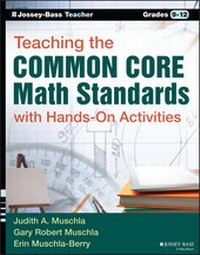
Teaching the Common Core Math Standards with Hands-On Activities, Grades 9-12
Description

More details
Other editions
Additional editions
Person
Content
Section 1
Standards and Activities for Number and Quantity
The Real Number System
The real number system consists of rational and irrational numbers. It is sometimes referred to as the continuum of real numbers.
Rational numbers are the set of numbers that can be expressed in the form of , where a and b are integers, b ? 0. Examples include integers, finite decimals, and repeating decimals.
Irrational numbers are the set of numbers that cannot be written as terminating or repeating decimals. Examples include , p, and e.
N-RN.1
"Extend the properties of exponents to rational exponents."
- 1. "Explain how the definition of the meaning of rational exponents follows from extending the properties of integer exponents to those values, allowing for a notation for radicals in terms of rational exponents."
Activity: Understanding Integer and Rational Exponents
Students will complete statements that show how the meaning of rational exponents follows from extending the properties of integer exponents.
Materials
One copy of reproducible N-RN.1, "The Meaning of Rational Exponents," for each student.
Procedure
- Explain that the meaning of rational exponents follows from the properties of integer exponents. Review the properties of exponents. a and b are real numbers and m and n are integers.
- , , and .
- , , and , a ? 0.
- Explain that these properties can be extended to rational exponents as follows: , where a > 0 and m and n are integers, n > 0.
- Explain that some expressions that have rational exponents are rational numbers. Examples include , , and . Other expressions, such as and , are irrational numbers.
- Explain that the reproducible, when completed, provides an explanation of how the value of can be found using properties of exponents. Students are to complete the statements by selecting the correct expressions, which are shown at the bottom of the page. Note that the steps are sequential and each expression can be used only once.
Closure
Ask your students to summarize how they used the properties of exponents to complete the statements.
Answers
(1) (2) 2, , 16 (3) , , 8
N-RN.2
"Extend the properties of exponents to rational exponents."
- 2. "Rewrite expressions involving radicals and rational exponents using the properties of exponents."
Activity: Finding the Values of Expressions
Working individually or in pairs, students will identify the value of expressions in simplest form.
Materials
One copy of reproducible N-RN.2, "Equations and Their Values," for the class; scissors for the teacher.
Preparation
After making one copy of the reproducible, cut out each box (each containing an "I have" and "Who has?" statement) so that you have a total of 21 slips of paper. The slips are arranged in order on the reproducible, each providing a number that is the value of the expression written on the previous slip, except for the value of the last expression, which is written on the first slip. The original reproducible will serve as your answer key.
Procedure
- Mix the slips up and then distribute one slip of paper to each student or one slip to pairs of students. For a small class, you may give some students two slips. You must distribute all 21 slips.
- Explain that each slip has a number in its simplest form on the left and a term that can be simplified on the right. Start the activity by asking a student to read the term that is written on the right side of his slip. You may find it helpful to write this term on the board. All students then should check the number they have on the left side of their slip to find the value of the term. Because of the way the slips are designed, only one slip will contain a correct match. The student who has the slip with the correct answer should say, "I have . . .," and then provide the answer. If the student is correct, she then reads the term written on the right side of her slip. If she is incorrect, point out her error. Another student should then provide the correct answer, which is printed on the left side of his slip.
- Continue this procedure until the student who read the first term has a number that is equal to the value of the last term.
Closure
Ask your students for examples of other expressions that can be simplified to the same number. For example, , and it also equals . Ask why this is so.
N-RN.3
"Use properties of rational and irrational numbers."
- 3. "Explain why the sum or product of two rational numbers is rational; that the sum of a rational number and an irrational number is irrational; and that the product of a nonzero rational number and an irrational number is irrational."
Activity: Sums and Properties of Rational and Irrational Numbers
This is a two-day activity. Students will work in pairs or groups of three. On the first day, students will place in sequence the steps for proving that the sum of two rational numbers is rational. On the second day, they will place in sequence the steps for proving that the sum of a rational number and an irrational number is irrational. They will also draw conclusions about the difference between two rational numbers as well as the product of a nonzero rational number and an irrational number.
Materials
Scissors; reproducibles N-RN.3, "Proving the Sum of Two Rational Numbers Is Rational," and N-RN.3, "Proving the Sum of Rational and Irrational Numbers Is Irrational," for each pair or group of students.
Procedure
Day One
- Distribute copies of reproducible N-RN.3, "Proving the Sum of Two Rational Numbers Is Rational," to each pair or group of students. Explain that the table shows how to prove that the sum of two rational numbers is rational. The table has five rows, each containing a statement and an explanation. The statements and explanations are correct, but the rows are out of order.
- Explain that students are to place the rows in the correct order. Suggest that they cut out each row, which will make it easier to arrange the rows correctly.
Closure
Discuss the proof. Ask your students what they can conclude about the difference of two rational numbers. (The difference of two rational numbers is a rational number.)
Answers
The sequence of some rows may vary; accept any sequence students can justify. One correct order of the rows follows: 2, 3, 5, 1, 4.
Procedure
Day two
- Hand out copies of reproducible N-RN.3, "Proving the Sum of Rational and Irrational Numbers Is Irrational," to each pair or group of students. Explain that the table shows how to prove that the sum of a rational number and an irrational number is irrational. This is a proof by contradiction that uses the fact that the difference of two rational numbers is rational, which was discussed during the closure on day one.
- Explain that this proof assumes that the sum of a rational number and an irrational number is rational, but a contradiction makes the assumption incorrect, leading to the conclusion that the sum of a rational number and an irrational number must be irrational.
- Explain that the table has seven rows; each row contains a statement and an explanation. The statements and explanations are correct, but the rows are out of order. Students are to place them in the proper order. Suggest that students cut out each row to make it easier to arrange the rows correctly.
Closure
Discuss the proof. Ask your students what they think is true about the product of a nonzero rational number and an irrational number based on their understanding of the sum of a rational number and an irrational number being irrational. (The product is an irrational number.)
Answers
The sequence of some rows may vary; accept any sequence students can justify. One correct order of the rows follows: 5, 3, 1, 4, 2, 7, 6.
Quantities
Quantities are numbers with units that involve measurement. Although in the lower grades students worked with units that addressed attributes such as length, width, height, and volume, in high school students work with other units of measurement that address a variety of problems in many different areas. Some examples include solving problems that involve measurement and acceleration, population density, per capita income, the miles per gallon rating of a car, or the energy consumption of household appliances.
N-Q.1
"Reason quantitatively and use units to solve problems."
- 1. "Use units as a way to understand problems and to guide the solution of multistep problems; choose and interpret units consistently in formulas; choose and interpret the scale and the origin in graphs and data displays."
Activity: A Recommendation for the Boss
This activity should be implemented over a few class periods. Students can also work outside of class. Working in groups of three to five, students...
