

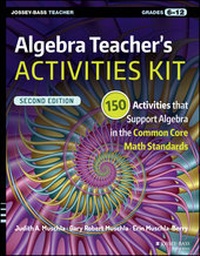
Algebra Teacher's Activities Kit
Description

The Algebra Teacher's Activities Kit: 150 Activities That Support Algebra in the Common Core Math Standards helps you bring the standards into your algebra classroom with a range of engaging activities that reinforce fundamental algebra skills. This newly updated second edition is formatted for easy implementation, with teaching notes and answers followed by reproducibles for activities covering the algebra standards for grades 6 through 12. Coverage includes whole numbers, variables, equations, inequalities, graphing, polynomials, factoring, logarithmic functions, statistics, and more, and gives you the material you need to reach students of various abilities and learning styles. Many of these activities are self-correcting, adding interest for students and saving you time.
This book provides dozens of activities that
* Directly address each Common Core algebra standard
* Engage students and get them excited about math
* Are tailored to a diverse range of levels and abilities
* Reinforce fundamental skills and demonstrate everyday relevance
Algebra lays the groundwork for every math class that comes after it, so it's crucial that students master the material and gain confidence in their abilities. The Algebra Teacher's Activities Kit helps you face the challenge, well-armed with effective activities that help students become successful in algebra class and beyond.
All prices
More details
Other editions
Additional editions
Persons
Gary Robert Muschla taught at Appleby School in Spotswood, New Jersey, for more than twenty-five years; his specialties include mathematics at the middle school level, reading, and writing. Judith and Gary have coauthored several successful math activity books, including Teaching the Common Core Math Standards with Hands on Activities, Grades 9-12, Hands-On Math Projects with Real Life Applications, The Math Teacher's Book of Lists, and Math Starters.
Erin Muschla-Berry teaches 8th grade math at Monroe Township Middle School in Monroe, New Jersey, and has collaborated with Judith and Gary on eight previous math books.
Content
Acknowledgments ix
Preface xvii
SECTION 1: RATIOS AND PROPORTIONAL RELATIONSHIPS 1
Teaching Notes for the Activities of Section 1 2
1-1: (6.RP.1) Understanding Ratios 2
1-2: (6.RP.2) Unit Rates and Ratios 2
1-3: (6.RP.3) Equivalent Ratios and the Coordinate Plane 3
1-4: (6.RP.3) Finding the Percent of a Number and Finding the Whole 3
1-5: (7.RP.1) Finding Unit Rates 4
1-6: (7.RP.2) Graphing Proportional Relationships 4
1-7: (7.RP.2) Representing Proportional Relationships 5
1-8: (7.RP.3) Solving Word Problems Involving Percents 5
Reproducibles for Section 1 6
SECTION 2: THE NUMBER SYSTEM AND NUMBER AND QUANTITY 19
Teaching Notes for the Activities of Section 2 20
2-1: (6.NS.5) Representing Positive and Negative Numbers 20
2-2: (6.NS.6) Graphing Rational Numbers on a Number Line 20
2-3: (6.NS.6) Graphing Points in the Coordinate Plane 21
2-4: (6.NS.7) The Absolute Value and Order of Rational Numbers 22
2-5: (6.NS.8) Using the Coordinate Plane to Solve Problems 22
2-6: (7.NS.1) Using the Number Line to Add and Subtract Rational Numbers23
2-7: (7.NS.1) Using Properties to Add and Subtract Rational Numbers 24
2-8: (7.NS.2) Multiplying and Dividing Rational Numbers 25
2-9: (7.NS.2) Converting Rational Numbers to Decimals26
2-10: (7.NS.3) Solving Word Problems Involving Rational Numbers 27
2-11: (8.NS.1) Expressing Fractions as Repeating Decimals and Repeating Decimals as Fractions 27
2-12: (8.NS.2) Using Rational Approximations of Irrational Numbers 28
2-13: (N-RN.1) Using the Properties of Exponents29
2-14: (N-RN.2) Rewriting Expressions Involving Radicals and Rational Exponents 29
2-15: (N-RN.3) Sums and Products of Rational and Irrational Numbers 30
2-16: (N-Q.1) Interpreting and Using Units 31
2-17: (N-Q.2) Defining Appropriate Quantities 31
2-18: (N-Q.3) Choosing Appropriate Levels of Accuracy for Measurement 32
2-19: (N-CN.1) Writing Complex Numbers 33
2-20: (N-CN.2) Adding, Subtracting, and Multiplying Complex Numbers 34
2-21: (N-CN.7) Solving Quadratic Equations That Have Complex Solutions 34
Reproducibles for Section 2 35
SECTION 3: BASIC EXPRESSIONS, EQUATIONS, AND INEQUALITIES 60
Teaching Notes for the Activities of Section 3 61
3-1: (6.EE.1) Writing and Evaluating Numerical Expressions with Whole-Number Exponents 61
3-2: (6.EE.2) Writing and Reading Algebraic Expressions 62
3-3: (6.EE.2) Evaluating Algebraic Expressions 62
3-4: (6.EE.3) Applying Properties of Operations to Generate Equivalent Expressions 63
3-5: (6.EE.4) Identifying Equivalent Expressions 63
3-6: (6.EE.5) Identifying Solutions of Equations and Inequalities 64
3-7: (6.EE.6) Writing Expressions in Which Variables Represent Numbers 64
3-8: (6.EE.7) Writing and Solving Equations 65
3-9: (6.EE.8) Using Inequalities 65
3-10: (6.EE.9) Using Variables to Represent Two Quantities 66
3-11: (7.EE.1) Adding, Subtracting, Factoring, and Expanding Linear Expressions 67
3-12: (7.EE.2) Rewriting Expressions in Different Forms 67
3-13: (7.EE.3) Solving Multi-Step Problems 68
3-14: (7.EE.4) Solving Equations and Inequalities 68
3-15: (8.EE.1) Applying Properties of Integer Exponents 69
3-16: (8.EE.2) Using Square Roots and Cube Roots 69
3-17: (8.EE.3) Using Numbers Expressed in Scientific Notation 70
3-18: (8.EE.4) Operations with Scientific Notation 71
3-19: (8.EE.5) Graphing Proportional Relationships 71
3-20: (8.EE.6) Deriving the Equation y = mx 72
3-21: (8.EE.7) Identifying Equations That Have One Solution, No Solutions, or Infinitely Many Solutions 73
3-22: (8.EE.7) Solving Equations with Variables on Both Sides 73
3-23: (8.EE.8) Solving Systems of Linear Equations Algebraically 74
3-24: (8.EE.8) Solving Systems of Equations by Graphing 75
Reproducibles for Section 3 75
SECTION 4: POLYNOMIAL, RATIONAL, EXPONENTIAL, AND RADICAL EXPRESSIONS, EQUATIONS, AND INEQUALITIES 103
Teaching Notes for the Activities of Section 4 104
4-1: (A-SSE.1) Interpreting Expressions 104
4-2: (A-SSE.2) Using the Structure of an Expression to Identify Ways to Rewrite It 104
4-3: (A-SSE.3) Factoring Quadratic Expressions to Reveal Zeroes 105
4-4: (A-SSE.3) Completing the Square to Reveal Maximum or Minimum Values 106
4-5: (A-SSE.4) Finding Sums of Finite Geometric Series 106
4-6: (A-APR.1) Adding, Subtracting, and Multiplying Polynomials 107
4-7: (A-APR.2) Applying the Remainder Theorem 107
4-8: (A-APR.3) Using Zeroes to Construct a Rough Graph of a Polynomial Function 108
4-9: (A-APR.4) Proving Polynomial Identities 109
4-10: (A-APR.6) Rewriting Rational Expressions 110
4-11: (A-CED.1) Writing and Solving Equations and Inequalities in One Variable 111
4-12: (A-CED.2) Writing and Graphing Equations in Two Variables 111
4-13: (A-CED.3) Representing Constraints and Interpreting Solutions 112
4-14: (A-CED.4) Highlighting Quantities of Interest in Formulas 113
4-15: (A-REI.1) Justifying Solutions to Equations 113
4-16: (A-REI.2) Solving Rational and Radical Equations 114
4-17: (A-REI.3) Solving Multi-Step Linear Equations in One Variable 115
4-18: (A-REI.3) Solving Multi-Step Linear Inequalities in One Variable 115
4-19: (A-REI.4) Solving a Quadratic Equation by Completing the Square 116
4-20: (A-REI.4) Solving Quadratic Equations in a Variety of Ways 116
4-21: (A-REI.5) Solving Systems of Equations 117
4-22: (A-REI.6) Solving Systems of Linear Equations 118
4-23: (A.REI.7) Solving a System of a Linear and a Quadratic Equation 118
4-24: (A-REI.10) Relating Graphs to the Solutions of Equations 119
4-25: (A-REI.11) Using Graphs and Tables to Find Solutions to Systems of Equations 120
4-26: (A-REI.12) Solving Systems of Inequalities by Graphing 120
Reproducibles for Section 4 121
SECTION 5: FUNCTIONS 155
Teaching Notes for the Activities of Section 5 156
5-1: (8.F.1) Identifying Functions 156
5-2: (8.F.2) Comparing Functions 157
5-3: (8.F.3) Determining Whether Data Lies on a Line 157
5-4: (8.F.4) Finding the Slope and Y-Intercept of a Line 157
5-5: (8.F.5) Analyzing and Graphing Functions 158
5-6: (F-IF.1) Understanding Functions 159
5-7: (F-IF.2) Finding the Values of Functions 159
5-8: (F-IF.3) Defining Sequences Recursively 160
5-9: (F-IF.4) Identifying Key Features of Graphs 160
5-10: (F-IF.5) Relating the Domain of a Function to Its Graph or Description 161
5-11: (F-IF.6) Finding the Average Rate of Change over Specified Intervals 162
5-12: (F-IF.7) Graphing Linear and Quadratic Functions 162
5-13: (F-IF.7) Graphing Polynomial Functions 163
5-14: (F-IF.8) Rewriting Quadratic Equations 164
5-15: (F-IF.9) Comparing Properties of Functions 165
5-16: (F-BF.1) Writing Functions 165
5-17: (F-BF.2) Writing Arithmetic and Geometric Sequences 166
5-18: (F-BF.3) Transforming a Function 166
5-19: (F-BF.4) Finding the Inverses of Functions 167
5-20: (F-LE.1) Proving Linear Functions Grow by Equal Differences over Equal Intervals 168
5-21: (F-LE.1) Proving Exponential Functions Grow by Equal Factors over Equal Intervals 168
5-22: (F-LE.2) Constructing Linear and Exponential Functions 169
5-23: (F-LE.3) Observing the Behavior of Quantities That Increase Exponentially 170
5-24: (F-LE.4) Writing and Solving Exponential Equations 170
5-25: (F-LE.5) Interpreting Parameters in a Linear or Exponential Function 171
5-26: (F-TF.1) Using Radian and Degree Measures 172
5-27: (F-TF.2) Using the Unit Circle 172
5-28: (F-TF.5) Modeling Periodic Phenomena 173
5-29: (F-TF.8) Finding the Values of the Sine, Cosine, and Tangent Functions 174
Reproducibles for Section 5 175
SECTION 6: STATISTICS AND PROBABILITY 221
Teaching Notes for the Activities of Section 6 222
6-1: (6.SP.1) Identifying Statistical Questions 222
6-2: (6.SP.2) Describing Data Distributions 222
6-3: (6.SP.3) Finding the Mean, Median, Mode, and Range 223
6-4: (6.SP.4) Using Dot Plots to Display Data 224
6-5: (6.SP.4) Constructing a Box Plot 224
6-6: (6.SP.5) Summarizing and Describing Data 225
6-7: (7.SP.1) Drawing Inferences from Samples 227
6-8: (7.SP.2) Drawing Inferences about a Population Using Random Samples 227
6-9: (7.SP.3) Comparing Two Data Sets 228
6-10: (7.SP.4) Drawing Inferences about Populations 229
6-11: (7.SP.5) Understanding the Probability of Events 229
6-12: (7.SP.6) Probabilities and Predictions 230
6-13: (7.SP.7) Using Probability Models to Find Probabilities of Events 230
6-14: (7.SP.8) Understanding the Probability of Compound Events 231
6-15: (7.SP.8) Finding Probabilities of Compound Events Using Tables, Lists, and Tree Diagrams 232
6-16: (8.SP.1) Constructing and Interpreting Scatter Plots 233
6-17: (8.SP.2) Fitting Lines to Data 234
6-18: (8.SP.3) Using Equations of Linear Models234
6-19: (8.SP.4) Constructing and Interpreting Two-Way Tables 235
6-20: (S-ID.1) Representing Data with Plots on the Real Number Line 236
6-21: (S-ID.2) Comparing Two Data Sets 236
6-22: (S-ID.3) Interpreting Differences in Shape, Center, and Spread of Data Distributions 237
6-23: (S-ID.4) Recognizing Characteristics of Normal Distributions 238
6-24: (S-ID.5) Summarizing Categorical Data in Two-Way Frequency Tables 238
6-25: (S-ID.6) Finding the Equation of the Line of Best Fit 239
6-26: (S-ID.6) Using Linear and Quadratic Models 240
6-27: (S-ID.7) Interpreting the Slope and Y-Intercept of a Linear Model 241
6-28: (S-ID.8) Computing and Interpreting the Correlation Coefficient 241
6-29: (S-ID.9) Distinguishing between Correlation and Causation 242
6-30: (S-IC.1) Understanding the Terminology of Statistical Experiments 242
6-31: (S-IC.2) Evaluating Probability Models through Simulations 243
6-32: (S-IC.3) Recognizing Surveys, Experiments, and Observational Studies 244
6-33: (S-IC.4) Using Simulations with Random Sampling 244
6-34: (S-IC.5) Comparing Two Treatments Using Simulations 245
6-35: (S-IC.6) Evaluating Data in Reports 246
6-36: (S-CP.1) Describing Events as Subsets of a Sample Space 246
6-37: (S-CP.2) Identifying Independent Events 247
6-38: (S-CP.3) Interpreting Conditional Probability 247
6-39: (S-CP.4) Understanding Two-Way Frequency Tables 248
6-40: (S-CP.5) Exploring Concepts of Conditional Probability 249
6-41: (S-CP.6) Finding Conditional Probabilities as a Fraction of Outcomes 249
6-42: (S-CP.7) Applying the Addition Rule 250
Reproducibles for Section 6 250
INDEX 305
Section 1
Ratios and Proportional Relationships
Teaching Notes for the Activities of Section 1
1-1: (6.RP.1) Understanding Ratios
For this activity, your students will read statements that describe ratios. They will be given choices of ratios and must select the ratio that matches each statement. Answering a question at the end of the worksheet will enable students to check their answers.
Explain that a ratio compares two numbers or quantities. For example, if you have 5 markers and 2 are green and 3 are red, you can write a ratio comparing green markers to red markers as 2 to 3. You may instead write a ratio comparing the red markers to green markers as 3 to 2. Ratios can also be written with a colon, 2:3, or as a fraction, .
Discuss the directions on the worksheet, emphasizing that students are to choose the ratio that matches each statement. Remind students to answer the question at the end.
Answers
(1) O, 5:7 (2) A, 32:8 (3) H, 12 to 5 (4) T, 6 to 10 (5) E, (6) O, (7) T, 5 to 6 (8) P, (9) W, 8 to 2 (10) L, 3:2 (11) R, 2:25
The answer to the question is "whole to part."
1-2: (6.RP.2) Unit Rates and Ratios
For this activity, your students are to determine if statements that describe unit rates associated with ratios are true or false. Answering a question at the end of the worksheet will enable them to check their answers.
Explain that a ratio that has a denominator of 1 is a unit rate. Examples of unit rates include: 4:1, , or 3 to 1. Unit rates may also be expressed as a quantity of 1, for example: 30 miles per gallon of gasoline or $3 per pound. Ratios such as 6:3, , and 2 to 9 do not represent unit rates. However, any ratio that compares two different quantities can be converted to a unit rate by writing the ratio as a fraction and dividing both numerator and denominator by the denominator. For example, or 2:1.
Discuss the directions on the worksheet with your students. After deciding whether a statement is true or false, they are to use the letters of correct answers to answer the question at the end.
Answers
(1) R, true (2) O, true (3) O, false (4) I, false (5) O, true (6) N, false (7) R, false (8) T, true (9) P, false (10) P, true The answer to the question is "proportion."
1-3: (6.RP.3) Equivalent Ratios and the Coordinate Plane
For this activity, your students will complete tables of equivalent ratios and then plot the pairs of values in the coordinate plane. They will need rulers and graph paper.
Discuss the example on the worksheet. Explain that equivalent ratios can be found by writing the ratio as a fraction, and then multiplying or dividing the numerator and denominator by the same nonzero number. Note that the process is the same as finding equivalent fractions.
Explain that ratios can be expressed as ordered pairs in the coordinate plane. If necessary, review the coordinate plane, ordered pairs, and how students can plot points. Instruct them to place the origin of their coordinate plane near the center of their graph paper to ensure that they will have enough space to plot all of the points.
Go over the directions with your students. Emphasize that after completing the tables they must use the first value of each ratio as the x-coordinate and the second value as the y-coordinate. They are then to plot the ordered pairs and use their rulers to connect the points.
Answers
Table 1: 1:2, 2:4, 3:6, 4:8, 5:10 Table 2: 2:3, 4:6, 8:12 Table 3: 12:8, 6:4, 3:2
1-4: (6.RP.3) Finding the Percent of a Number and Finding the Whole
For this activity, your students will have two tasks: Find the percent of a number and find a whole, given the percent and a part.
If necessary, review that to find the percent of a number students should change the percent to a decimal or fraction and multiply. For example, , or .
Also review the process for finding the whole, given the percent and a part. Offer the following example: . In this case, students should say to themselves, "35% of what number is 14." To find this number using a decimal, students should change the percent to a decimal and divide, . To find the number using a fraction, they should first change the percent to a fraction and simplify, and then divide, . You may want to note that solving these kinds of problems is usually easier when converting the percents to decimals.
Discuss the directions on the worksheet. Suggest that students follow the instructions at the end to see if their answers are most likely to be correct. (The term most likely is necessary for the rare case that students may make mistakes but still find the correct sum when adding their answers.)
Answers
(1) 16 (2) 27 (3) 6 (4) 3 (5) 24 (6) 12 (7) 35 (8) 15 (9) 80 (10) 32 The sum of the answers is 250. .
1-5: (7.RP.1) Finding Unit Rates
For this activity, your students will be given various problems for which they must find unit rates. Answering a question at the end of the worksheet will enable them to check their answers.
Explain that a unit rate is a ratio written as a fraction with a denominator of 1. Ratios such as feet per second, dollars per hour, and pounds per square inch are unit rates.
Offer this example: During his morning office hours, a doctor saw 15 patients in 3 hours. The unit rate can be found by writing a ratio of the number of patients to the number of hours as a fraction and simplifying: , which is a rate of 5 patients per hour. Note that some problems on the worksheet can be expressed as complex fractions. If necessary, review simplifying complex fractions.
Discuss the directions on the worksheet with your students. Remind them to answer the question at the end.
Answers
(1) M, 52 (2) E, $0.01 (3) R, $1.85 (4) S, 61 (5) U, $8.50 (6) R, $1.85 (7) K, 1 (8) P, $0.11 (9) S, 61 (10) E, $0.01 (11) A, 5 (12) T, $1.29 The stores are "supermarkets."
1-6: (7.RP.2) Graphing Proportional Relationships
For this activity, your students are to determine equivalent ratios by graphing. They will need rulers and graph paper.
Explain that a proportion is a statement that two ratios are equal. One way to determine if two or more quantities are in a proportional relationship is to graph the quantities in the coordinate plane. Quantities that result in a graph that is a line through the origin are equivalent ratios.
To complete this activity, students will need to be familiar with graphing points in the coordinate plane in all quadrants. If necessary, review these skills.
Discuss the directions on the worksheet with your students. After plotting all of the points, students should find three groups of equivalent ratios by identifying points that lie on lines through the origin. Not all of the plotted points can be expressed as equivalent ratios. Caution your students that they will need to examine the points carefully and use their rulers to draw the lines. For the final part of the activity, students are to express the groups of equivalent ratios as .
Answers
Following are the three groups of ratios. ; ;
1-7: (7.RP.2) Representing Proportional Relationships
For this activity, your students will write equations to represent proportional relationships. Answering a question at the end of the worksheet will enable them to check their answers.
Explain that a proportion is an equation that states two ratios are equal. Proportions can be written to represent relationships. For example, suppose that 4 bean seeds germinate for every 5 seeds that are planted. This relationship can be shown by the ratio of . The number of seeds expected to grow if 100 seeds were planted can be shown by the proportion of .
Discuss the directions on the worksheet with your students. They are to write a proportion to show the relationship in each problem and express the proportions to match the proportions in the Answer Bank. Note that students are not to solve the proportions (as this is not a focus of this Standard). To check if their work is correct, students should answer the question at the end.
Answers
(1) I, (2) N, (3) S, (4) R, (5) E, (6) T, (7) W, (8) H, (9) F, (10) O, (11) A, "Proportio" means "for its own share."
1-8: (7.RP.3) Solving Word Problems Involving Percents
This activity requires your students to solve a variety of word problems on topics such as commissions, tax, discounts, and percent increase and percent decrease. Students are to determine if given answers are correct, explain why incorrect answers are wrong, and correct wrong answers.
Start the activity by reviewing percents and basic types of percent problems. Explain that whenever attempting to solve a problem, it is essential to formulate a strategy and follow the proper procedure. Understanding the problem and identifying what one wishes to find is vital to finding the solution.
Discuss the directions on the worksheet with your students. Emphasize that some of the provided answers are incorrect. The errors are not computational. If an answer is incorrect, your students must identify the error and solve the problem. Point out that 40% of the problems are correct.
Answers
(1) Incorrect-The weekly salary was not added;...
