

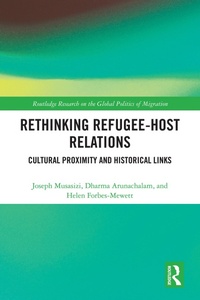
Rethinking Refugee-Host Relations
Cultural Proximity and Historical Links
1st Edition
Published on 24. November 2025
224 pages
978-1-040-56472-1 (ISBN)
Description

Musasizi, Arunachalam and Forbes-Mewett take a sociological approach to explore the complexities of cultural proximity and how it intersects with situational factors such as social, economic and historical events to influence refugee-host relations in Uganda.
Drawing on the everyday lived experiences of host community members, cultural leaders, local political and refugee leaders, and relief organisations, including UNHCR, this book examines how cultural affinities between host communities and different refugee groups intersect with situational and structural factors to shape refugee-host relations. The book problematises viewing refugees as a homogeneous group and applies the insider and outsider theory to explore factors that underlie inclusion and exclusion in host communities' relations with different refugee groups. Some refugee groups not only are socially, culturally and ideologically distant from locals but also practise forms of livelihoods which, in the hosts' view, threaten economic life in the host communities. The host communities are particularly threatened by the cultural incongruence, which is believed to interfere with their way of life. The book provides knowledge and understanding of the complex and multifaceted nature of refugee-host relations and offers key insights for guiding policy and practice, especially in countries that host large refugee populations.
A valuable resource for researchers and academics in sociology, migration and refugee studies, and those interested to understand how cultural proximity influences refugee-host relations and how the diverse nature of refugees shapes their relations with host state and communities.
Drawing on the everyday lived experiences of host community members, cultural leaders, local political and refugee leaders, and relief organisations, including UNHCR, this book examines how cultural affinities between host communities and different refugee groups intersect with situational and structural factors to shape refugee-host relations. The book problematises viewing refugees as a homogeneous group and applies the insider and outsider theory to explore factors that underlie inclusion and exclusion in host communities' relations with different refugee groups. Some refugee groups not only are socially, culturally and ideologically distant from locals but also practise forms of livelihoods which, in the hosts' view, threaten economic life in the host communities. The host communities are particularly threatened by the cultural incongruence, which is believed to interfere with their way of life. The book provides knowledge and understanding of the complex and multifaceted nature of refugee-host relations and offers key insights for guiding policy and practice, especially in countries that host large refugee populations.
A valuable resource for researchers and academics in sociology, migration and refugee studies, and those interested to understand how cultural proximity influences refugee-host relations and how the diverse nature of refugees shapes their relations with host state and communities.
More details
Series
Edition
1. Auflage
Language
English
Place of publication
London
United Kingdom
Publishing group
Taylor & Francis Ltd
Target group
College/higher education
Professional and scholarly
File size
18,06 MB
ISBN-13
978-1-040-56472-1 (9781040564721)
Copyright in bibliographic data and cover images is held by Nielsen Book Services Limited or by the publishers or by their respective licensors: all rights reserved.
Schweitzer Classification
Other editions
Additional editions
Joseph Musasizi | Dharma Arunachalam | Helen Forbes-Mewett
Rethinking Refugee-Host Relations
Cultural Proximity and Historical Links
Book
approx. 11/2025
1st Edition
Routledge
€207.50
Not yet published
Persons
Joseph Musasizi is a researcher and teaching associate in the School of Social Sciences at Monash University, Melbourne, Australia. He is a sociologist with research interests in migration, integration, intergroup relations, and theories of identity and intergroup relations. Joseph's recent publication is Understanding the Dynamics of Refugee Impact on Employment: Evidence from Northern Uganda.
Dharma Arunachalam is Professor of Sociology at Monash University, Melbourne, Australia. His current research focuses on immigration, cultural diversity, integration and social cohesion in Australia. He recently co-authored a research monograph Identity and Belonging among Chinese Australians: Phenotype, Ethnic Language and Cultural Values and is currently working on another monograph on Indians in Australia.
Helen Forbes-Mewett is Professor of Sociology at Monash University, Melbourne, Australia. Her research focuses on human security in relation to immigration, transnational education, cultural diversity and integration. She is the author of five books, all relating to mobile populations. Most recently, she co-authored a research monograph Identity and Belonging Among Chinese Australians: Phenotype, Ethnic Language and Cultural Values.
Dharma Arunachalam is Professor of Sociology at Monash University, Melbourne, Australia. His current research focuses on immigration, cultural diversity, integration and social cohesion in Australia. He recently co-authored a research monograph Identity and Belonging among Chinese Australians: Phenotype, Ethnic Language and Cultural Values and is currently working on another monograph on Indians in Australia.
Helen Forbes-Mewett is Professor of Sociology at Monash University, Melbourne, Australia. Her research focuses on human security in relation to immigration, transnational education, cultural diversity and integration. She is the author of five books, all relating to mobile populations. Most recently, she co-authored a research monograph Identity and Belonging Among Chinese Australians: Phenotype, Ethnic Language and Cultural Values.
Content
About the Author
Preface
1. Understanding Refugee-Host Relations of Categorisation and Othering
2. Refugees in Uganda: Policy, History, Politics and Development
3. Cultural Proximity and Refugee-Host Relations
4. Social Identity and Conflict
5. Economic Impacts of Refugees
6. Land Use Conflict
7. Conclusion: Culture, History and Host-Refugee Relations
Index
Preface
1. Understanding Refugee-Host Relations of Categorisation and Othering
2. Refugees in Uganda: Policy, History, Politics and Development
3. Cultural Proximity and Refugee-Host Relations
4. Social Identity and Conflict
5. Economic Impacts of Refugees
6. Land Use Conflict
7. Conclusion: Culture, History and Host-Refugee Relations
Index
