

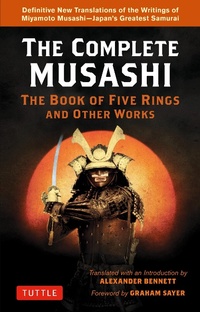
Complete Musashi: The Book of Five Rings and Other Works
The Definitive Translations of the Complete Writings of Miyamoto Musashi--Japan's Greatest Samurai
Published on 20. November 2018
240 pages
978-1-4629-2027-3 (ISBN)
Description

Miyamoto Musashi (1584-1645) is the most famous Samurai who ever lived. His magnum opus, the Go-Rin-Sho or Book of Five Rings is a classic that is still read by tens of thousands of people each year—Japanese and foreigners alike.
Alex Bennett's groundbreaking new translation of The Book of Five Rings reveals the true meaning of this text for the first time. Like Sun Tzu's The Art of War, Musashi's book offers unique insights, not just for warriors, but for anyone wanting to apply the Zen Buddhist principle of awareness to achieve success in their endeavors. This book sheds new light on Japanese history and on the philosophical meaning of Bushido—the ancient "code of the Japanese warrior."
Unlike other translations that are based on incomplete and inaccurate versions of Musashi's work, Bennett's is the first to be based on a careful reconstruction of the long-lost original manuscript. Capturing the subtle nuances of the original Japanese classic, the result is a far more accurate and meaningful English version of The Book of Five Rings text.
Richly annotated and with an extensive introduction to Musashi's life, this version includes a collection of his other writings—translated into English for the first time. A respected scholar, as well as a skilled martial artist, Bennett's understanding of Musashi's life and work is unparalleled.
This book will be widely read by students of Japanese culture, history, military strategy, and martial arts. It sets a new standard against which all other translations will be measured.
Alex Bennett's groundbreaking new translation of The Book of Five Rings reveals the true meaning of this text for the first time. Like Sun Tzu's The Art of War, Musashi's book offers unique insights, not just for warriors, but for anyone wanting to apply the Zen Buddhist principle of awareness to achieve success in their endeavors. This book sheds new light on Japanese history and on the philosophical meaning of Bushido—the ancient "code of the Japanese warrior."
Unlike other translations that are based on incomplete and inaccurate versions of Musashi's work, Bennett's is the first to be based on a careful reconstruction of the long-lost original manuscript. Capturing the subtle nuances of the original Japanese classic, the result is a far more accurate and meaningful English version of The Book of Five Rings text.
Richly annotated and with an extensive introduction to Musashi's life, this version includes a collection of his other writings—translated into English for the first time. A respected scholar, as well as a skilled martial artist, Bennett's understanding of Musashi's life and work is unparalleled.
This book will be widely read by students of Japanese culture, history, military strategy, and martial arts. It sets a new standard against which all other translations will be measured.
More details
Other editions
Additional editions
Miyamoto Musashi
The Complete Musashi: The Book of Five Rings and Other Works
The Definitive Translations of the Complete Writings of Miyamoto Musashi - Japan's Greatest Samurai
Book
10/2018
Tuttle Publishing
€36.08
Article exhausted; check for reprint
Persons
Alex Bennett has two doctoral degrees in Japanese literature and history from Kyoto University and the University of Canterbury (NZ). He is a professor in Japanese history, martial arts and Budo theory at Kansai University. He is Vice President of the International Naginata Federation, International Committee Member of the All Japan Kendo Federation, Director of the Japanese Academy of Budo, and he is Head Coach of the NZ Kendo national team. He co-founded and publishes Kendo World, the first English-language journal dedicated to Kendo. He holds black belts in several martial arts--Kendo Kyoshi 7-dan, Iaido 5-dan and Naginata 5-dan. His published works include Japan: The Ultimate Samurai Guide and Hagakure: The Secret Wisdom of the Samurai.
Content
- Intro
- Contents
- INTRODUCTION
- The Musashi Myth Industry
- Early Accounts of Musashi's Life
- The Modern Musashi Boom
- Birth of the Legend: Musashi's Childhood
- Forging Mettle
- The Quest for Higher Awareness
- Musashi's Twilight Years
- Musashi's Swordsmanship
- The "Five Ring" Scrolls in Context
- The Content of Gorin-no-sho
- Conclusion
- Transition of Techniques in Musashi's Schools and Writings
- SCROLL 1
- Introduction
- (1) About the Way of Combat19
- (2) The Way of Combat Strategy-A Comparison with Carpentry
- (3) The Way of Combat Strategy
- (4) About This Book of Combat-The Five Scrolls
- (5) About This School-Naming it "¯Nito"
- (6) Knowing the Principles Behind the Two Ideo-grams in "Hei-¯ho"
- (7) Knowing the Advantages of Weapons in Combat
- (8) About Cadence in Strategy
- SCROLL 2
- Introduction
- (1) About the Mindset of Combat
- (2) About Posture in Strategy
- (3) About the Gaze in Strategy
- (4) About Gripping the Sword
- (5) About Footwork
- (6) About the Five-way Stances
- (7) About Sword Pathways
- (8) The Five Exterior Forms-Number One
- (9) Exterior Form Number Two
- (10) Exterior Form Number Three
- (11) Exterior Form Number Four
- (12) Exterior Form Number Five
- (13) The "Stance, No-Stance" Teaching
- (14) About Hitting the Enemy with a "One-Count" Strike
- (15) About the "Two-Phase Traversing Cadence"
- (16) About the Strike of "No-Thought No-Form"
- (17) About the "Flowing Water" Strike
- (18) About "Opportunity Knocks"
- (19) About the "Flint Spark" Blow
- (20) About the "Autumn Leaves" Strike
- (21) About "Body Replaces Sword"
- (22) About "Striking and Hitting"
- (23) About the "Body of an Autumn Monkey"
- (24) About the "Body of Lacquer and Glue"
- (25) About "Contesting Height"
- (26) About "Making it Bind"
- (27) About "Body Smashing"
- (28) About the "Three Parries"
- (29) About "Stabbing the Face"
- (30) About "Stabbing the Chest"
- (31) About "Katsu-Totsu"
- (32) About the "Slapping Parry"
- (33) About "Dealing to Many Enemies"
- (34) About the "Principles of Engagement"
- (35) About "One Strike"
- (36) About "Direct Transmission"
- SCROLL 3
- Introduction
- (1) About Assessing the Location
- (2) About the "Three Initiatives"
- (3) About "Stopping the Start"
- (4) About "Traversing Critical Points"
- (5) About "Knowing the Conditions"
- (6) About "Trampling the Sword"
- (7) About "Recognizing Collapse"
- (8) About "Becoming your Enemy"
- (9) About "Releasing the Four Hands"
- (10) About "Shifting the Shadow"
- (11) About "Arresting the Shadow"
- (12) About "Infecting"
- (13) About "Eliciting Agitation"
- (14) About "Invoking Fear"
- (15) About "Blending"
- (16) About "Hitting the Corners"
- (17) About "Causing Confusion"
- (18) About "The Three Cries"
- (19) About "Mixing In"
- (20) About "Crushing"
- (21) About "The Mountain-Sea Alternation"
- (22) About "Knocking the Bottom Out"
- (23) About "Starting Anew"
- (24) About "Rat's Head, Ox's Neck"
- (25) About "The General Knows His Troops"
- (26) About "Releasing the Hilt"
- (27) About "The Body of a Boulder"
- SCROLL 4
- Introduction
- (1) Schools Employing Extra-Long Swords
- (2) About Schools That Use Swords with Force
- (3) Schools That Use Short Swords
- (4) About Schools With Many Techniques
- (5) Schools That Emphasize Sword Stances
- (6) About "Fixing the Gaze" in Other Schools
- (7) About Footwork in Other Schools
- (8) The Use of Speed in Other Schools
- (9) About "Interior" and "Exterior" Teachings in Other Schools
- SCROLL 5
- Introduction
- (1) The Mindset of Strategy and Positioning
- (2) About Gaze
- (3) Taking Hold of the Sword
- 4) About Closing the Distance When Facing Off
- (5) About Footwork
- (6) About Posture
- (Seven Dual-Sword Forms)
- (7) About "Extended Cut"
- (8) About Detaching from "Change"
- (9) Same as above (Change) "Striking Down"
- (10) About "In-no-Kurai (Yin)" and "Katsu-Totsu"
- (11) About "Yo-¯no-Kurai (Yang)" and Mindset for "Evasion"
- (12) Same as above (Yang) "Slap and Advance"
- (13) About "J¯okat¯o"
- (Seven Dual-Sword Methods for Winning)
- (14) About Taking the Initiative
- (15) About "Kissaki-gaeshi"
- (16) About Striking the Legs
- (17) About Attacking the Arms
- (18) About "Disengaging the Sword Tip"
- (19) About "Riding"
- (20) About "Shuffling Feet"
- Ura Maeroku (Reverse Set of Six Forms)
- (21) About "Shin-no-Kurai"
- (22) About the "Two Swords of Existence and Nonexistence"
- (23) About "Throwing the Sword"
- (24) About "Fighting Many Opponents"
- (25) About "Taking the Hand"
- (26) Drawing Swords of Different Lengths and Compatible Stances
- (27) About the "Ultimate One-Sword Strike"
- (28) About the "Direct Path"
- (1) About Mindset
- (2) About Gaze
- (3) About Posture
- (4) About Taking Hold of the Sword
- (5) About Footwork
- (6) About the Five Sword Stances
- (7) About Hitting and Striking8
- (8) Hitting the Hands
- (9) Hitting the Legs
- (10) About Blocking
- (11) About Moving in Close14
- (12) Cadences for Striking the Enemy
- (13) About Taking the Initiative
- (14) About Shouting
- Introduction
- (1) Why I Name My Way that of "Two Swords"
- (2) About Understanding the Way of Combat
- (3) About How to Take Hold of the Sword
- (4) About Posture
- (5) About Footwork7
- (6) About Gaze
- (7) About Measuring the Interval10
- (8) About Mindset
- (9) To Know the Upper, Middle and Lower Levels of Strategy
- (10) About the "Cord-Measure"
- (11) About "Sword Pathways"
- (12) About "Striking and Hitting"
- (13) About the "Three Initiatives"
- (14) About "Traversing Critical Points"
- (15) On "Body Replaces Sword"
- (Absent in
- (16) About the "Two Steps"
- (17) About "Trampling the Sword"
- (18) About "Arresting the Shadow"
- (19) About "Shifting the Shadow"
- (20) About "Detaching the Bowstring"
- (21) About the "Small Comb" Teaching
- (22) About "Knowing Gaps in Cadence"
- (23) About "Stopping the Start"
- (24) About "Knowing the Conditions"
- 25) About "Becoming your Enemy"
- (26) "Retained Mind" and "Freed Mind"
- (27) About "Opportunity Knocks"
- (28) About "Sticking Like Lacquer and Glue"
- (29) About the "Body of an Autumn Monkey"
- (30) About "Contesting Height"
- (31) About the "Door" Teaching
- (32) The "General and His Troops" Teaching
- (33) About the "Stance of No-Stance"
- (34) About "The Body of a Boulder"
- (35) To "Know the Moment"
- (36)
- About "Myriad Principles, One Void"
- APPENDIX
