

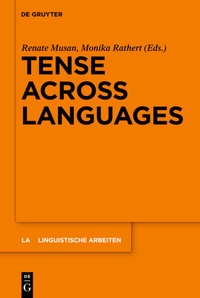
Tense across Languages
Description

This book addresses recent developments in the study of tense from a cross-paradigm and cross-linguistic point of view. Leading international scholars explore challenging ideas about tense at the interfaces between semantics and syntax as well as syntax and morphology. The book is divided into three main subsections: 1) Tense in tenseless languages; 2) Tense, mood, and modality, and 3) Descriptive approaches to some tense phenonema. Although time is a universal dimension of the human experience, some languages encode reference to time without any grammatical tense morphology of the verb. Some of these exceptional "tenseless" languages are investigated in this volume: Kalaallisut, Paraguayan Guaraní and Movima. Modal verbs are polyfunctional in the sense that they express both tense and modality. In this volume, an untypical modal is analyzed, a modal analysis of imperatives is argued for, and sentential mood, which is closely related to modality, is analyzed. It is always interesting to look at the expression of tense in understudied languages, which is done here for Scottish Gaelic, Austronesian Rukai and German dialects. The volume can be used for graduate and undergraduate level teaching
Reviews / Votes
"All in all, despite the issues raised above, scholars and students interested in the semantics and typology of tense should find the volume of great interest. The original work compiled here offers an exciting addition to previous semantic and typological treatments of tense (and modality) cross linguistically. Both empirically and theoretically, "Tense across languages" opens up many avenues for further research. Indeed, much remains to be charted and the present volume is a valuable contribution in the right direction."Celeste Rodríguez Louro in: Linguist List 23.2360More details
Other editions
Additional editions
Persons
Content
2 - A. TENSE, MOOD, AND MODALITY [Seite 15]
2.1 - Tense and Volitionality [Seite 15]
2.2 - Imperatives and Tense [Seite 43]
2.3 - (Non)veridicality and Mood Choice: Subjunctive, Polarity, and Time [Seite 65]
3 - B. UNDERSTUDIED TENSE PHENOMENA AND TYPOLOGICAL VARIATION [Seite 97]
3.1 - Use and Temporal Interpretation of the Rukai Future Tense [Seite 97]
3.2 - Tense in the Scottish Gaelic Verbal System [Seite 115]
3.3 - New Perspectives on Double Perfect Constructions in German [Seite 133]
4 - C. TENSE IN TENSELESS LANGUAGES AND SEQUENCE-OF-TENSE PHENOMENA [Seite 153]
4.1 - Time and Modality without Tenses or Modals [Seite 153]
4.2 - Tense Marking on Dependent Nominals in Movima [Seite 195]
4.3 - The Paraguayan Guaraní Future Marker -ta: Formal Semantics and Cross Linguistic Comparison [Seite 213]
4.4 - Zero-Tense vs. Indexical Construals of the Present in French L1 [Seite 239]
5 - Index [Seite 263]
