

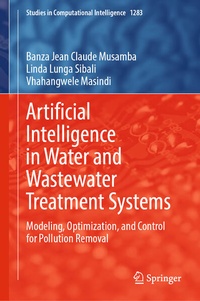
Artificial Intelligence in Water and Wastewater Treatment Systems
Description

This book presents a comprehensive and practical overview of machine learning-driven adsorption processes for pollution removal from wastewater, with a focus on modeling, optimization, and mechanistic insights. It explores how techniques such as Artificial Neural Networks (ANN), Adaptive Neuro-Fuzzy Inference Systems (ANFIS), and Response Surface Methodology (RSM) can enhance the efficiency of removing heavy metals-including Chromium (VI), Copper (II), Cadmium (II), and Zinc (II)-using biodegradable and nanostructured adsorbents like modified cellulose nanocrystals. Through detailed case studies, experimental methodologies, and comparative analysis of AI algorithms, this book bridges traditional adsorption science with advanced computational approaches, offering valuable tools and insights for researchers, engineers, and practitioners working in environmental science, chemical engineering, and sustainable water treatment.
More details
Other editions
Additional editions
Content
Artificial intelligence applications in water environments Recent work and prospects.- The incorporation of artificial neural networks and response surface methods to optimise the removal of chromium (VI) from a biodegradable composite.- The optimisation and prediction of copper (II) removal from a green adsorbent via the Box-Behnken (BBD) experimental design approach using adaptive neuro fuzzy (ANFIS).- Prediction of Cadmium (II) Removal from Aqueous Solution via the Adsorption Process: Adsorption Mechanism, Mechanistic Modelling and Artificial Neural Network (ANN) Approach.- The application of soft computing for the removal of lead (II) by biodegradable adsorbents from wastewater.- Zinc (II) removal from water onto cellulose nanocrystal beads via a fixed bed column: experimental and modelling studies.
